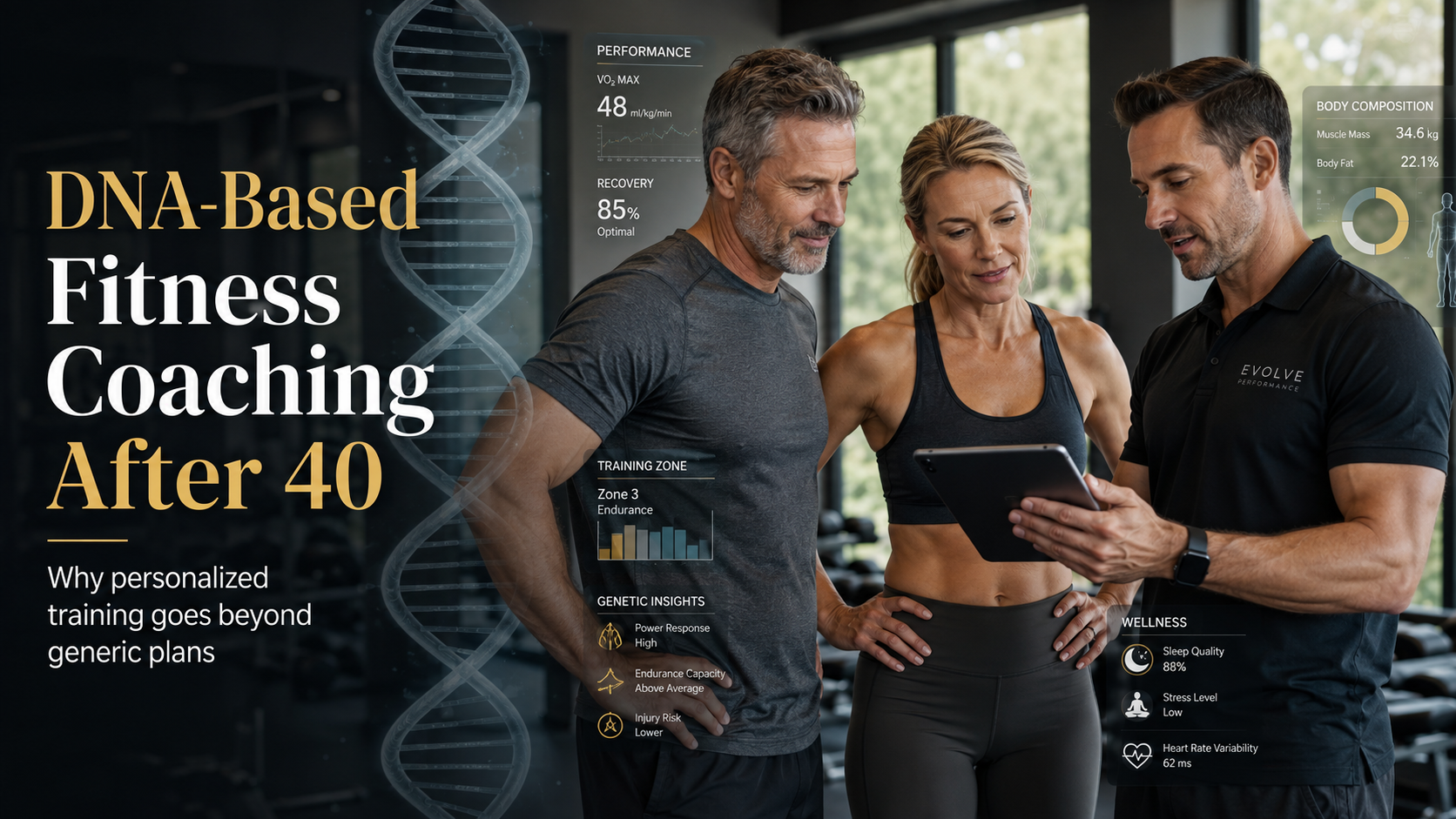

If you have tried multiple workout plans and still feel like your results are unpredictable, DNA testing may sound appealing.
Why does one person thrive on higher-carbohydrate meals while another feels better with fewer carbohydrates? Why do some people build strength quickly, while others need more time? Why can the same training program leave one person energized and another sore for days?
Your genes may be part of the answer.
But they are not the whole answer.
DNA testing can offer useful clues about tendencies related to fuel utilization, muscle fiber type, nutrient metabolism, recovery, and weight management. It cannot tell you exactly what will happen, guarantee results, or replace medical care.
At Posh Fitness, we believe DNA is a tool for better questions, not a verdict about your future. We’re not trainers, we’re longevity coaches. Our goal is to help you use good science, real-world data, and practical coaching to improve your health and performance over time.
DNA Is a Starting Point, Not a Finish Line
Your DNA sequence is largely fixed. Your health, however, is not.
Genes interact with:
- Training history
- Nutrition
- Sleep quality
- Stress
- Age
- Hormones
- Medical history
- Medication
- Environment
- Daily habits
This is why two people with similar genetic results can have very different outcomes.
Research on athletic performance consistently shows that genes influence traits such as strength and aerobic capacity. However, performance is highly complex and polygenic. It involves many genes, each with a small effect, plus years of training and recovery. Even the most studied variants cannot reliably predict whether someone will become an elite athlete or determine the perfect workout plan for them (Guth & Roth, 2013; Bouchard, 2012).
The practical takeaway is reassuring:
A result that suggests a tendency toward slower recovery or greater weight sensitivity does not mean you are stuck. It means we may want to pay closer attention to recovery, nutrition, and consistency.

What Can DNA Testing Tell You About Fitness?
1. Fuel Utilization and Nutrition Tendencies
Some genetic markers are associated with how your body processes fats, carbohydrates, and specific nutrients.
This does not mean your DNA can prescribe a perfect diet. It may, however, help us investigate why you respond well, or poorly, to certain approaches.
For example, a DNA report may provide insight into tendencies involving:
- Carbohydrate tolerance
- Fat metabolism
- Appetite and cravings
- Caffeine metabolism
- Lactose digestion
- Micronutrient needs
- Inflammation-related pathways
The important word is tendency.
A genetic result should not lead to extreme restriction. Instead, it can help us create a reasonable starting plan and then evaluate your response through body composition, energy, digestion, bloodwork, and performance.
2. Muscle Fiber Type and Training Response
The ACTN3 gene is one of the most studied genes in sports science. It helps produce alpha-actinin-3, a protein found primarily in fast-twitch muscle fibers.
Certain ACTN3 variants are more common among elite power and sprint athletes. Other variants may be associated with differences in muscle characteristics and endurance-related traits. The association is biologically interesting, but it is not a prediction of your athletic destiny.
You can still gain muscle, improve strength, and build power regardless of your ACTN3 result.
The same applies to the ACE gene. Some ACE variants have been associated with endurance or power performance in certain populations. However, the effects are modest and inconsistent across sports, ethnic groups, and individuals. A systematic review and meta-analysis found associations between ACE and ACTN3 variants and performance traits, but these markers are not strong enough to determine an individual’s ideal training program (Ma et al., 2013).
Your actual response to training remains more useful than a label on a report.
We will look at:
- How quickly you recover between sessions
- Whether you are gaining strength
- How your resting heart rate changes
- How you feel during training
- Whether your joints and tissues tolerate the workload
- Whether you can consistently follow the program
That real-world feedback is essential.
3. Recovery and Exercise-Induced Muscle Damage
Some research suggests that genetic variation may affect inflammation, muscle damage, and recovery after demanding exercise.
ACTN3 is one example. Some studies have found that certain ACTN3 patterns are associated with greater muscle damage after eccentric exercise. Other studies have found conflicting results or no meaningful association.
That is why we do not use DNA results to tell you, “You need exactly three days of rest.” Instead, DNA may encourage a more thoughtful recovery strategy.
Your plan may include:
- More gradual increases in training volume
- Careful use of eccentric exercises
- Additional mobility work
- Better sleep routines
- Adequate protein and calories
- Recovery days based on performance and symptoms
Genes may help us understand possibilities. Your body’s response helps us make decisions.
4. Nutrient Absorption and Omega-3 Metabolism
The FADS1 gene is a good example of where genetics may offer a practical nutritional clue.
FADS1 is involved in the metabolism of polyunsaturated fatty acids. Research has found that certain FADS1 and FADS2 variants are associated with differences in the conversion of plant-based omega-3 alpha-linolenic acid, or ALA, into longer-chain omega-3 fats such as EPA and DHA (Lemaitre et al., 2011).
This does not mean someone with a particular variant must take a supplement. It means we may want to ask better questions:
- Do you regularly eat fatty fish?
- Do you follow a vegetarian or vegan diet?
- What does your omega-3 index show?
- Are triglycerides elevated?
- Are you taking medications that affect your plan?
- Is an EPA/DHA supplement medically appropriate?
This is an excellent example of why DNA should be combined with bloodwork. A genetic result may suggest a possible conversion tendency. A blood test can tell us more about your current status.
5. Weight Management Tendencies
The FTO gene is often called an “obesity gene.” That phrase is misleading.
Certain FTO variants are associated with a slightly higher likelihood of increased body weight or appetite-related challenges. But they do not make weight loss impossible. They do not erase the benefits of resistance training, walking, protein intake, sleep, or an appropriate calorie deficit.
Research suggests that physical activity can reduce or modify the influence of FTO-related obesity risk (Kilpeläinen et al., 2011).
A useful interpretation might be:
“You may benefit from a plan that makes appetite, meal structure, and activity easier to manage.”
That is very different from:
“Your genes are preventing you from losing weight.”
At Posh Fitness, we focus on sustainable changes that help you build muscle, reduce excess body fat, and feel more in control of your health.
What DNA Testing Cannot Tell You
DNA testing cannot reliably tell you:
- Your exact ideal workout
- The precise number of calories you need
- Whether you will become a high-level athlete
- Whether you will suffer a specific injury
- Which supplement will cure a symptom
- Whether a disease is present right now
- Whether you can ignore poor sleep or high stress
- Whether you should stop prescribed medication
- Whether a genetic “risk” will ever affect you
Injury genetics is a good example. Researchers have identified variants related to collagen, inflammation, muscle structure, and connective tissue. But available tests are not accurate enough to predict individual injury risk in routine fitness practice.
Your previous injuries, training load, movement patterns, strength, technique, sleep, and recovery habits are usually more actionable.
The same caution applies to MTHFR and methylation.
MTHFR variants can influence folate metabolism and homocysteine levels, particularly when folate or B-vitamin status is inadequate. But a common MTHFR variant is not a complete explanation for fatigue, anxiety, poor detoxification, or every other symptom sometimes attributed to “methylation.”
We would rather review your symptoms and relevant biomarkers than sell you an expensive supplement protocol based on one gene.
The Posh Fitness Approach: DNA Plus the Full Picture
A DNA report becomes more useful when it is interpreted alongside:
- Bloodwork
- Sleep duration and quality
- Stress levels
- Digestion and symptoms
- Training history
- Body composition
- Medication and supplement use
- Family history
- Personal goals

This is the difference between reading data and understanding a person.
For busy professionals over 40, that context matters. You may not need another generic workout plan. You may need a clear strategy that fits your schedule and considers your current biology.
That is the purpose of our DNA fitness coaching program.
DNA Coach Pro Testing With Personal Coaching
Posh Fitness offers DNA Coach Pro testing with interpretation and guidance from Peter Marino, an ISSA-certified DNA Fitness Coach and personal trainer with a Master’s in Biotechnology.
The process is designed to be simple:
- Complete an at-home DNA test.
- Review the results with Peter.
- Discuss nutrition, training, recovery, and lifestyle implications.
- Build a personalized plan.
- Track your response through the Posh Fitness app and ongoing coaching.
Depending on your goals, your plan may include personalized fitness programming, nutrition guidance, supplement suggestions, habit coaching, and text or email support.
The test is not a replacement for your physician or medical evaluation. It is also not a promise of perfect personalization. It is one piece of a broader longevity strategy.
A Better Way to Think About Your Genes
Your DNA can help explain why certain strategies may deserve attention.
It cannot decide what you are capable of achieving.
The best use of DNA testing is not fear, hype, or a rigid list of rules. It is better decision-making.
You may discover that you should pay closer attention to omega-3 status, protein intake, recovery, appetite control, or nutrient sufficiency. Then we can test, track, and adjust.
That is how you make DNA useful.
Not as a verdict.
As a guide.
If you are in Fairfield County CT, Greenwich CT, or working with us virtually from anywhere in the country, Posh Fitness can help you turn health data into a practical plan. We provide elite personal training, virtual coaching, and longevity-focused support designed for real life.
No insane workouts. No genetic fearmongering. Just good science, thoughtful coaching, and a plan that helps you feel and perform better for years to come.
References
Bouchard, C. (2012). Genomic predictors of trainability. Experimental Physiology, 97(3), 347–352. https://doi.org/10.1113/expphysiol.2011.058735
Guth, L. M., & Roth, S. M. (2013). Genetic influence on athletic performance. Current Opinion in Pediatrics, 25(6), 653–658. https://pmc.ncbi.nlm.nih.gov/articles/PMC3993978/
Kilpeläinen, T. O., Qi, L., Brage, S., Sharp, S. J., Sonestedt, E., Demerath, E., et al. (2011). Physical activity attenuates the influence of FTO variants on obesity risk: A meta-analysis of 218,166 adults and 19,268 children. PLoS Medicine, 8(11), e1001116. https://doi.org/10.1371/journal.pmed.1001116
Lemaitre, R. N., Tanaka, T., Tang, W., Manichaikul, A., Foy, M., Kabagambe, E. K., et al. (2011). Genetic loci associated with plasma phospholipid n-3 fatty acids: A meta-analysis of genome-wide association studies from the CHARGE Consortium. PLoS Genetics, 7(7), e1002193. https://doi.org/10.1371/journal.pgen.1002193
Ma, F., Yang, Y., Li, X., Zhou, F., Gao, C., Li, M., & Gao, L. (2013). The association of sport performance with ACE and ACTN3 genetic polymorphisms: A systematic review and meta-analysis. PLoS ONE, 8(1), e54685. https://doi.org/10.1371/journal.pone.0054685
Pickering, C., & Kiely, J. (2017). ACTN3: More than just a gene for speed. Frontiers in Physiology, 8, 1080. https://pmc.ncbi.nlm.nih.gov/articles/PMC5741991/
Bouchard, C., Sarzynski, M. A., Rice, T. K., Kraus, W. E., Church, T. S., Sung, Y. J., et al. (2011). Genomic predictors of the maximal oxygen uptake response to standardized exercise training programs. Journal of Applied Physiology, 110(5), 1160–1170. https://pmc.ncbi.nlm.nih.gov/articles/PMC3098655/