


Your genes do influence how you react to caffeine, mainly through two of them: CYP1A2, which affects how fast your liver clears caffeine, and ADORA2A, which affects how strongly your brain responds to it. Genes are only part of the picture, though. Body weight, medications and medical conditions all change how caffeine hits you, and your own experience of a cup of coffee is often the best evidence you have. Below we explain what each gene does, how to recognize sensitivity, whether a DNA test is worth it, and how the same logic applies to carbohydrate tolerance.
Key Takeaways
- CYP1A2 affects how quickly your liver processes caffeine, while ADORA2A affects how your brain’s adenosine receptors respond to it. Both are linked to sensitivity.
- Feeling jittery, anxious or sleepless after small amounts of caffeine is a more practical signal than a genotype alone.
- Genetic tests can miss part of the story, so treat results as one input alongside a symptom log and your medical history.
- Carbohydrate tolerance has genetic influences too, but individual variants have small effects and interact heavily with lifestyle.
- A two-week tracking experiment with your coach or clinician usually teaches you more than any single test result.
Table of Contents
- How Genes Shape Your Response to Caffeine
- Signs You May Be Unusually Sensitive to Caffeine
- Caffeine, Training and Recovery
- Should You Take a Caffeine Genetic Test?
- A Two-Week Caffeine Experiment
- Carbohydrate Sensitivity and Genetics
- Our Perspective
- Turn the Data Into a Plan
- Frequently Asked Questions
- Sources
How Genes Shape Your Response to Caffeine
Caffeine response has two stages. First, your body has to break the caffeine down. Second, whatever remains in your bloodstream acts on receptors in your brain. Genetics touches both stages, which is why two people drinking the same cold brew can have very different afternoons.
CYP1A2: how fast you clear it
CYP1A2 codes for a liver enzyme. A 2024 review reports that genetic variation in this gene influences the activity of the enzyme that metabolizes about 95% of caffeine. The same review identified CYP1A2 as associated with caffeine metabolism across 15 studies, making it the best-studied gene in this area.
In practical terms, people are often described as fast or slow metabolizers. A slow metabolizer keeps caffeine in circulation longer, so a mid-afternoon coffee may still be active at bedtime. A fast metabolizer clears it sooner and may tolerate more. These are useful shorthand terms, but real metabolism is a spectrum, not two boxes.
ADORA2A: how your brain responds
Caffeine works largely by blocking adenosine receptors, the receptors that help signal tiredness. Variation in ADORA2A may affect caffeine and adenosine receptor binding and the downstream responses. The 2024 review found ADORA2A associated with caffeine metabolism across five studies, a smaller body of evidence than for CYP1A2.
This is why someone can clear caffeine at a normal speed and still feel wired or anxious: their receptors may simply react more strongly. Cleveland Clinic notes that variations in CYP1A2 and ADORA2A may make people take longer to process caffeine and feel its effects more strongly.
Sensitivity is a spectrum
An expert report from 2018 describes sensitivity as a spectrum influenced by both liver metabolism and receptor binding in the central nervous system. Many people, it notes, naturally limit their intake based on how they feel. That matches what we see with clients: the person who says “I just can’t do coffee after noon” has usually already run the experiment.
Signs You May Be Unusually Sensitive to Caffeine
Yes, someone can be extremely sensitive to caffeine. MedlinePlus explains that some people are more sensitive than others, and that too much caffeine can cause a fast heart rate, anxiety, insomnia, restlessness and shakiness.
Patterns worth noticing:
- Small doses, big effects. You feel over-stimulated after a small cup of coffee, a cup of tea or a pre-workout scoop.
- Delayed sleep trouble. You fall asleep fine but wake at 3 a.m., or your sleep feels light, on days you had caffeine after lunch.
- Anxiety or a racing heart. Your chest feels tight or fluttery within an hour of caffeine.
- Cycle-linked changes. Some people notice caffeine feels harsher at certain times of the month, and a two-cycle caffeine and PMS symptoms test is one way to check whether that applies to you.
- Hidden sources. Energy bars, preworkouts, soda, chocolate and some pain relievers add up faster than you expect.
If your heart races, you feel faint, or symptoms are severe or new, talk to your physician before trying to solve it with a supplement or a coaching tweak. Palpitations are a medical question first.
What else changes your sensitivity
Genetics is not the only dial. The FDA notes that factors such as body weight, medications and medical conditions cause wide variation in how people respond to caffeine. If a medication or a thyroid issue is in the mix, the right person to adjust your intake is your prescriber, not a gene report.
For general intake, the expert report cited above recommends self-moderation based on personal tolerance, with a limit of 400 mg per day for healthy adults and 200 mg per day during pregnancy. Those are ceilings, not targets. A sensitive person may feel poorly well below them.
Caffeine, Training and Recovery
Caffeine is popular before workouts because it can make effort feel easier. But if you are sensitive, the same dose can cost you in the other direction: a wired, shaky session, a poor night of sleep, and a slower recovery the next day. If you often feel drained after training, our checklist on feeling tired after workouts walks through the red flags, and caffeine timing is one of the first things to rule out.
Timing matters as much as dose. If you train in the evening, caffeine may be working against your sleep. Our guide to morning versus evening workouts can help you decide which slot suits you, and a sensitive person often does better training earlier and keeping caffeine before noon.
Long-term habits matter too. If caffeine is a regular part of your routine, it is reasonable to ask how it fits into your overall health picture, including bones. Some readers look into caffeine and bone density to understand what the evidence shows before deciding how much to keep in their day.
Should You Take a Caffeine Genetic Test?
A test can be interesting, but it has limits, and it helps to know them before paying for one.
What it can do. It can show whether you carry a variant in a gene such as CYP1A2 that is associated with slower processing. Cleveland Clinic notes that providers may recommend genetic testing to identify a variation affecting caffeine metabolism, alongside tracking your intake and symptoms in a food diary.
What it can miss. The Center for Science in the Public Interest points out that some tests only examine the caffeine-metabolism gene and may miss adenosine-receptor variants that affect sensitivity. Researcher Marilyn Cornelis, quoted in the same piece, said personal experience, such as feeling over-stimulated after small amounts, is often a more reliable indicator than a genetic test alone.
So here is how we would use a result:
| Situation | What a genetic result adds | What to do |
|---|---|---|
| You already know caffeine wrecks your sleep | Little. You have your answer. | Move caffeine earlier and lower the dose |
| You feel fine but are unsure about high intake | Some context | Track symptoms and sleep for two weeks |
| Your results say “slow” but you feel fine | A reason to watch late-day intake | Trust your log, and keep the test as a flag |
| Your results say “fast” but you feel jittery | Not a green light | Believe your body, and consider receptor sensitivity |
| You have heart symptoms or take medications | Not a substitute for care | Talk to your physician first |
A Two-Week Caffeine Experiment
This is the process we suggest before spending anything on testing.
- Week one, observe. Keep your normal routine. Log each caffeine source, the time, the amount, your energy at 2 p.m. and 5 p.m., and your sleep quality.
- Week two, adjust one variable. Move your last caffeine to before noon, or halve the dose. Change nothing else.
- Compare. Look at sleep, mood, and workout quality across the two weeks.
- Decide. Keep what worked. If you still feel off, bring the log to your clinician.
It pairs well with a broader look at your mornings. Our post on a two-week morning routine for energy uses the same test-and-compare approach, and if fatigue is the real issue, low energy at 40 covers causes worth checking with a doctor.
Carbohydrate Sensitivity and Genetics
Readers asking about caffeine often ask the next question: do genes also decide how well I handle carbs? The honest answer is similar, with even more caution.
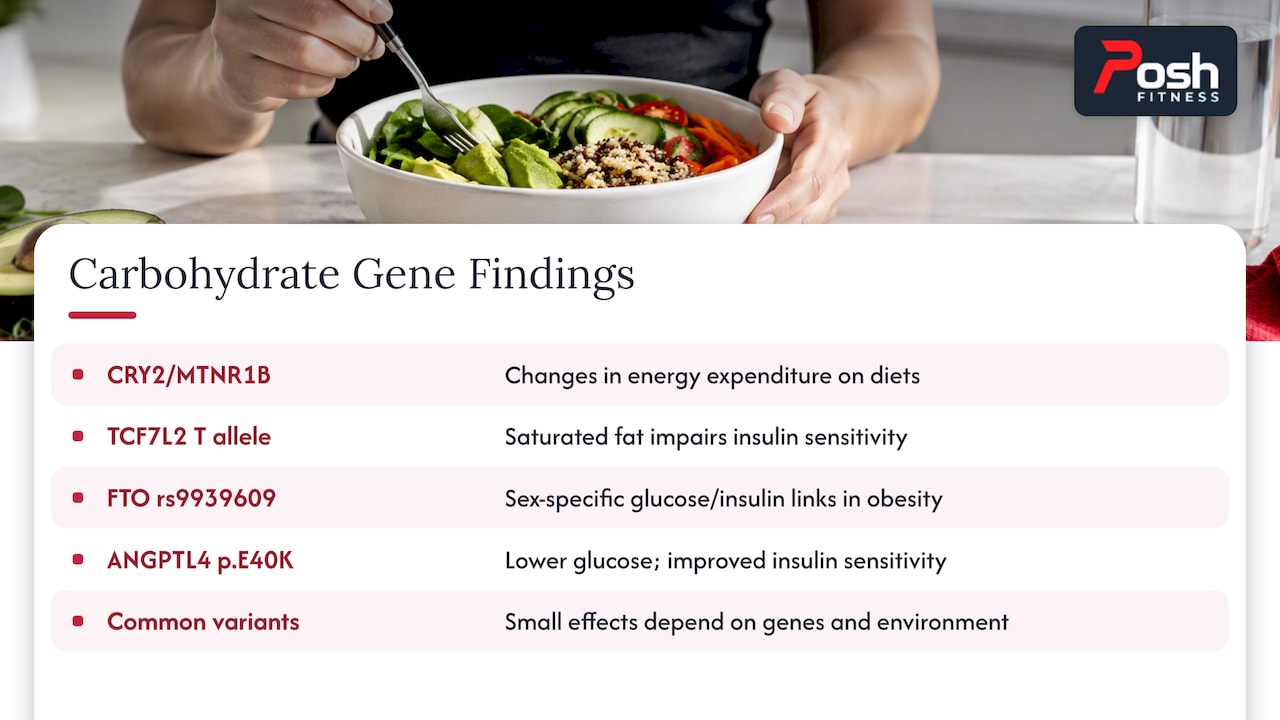
Research has found gene-diet links. For example, variants in circadian rhythm related genes such as CRY2 and MTNR1B have been shown to influence changes in energy expenditure on different weight-loss diets. TCF7L2 variants show macronutrient-dependent effects: carriers of the rs7903146 T allele have impaired insulin sensitivity with higher saturated-fat intake. FTO variants such as rs9939609 have shown sex-specific associations with insulin sensitivity and glucose tolerance in adults with obesity. And ANGPTL4 p.E40K has been linked to lower fasting glucose and improved insulin sensitivity.
None of these is a verdict about you. A review of genetic variants and very low carbohydrate diets concludes that most common variants have small effects that depend on other variants and on environment. More recent literature suggests genotype-informed nutrition may offer the greatest benefit in high-risk populations, rather than being required for everyone.
Carb quality still matters most
The American Heart Association stresses that carbohydrates need context: the source matters, such as fruit versus refined sugar, because it affects how your body processes that fuel. Preliminary research the AHA reported also suggests that diet quality may matter more than carbohydrate quantity for type 2 diabetes risk on lower-carb diets.
A practical way to find your own carb tolerance is observational, just like caffeine:
- Note energy, hunger and focus two to three hours after meals with different carbohydrate sources.
- Pair carbs with protein and fiber and compare the response.
- Ask your physician about fasting glucose and related bloodwork, especially if diabetes runs in your family.
Our post on the metabolic flexibility diet goes deeper on steady energy through food choices.
Our Perspective
We use genetics because it can be a helpful starting point, but we have learned to hold it loosely. A DNA report is a map of tendencies. It does not know how you slept last night, what your stress level is, which medications you take or how much you really drink in a week.
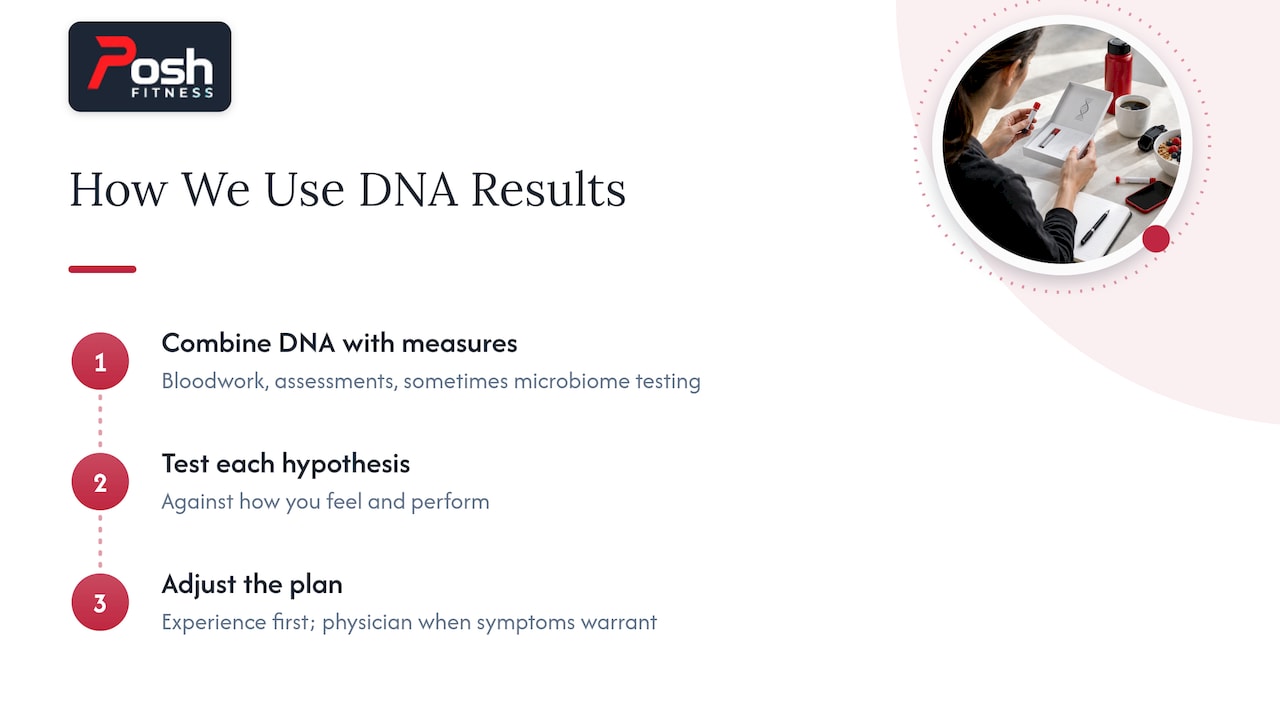
That is why our process pairs DNA with bloodwork, physical assessments and, where it fits, gut microbiome testing, then tests every hypothesis against how you actually feel and perform. If your CYP1A2 result says you are a fast metabolizer yet three coffees leave you anxious, we do not argue with you. We adjust the plan around your experience and work alongside your physician when symptoms warrant it.
The same applies to carbohydrates. We would rather see you track energy, appetite and training quality for two weeks than reorganize your diet around one variant with a small effect. For a plain look at what testing does and does not tell you, see our piece on what DNA testing can and cannot tell you about fitness.
— Peter
Turn the Data Into a Plan
If you live in Fairfield County or Westchester and want help translating genetic and lab results into daily habits, our 4 Week DNA Coaching program uses your DNA and health data to shape training, nutrition and stimulant timing. We coach in your home, at affiliated gyms or virtually. If you prefer to start online, the Truly Personal Plan is $99 per month, and a single live virtual session is $80. You can see the options on our online personal training page.

Prefer to meet in person? Our in-home personal training in Greenwich, Stamford, Darien, Westport and Norwalk puts the plan right where you live.
Frequently Asked Questions
Can someone be extremely sensitive to caffeine?
Yes. Sensitivity varies widely, and some people get a fast heart rate, anxiety, insomnia or shakiness from small amounts. Genes such as CYP1A2 and ADORA2A are linked to this, but so are body weight, medications and medical conditions. If symptoms are strong, speak with your physician.
How can I tell if I am a slow caffeine metabolizer?
Start with a food and symptom diary tracking your intake, timing, sleep and jitteriness. If you consistently feel stimulated hours later or sleep poorly after afternoon coffee, you may process caffeine slowly. A provider can also discuss genetic testing, though your own response is often the more reliable guide.
Does a caffeine DNA test tell me the whole story?
Not always. Some tests look only at the caffeine-metabolism gene and miss adenosine-receptor variants that influence how strongly you feel caffeine. Use the result as one clue alongside your symptoms and health history.
Do genes determine how well I tolerate carbohydrates?
They contribute, but the effects of individual variants are small and interact with lifestyle. Carb quality, meal composition, activity and overall health usually matter more. If you are concerned about blood sugar, ask your physician about bloodwork.
How much caffeine is too much?
An expert report recommends up to 400 mg per day for healthy adults and 200 mg per day during pregnancy, with self-moderation based on your tolerance. If you are sensitive, your comfortable amount may be much lower, and that is a perfectly valid limit.
Sources
- Caffeine: MedlinePlus
- Genetics, metabolism and individual responses to caffeine (expert report, 2018)
- Caffeine Sensitivity: Symptoms and Treatment, Cleveland Clinic
- Is caffeine helping or harming your health? CSPI
- Genetic susceptibility to caffeine intake and metabolism (2024 review)
- Impact of Genetic Variability on Physiological Responses to Caffeine
- Spilling the Beans: How Much Caffeine is Too Much? FDA
- Variants in glucose- and circadian rhythm-related genes and weight-loss diets
- Genetic variants for personalised management of very low carbohydrate ketogenic diets
- Personalised Nutrition in Obesity and Prediabetes
- FTO gene allele and insulin sensitivity
- Genetic inactivation of ANGPTL4 improves glucose homeostasis
- Some reduced-carb diets may decrease diabetes risk, American Heart Association
- Confused about carbs? American Heart Association