


A metabolic flexibility diet centers on the timing and composition of your meals plus targeted exercise, so your body can reliably switch between burning carbohydrates and fat for fuel. The three highest-impact starting points are an earlier eating window, protein-first meals paired with fiber, and a weekly mix of resistance and zone-2 aerobic training. If you take glucose-lowering medication, check with your physician before shifting meal timing.
TL;DR:
- Improving metabolic flexibility is most effective through earlier eating windows, protein-first meals with fiber, and combining resistance with zone-2 aerobic exercise.
- Small, sustainable habits like a 5% weight reduction or consistent meal timing can significantly enhance glucose regulation and reduce disease risk.
- Frequent snacking and diets high in ultra-processed carbs impair substrate switching by keeping insulin elevated and limiting fat-burning.
- Combining resistance training with moderate aerobic efforts improves muscle glucose disposal and mitochondrial function more than either alone.
- Personalized diagnostics such as bloodwork or microbiome testing can help break through plateaus when standard efforts stall.
Table of Contents
- What Metabolic Flexibility Actually Means
- Why Metabolic Flexibility Matters for Energy, Weight, and Glucose
- How Your Body Switches Between Fuels
- Dietary Strategies That Support Metabolic Flexibility
- Exercise Prescription: Pairing Resistance and Aerobic Training
- Tracking Progress Without Overcomplicating It
- Sample Day-Plans for Three Common Goals
- When Personalized Coaching and Diagnostics Add Value
- Common Myths About Metabolic Flexibility
- Risks and Contraindications to Keep in Mind
- The Gut Microbiome’s Role in Fuel Switching
- How Fat Type Shapes Metabolic Flexibility
- Making These Changes Stick Long Term
- Metabolic Flexibility and Metabolic Disorders
- What Realistic Progress Actually Looks Like
- Where Personalized Coaching Fits Your Next Step
- Sources
- FAQ
What Metabolic Flexibility Actually Means
Metabolic flexibility describes your body’s capacity to shift between burning carbohydrates and burning fat depending on what is available and what you need. It is not a single organ’s job. Skeletal muscle, the liver, and the mitochondria inside your cells all coordinate this switch, ramping fat oxidation up during a fast or overnight and shifting toward carbohydrate use after a meal. A comprehensive review of the concept describes impaired flexibility as a hallmark of obesity, insulin resistance, and broader metabolic disease, with mitochondrial and muscle function sitting at the center of the problem.
This matters because metabolic flexibility is different from metabolic health in one important way: it is a trainable capacity, not a fixed state or a single lab value. You build it or lose it over months of habitual patterns, not from any single meal or workout.
- Substrate switching is the technical term for moving between fat and carbohydrate as fuel.
- Mitochondria are the cellular engines that determine how efficiently your body can burn either fuel.
- Skeletal muscle is your largest site for glucose disposal and a major driver of flexibility.
Someone who eats constantly, moves little, and relies on ultra-processed carbohydrates day after day gradually loses this adaptability, even if their weight stays stable for years.
Why Metabolic Flexibility Matters for Energy, Weight, and Glucose
Better metabolic flexibility shows up as steadier energy, easier weight management, and improved glucose control, because a body that switches fuels efficiently is not lurching between spikes and crashes. Research on metabolic inflexibility and disease links poor substrate switching directly to obesity and insulin resistance, and the same body of work ties improvement to outcomes people actually feel day to day: fewer afternoon slumps, more stable appetite, and better recovery between workouts.
A modest body weight reduction around 5% can meaningfully improve metabolic markers. Lifestyle studies summarized in that PMC review show that this level of weight loss reduces visceral fat and improves glucose and lipid markers, which is a far smaller target than the dramatic transformations often marketed as necessary.
The practical takeaway is that you do not need an extreme intervention to move the needle. Small, sustained changes in body composition and daily rhythm tend to outperform aggressive short-term diets, because they change the underlying capacity rather than temporarily forcing a number lower.
How Your Body Switches Between Fuels
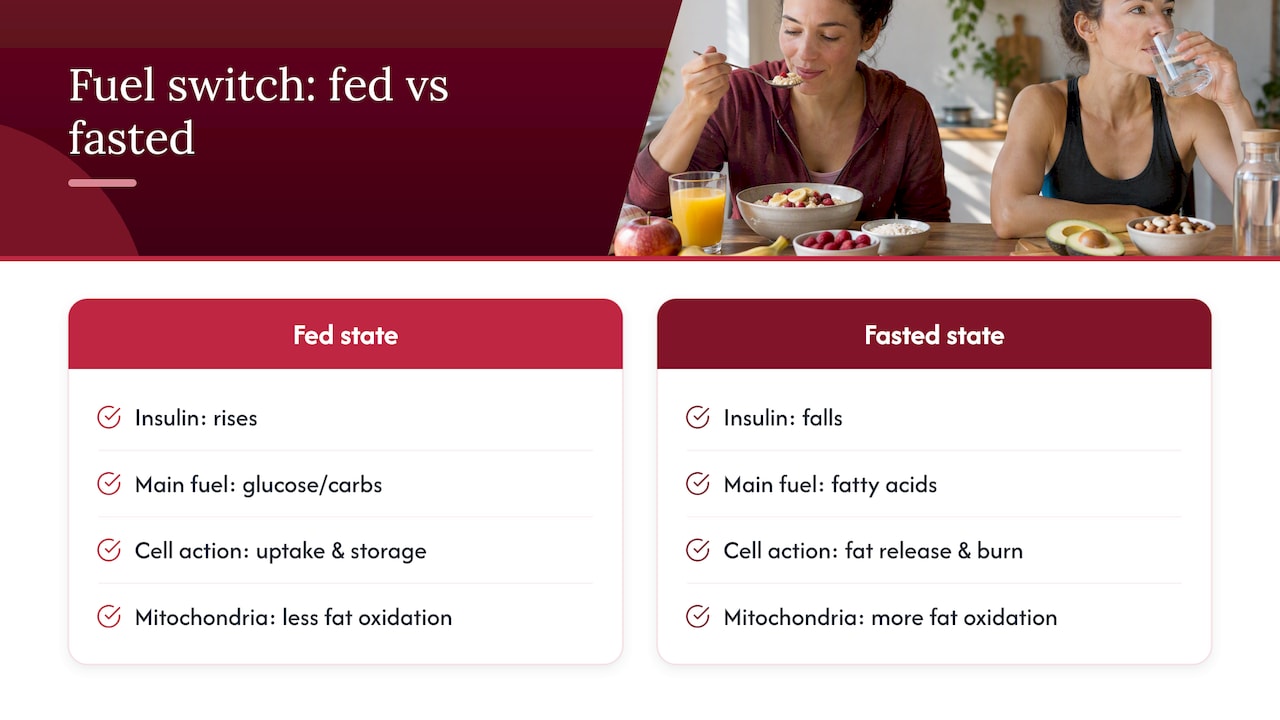
In the fed state, insulin rises and tells your cells to take up glucose and store it, which shifts your fuel mix toward carbohydrate. In a fasted state, insulin falls, fat stores release fatty acids, and your mitochondria shift toward burning fat. This back-and-forth is the whole point of metabolic flexibility: a well-adapted system moves smoothly between the two, while an inflexible one gets stuck relying on glucose even when fasting, or struggles to clear glucose efficiently after eating.
Exercise intensity changes which fuel your muscles prefer. Lower-intensity, sustained effort (commonly called zone-2 training) draws heavily on fat oxidation and helps build the mitochondrial machinery needed for that pathway. Higher-intensity resistance work draws more on glucose and glycogen, and it builds the muscle mass that absorbs glucose after meals. Both matter, for different reasons.
Constant snacking works against this system. When you eat every two hours, insulin rarely has a chance to fall, so your body never fully practices the fat-burning side of the switch. Diets heavy in ultra-processed carbohydrates and added sugar compound the problem by driving frequent insulin spikes that keep the system anchored on one fuel source. Over months, that pattern is part of what a foundational review on metabolic flexibility points to when describing physical inactivity and constant fueling as drivers of inflexibility, while regular exercise increases fatty acid oxidation and mitochondrial function.
Dietary Strategies That Support Metabolic Flexibility
Diet changes that support metabolic flexibility do not require an extreme macronutrient overhaul. They work through timing, sequencing, and food quality more than through any single forbidden ingredient.
- Shift your eating window earlier in the day. Early time-restricted eating, often built around an 8 to 10-hour window that closes in the early evening, has been linked in chrono-nutrition research to improved insulin sensitivity and favorable changes in blood pressure and lipids, sometimes independent of weight loss.
- Lead meals with protein and fiber. Eating protein and vegetables before refined carbohydrates blunts the glucose spike that follows, giving your insulin response a gentler curve to manage.
- Add healthy fats for satiety, not as a headline macro. Olive oil, nuts, and avocado slow digestion and support steadier post-meal energy without needing to hit a specific fat percentage.
- Space meals out instead of grazing. Three to four defined meals, rather than constant small snacks, gives insulin room to fall between eating occasions.
- Use carb cycling selectively, not as a default. Adjusting carbohydrate intake around training days can help athletes match fuel to demand, but Harvard Health’s review of the approach notes it lacks consistent evidence for “repairing” metabolic flexibility on its own, and works best layered on top of, not instead of, consistent training and sleep.
Meal timing itself carries clinical weight. Research on meal timing and metabolic risk finds that irregular or late eating correlates with worse glycemic outcomes, while earlier and more regular timing tends to improve them, which suggests timing is a lever you can pull even before touching total calories.
Strict ketogenic approaches are not required for most people pursuing flexibility. They can be useful in specific medical or performance contexts, but the broader evidence favors sustainable, moderate patterns over rigid exclusion diets.
Pro Tip: Try closing your kitchen two to three hours before bed for one week before changing anything else; it is the single easiest lever to pull and it touches both timing and sleep quality at once.
Exercise Prescription: Pairing Resistance and Aerobic Training
Building muscle is one of the most direct ways to improve how your body disposes of glucose and fatty acids, because skeletal muscle is the largest tissue responsible for clearing glucose after a meal. Zone-2 aerobic training complements this by building the mitochondrial density needed for efficient fat oxidation, while occasional higher-intensity sessions add further mitochondrial adaptations that steady-state work alone does not fully deliver.

The STRRIDE research program found that combining aerobic and resistance training produces more consistent improvements in insulin sensitivity and glucose homeostasis than either mode alone, particularly when paired with modest weight loss. Exercise functions almost like medicine here: the combination of resistance and aerobic work delivers the most reliable and durable gains in substrate switching of any single behavior change available to most people.
A realistic weekly structure looks like this:
- Two to three resistance sessions, covering major muscle groups with progressive overload.
- Two to three zone-2 aerobic sessions, roughly 30 to 45 minutes at a conversational pace.
- One optional higher-intensity session, such as intervals, once the base of the other work is established.
Progression should be gradual: add weight or reps to resistance work every one to two weeks, and extend aerobic duration before chasing intensity. Consistency across months matters far more than any single standout workout.
Tracking Progress Without Overcomplicating It
You do not need a lab to know whether your metabolic flexibility is improving, though certain tools help. People with access to a continuous glucose monitor can watch how their glucose responds after meals and how quickly it returns to baseline, while a simple fasting glucose check offers a lower-effort snapshot for those without one.
A body weight reduction around 5% is associated with measurable improvements in glucose and lipid markers, according to the same review of metabolic inflexibility referenced earlier, which gives you a concrete, modest target to track against rather than an open-ended goal.
Beyond numbers, pay attention to signals you already feel:
- Steadier daytime energy, without the sharp afternoon crash that follows a heavy carbohydrate lunch.
- Fewer post-meal slumps, especially after meals that once left you reaching for coffee or sugar.
- Better recovery between workouts, reflected in less next-day soreness and more consistent performance.
- More stable appetite, with less urgent hunger between meals.
If you take medication for diabetes or another metabolic condition, or if your fasting or post-meal glucose readings look unusual, treat that as a signal to involve your physician rather than adjusting your diet or training on your own.
Sample Day-Plans for Three Common Goals
The principles above translate into flexible templates rather than rigid menus. Adjust timing to fit shift work or long training days; the structure matters more than the exact clock hours.
- Steady-energy maintenance: Break your fast around 10 a.m. with eggs and vegetables, have a protein-and-fiber-forward lunch by 1 p.m., and finish dinner by 7 p.m. with a lean protein, starchy vegetable, and olive oil. A handful of nuts covers any afternoon dip.
- Modest calorie deficit for fat loss: Keep the same 10 a.m. to 7 p.m. window, but lead each meal with a larger protein portion and non-starchy vegetables before any refined carbohydrate, which helps manage hunger while calories are reduced.
- Athletic training fueling: Shift the window slightly around training, with a carbohydrate-inclusive meal within two hours of hard sessions and a protein-forward, lower-carbohydrate dinner on rest days.
For shift workers or those with long training days, anchor the eating window around your main waking hours rather than the clock, and keep the same protein-first sequencing regardless of when meals fall. Batch-cooking proteins and pre-washed vegetables on a weekend removes the main barrier most people hit on busy weeknights.
When Personalized Coaching and Diagnostics Add Value
Standard advice covers most people well, but some readers hit a wall even after months of consistent effort. That is where diagnostics such as DNA analysis, bloodwork, and gut microbiome testing clarify what generic guidance cannot, showing why a particular macronutrient ratio, meal timing, or training style suits your biology specifically.
- DNA and bloodwork can highlight individual differences in carbohydrate tolerance and fat metabolism.
- Gut microbiome testing can reveal patterns that influence digestion and glucose response.
- Individualized meal timing and training plans, delivered virtually, in-home, or at a partner gym, tend to support better adherence than a one-size-fits-all program.
Common Myths About Metabolic Flexibility
The biggest myth is that metabolic flexibility requires an extreme diet, whether that is strict keto, carnivore, or aggressive fasting windows. The underlying evidence points the other way: modest, sustained changes in timing and training outperform rigid exclusion diets for most people.
A second myth treats carb cycling as a metabolic repair tool on its own. As the Harvard Health review notes, it can help match fuel to training demand, but it is not a substitute for consistent exercise or sleep, and it does little without those foundations in place.
A third misconception is that metabolic flexibility can be judged from a single blood draw or a single “good” or “bad” meal. It is a capacity built over months of habitual behavior, not a snapshot. Someone can have one indulgent dinner without undoing weeks of consistent training and timing, just as one clean week will not fully repair years of sedentary, ultra-processed eating.
Finally, many people assume fasting longer is always better. Evidence on early time-restricted eating supports moderate windows, generally 8 to 10 hours, and there is no clear signal that pushing fasting durations to extremes adds proportional benefit for most healthy adults.
Risks and Contraindications to Keep in Mind
Metabolic flexibility strategies are generally safe for healthy adults, but a few groups need caution. Anyone on insulin or other glucose-lowering medication should not change meal timing or fasting windows without medical guidance, since a shifted eating pattern can increase the risk of hypoglycemia.
Pregnant or breastfeeding individuals, people with a history of disordered eating, and those managing adrenal or thyroid conditions should also approach time-restricted eating cautiously, since skipping structured meals can interact with each of these conditions differently. Extended fasting windows are not appropriate for growing adolescents or for older adults at risk of unintentional weight loss or muscle wasting.
Strict low-carbohydrate or ketogenic approaches, sometimes recommended alongside metabolic flexibility goals, can also interact with certain medications and are not universally appropriate, particularly for anyone with a history of kidney issues or gallbladder disease. The safest path for most readers is a gradual shift in timing and food quality, checked against a physician’s input whenever an existing condition or medication is in the picture.
The Gut Microbiome’s Role in Fuel Switching
Your gut microbiota influences metabolic flexibility indirectly but meaningfully, by shaping how efficiently you extract energy from food and how your body responds to different macronutrients. A diverse, fiber-fed microbiome tends to support steadier glucose responses, partly through the short-chain fatty acids bacteria produce when fermenting fiber, which appear to support insulin sensitivity and gut barrier function.

Diets low in fiber and high in ultra-processed ingredients are associated with reduced microbial diversity, which may compound the same patterns that blunt substrate switching elsewhere in the body. This is one reason fiber sits alongside protein as a foundational recommendation rather than an afterthought: it feeds the bacterial populations that support metabolic function, not just digestion.
This is still an evolving area of research, and no single food or supplement reliably “fixes” a gut microbiome. The most defensible approach remains consistent, varied fiber intake from vegetables, legumes, and whole grains, paired with the timing and training habits already covered.
How Fat Type Shapes Metabolic Flexibility
Not all dietary fat affects metabolic flexibility the same way. Unsaturated fats, found in olive oil, nuts, and fatty fish, are generally associated with favorable effects on insulin sensitivity and lipid markers when they replace refined carbohydrates or highly processed fats in the diet.
Saturated fat is more context-dependent. In excess, particularly alongside a diet high in refined carbohydrates, it has been linked to reduced insulin sensitivity in some research, though the picture is less clear-cut than headlines often suggest and depends heavily on the overall dietary pattern rather than any single food.
The practical guidance that follows from this is straightforward: build most meals around unsaturated fat sources, treat saturated fat as something to moderate rather than eliminate, and avoid framing any single fat as the villain or the hero. The surrounding diet, especially carbohydrate quality and portion consistency, matters as much as the fat itself.
Making These Changes Stick Long Term
The habits that build metabolic flexibility only work if you keep them up for months, which means adherence matters more than any single tactic’s theoretical potency. Start with two or three changes rather than overhauling your diet and training in the same week; an earlier eating window and a protein-first breakfast are enough for the first month.
Build in flexibility for real life. A late dinner on a Friday or a missed workout during a busy week will not undo the underlying adaptation, provided the overall pattern holds across most days. Treating occasional deviations as failures is one of the most common reasons people abandon otherwise effective routines.
Track something simple, whether that is energy levels, workout consistency, or a monthly weight check, rather than daily fluctuations that mostly reflect water and food volume. And revisit your plan every few months. What worked when you started may need adjusting as your training volume, sleep, or stress levels change, which is part of why habit-based approaches tend to outlast rigid diet plans over a year or more.
Metabolic Flexibility and Metabolic Disorders
For people managing type 2 diabetes or metabolic syndrome, improving metabolic flexibility is not a replacement for medical treatment, but it can be a meaningful complement to it. The same review on metabolic inflexibility that links a 5% weight reduction to improved markers draws its evidence largely from people managing exactly these conditions, which suggests the same timing, training, and food-quality principles apply, just with tighter medical oversight.
Anyone on insulin or sulfonylureas should treat meal timing changes as a medical decision, not a lifestyle experiment, since a shifted eating window changes when and how much insulin the body needs. A physician or diabetes educator can adjust medication timing alongside dietary changes so that the two move together rather than working against each other.
For metabolic syndrome specifically, the combination of resistance training, zone-2 aerobic work, and earlier meal timing addresses several risk markers at once, including waist circumference, triglycerides, and fasting glucose, which is part of why lifestyle intervention remains a first-line recommendation alongside, not instead of, any prescribed medication.
What Realistic Progress Actually Looks Like
Metabolic flexibility improves over weeks and months, not days, and the earliest gains usually show up as steadier energy before they show up on a scale. I would rather see someone commit to two or three sustainable changes, an earlier eating window and consistent resistance training, than chase every tactic in this article at once. Muscle and routine outlast any single trick.
— Peter
Where Personalized Coaching Fits Your Next Step
If you have already tightened your meal timing and added resistance training but progress has stalled, that plateau is often where diagnostics earn their cost. Plans built around DNA analysis, bloodwork, and gut microbiome testing can clarify why a standard protein-first, early-eating-window approach is not moving your numbers the way it should.

The 4 Week DNA Coaching package pairs diagnostic testing with a plan built around your own biology, and services are available virtually, in-home, or at a partner gym depending on what fits your schedule. If stalled fat loss, inconsistent energy, or a training plan that has stopped delivering results sounds familiar, visit Posh Fitness to see which coaching option matches where you are right now.
Sources
This guide draws on peer-reviewed reviews of metabolic flexibility physiology, the STRRIDE exercise trials, chrono-nutrition research on time-restricted eating, and clinical commentary on meal timing and metabolic risk.
- Metabolic flexibility as an adaptation to energy resources and requirements in health and disease (PMC)
- Metabolic flexibility and inflexibility: pathology underlying metabolism dysfunction (PMC)
- Time-restricted feeding and chrono-nutrition (PMC)
FAQ
How do I improve my metabolic flexibility?
Focus on an earlier eating window, protein-first meals with fiber, and a weekly mix of resistance and zone-2 aerobic training. Evidence on early time-restricted eating shows these changes can improve insulin sensitivity within weeks, even before meaningful weight loss occurs.
What are the 5 metabolic superfoods?
There is no single, scientifically defined list of “metabolic superfoods.” Foods that consistently support the underlying goals, fiber intake, protein adequacy, and steady glucose response, include leafy greens, legumes, fatty fish, eggs, and nuts, though the surrounding diet pattern matters more than any individual food.
What is the 21 day metabolic reset?
"‘Metabolic reset’ programs are marketing terms rather than defined clinical protocols, and definitions vary widely between programs. The underlying principles that tend to appear, such as an earlier eating window, reduced processed carbohydrates, and added movement, align with the evidence covered here, but no single short-term program has been shown to permanently reset metabolic capacity on its own.
How do I know if I am metabolically flexible?
Practical signs include steady energy through the day, minimal post-meal crashes, and reliable workout recovery, alongside stable fasting or post-meal glucose readings if you track them. People with access to a continuous glucose monitor can also look at how quickly glucose returns to baseline after meals, which reflects how efficiently the body shifts between fuels.