
Body recomposition means losing fat while maintaining or gaining muscle; weight loss means lowering total body mass, and that loss may include muscle along with fat. If your goal is a leaner, stronger physique without chasing a specific scale number, recomposition is the better framework. If you need rapid, measurable mass reduction for a health marker or event, structured weight loss is the right tool, provided you protect muscle along the way.
Key Takeaways
Body recomposition is the most effective approach for losing fat while maintaining or gaining muscle, especially for long-term health and physique goals.
| Point | Details |
|---|---|
| Recomposition vs. weight loss | Recomposition moves slowly and emphasizes muscle preservation, while weight loss is faster but risks muscle loss. |
| Key to body recomposition | Consistent resistance training and high protein intake are essential for building muscle and losing fat simultaneously. |
| Measuring progress accurately | Using waist measurements, strength tests, photos, and body composition tests provides a clearer view than weight alone. |
| Ideal for different starting points | Recomposition suits beginners and active individuals, while structured weight-loss phases benefit those with urgent health needs. |
| Practical nutrition approach | Both strategies benefit from high-protein, balanced meals, with caloric intake adjusted according to goals. |
Table of Contents
- What recomposition and weight loss mean at the physiological level
- How outcomes, timelines, and risk differ between the two paths
- How to train and eat for recomposition or muscle-protected weight loss
- How to measure progress without being misled by the scale
- Choosing the right approach for your starting point
- The mindset shift between chasing a number and chasing a shape
- What eating looks like for each approach
- Why age and gender change how each approach performs
- Health markers beyond how you look
- Which approach fits your life for the long run
- A realistic take on what actually moves the needle
- How personalized coaching turns these principles into results
- FAQ
- Sources
What recomposition and weight loss mean at the physiological level
Your body weight is made up of fat mass and lean mass, which includes muscle, water, bone, and organ tissue. The scale only measures total mass, not which of those compartments changed, and that distinction is the root of most confusion between the two approaches.
Muscle tissue is in constant turnover between protein synthesis and protein breakdown. A calorie deficit tilts that balance toward breakdown, which is efficient for losing fat but also puts muscle at risk if nothing counteracts it. According to Harvard Health, a significant portion of the weight lost during dieting can come from muscle rather than fat, and that share rises further with rapid loss or very low protein intake. Resistance training is the main lever against this. A systematic review and meta-analysis found that adding resistance exercise during dietary weight loss preserved fat-free mass and increased fat mass loss compared with dieting alone, with moderate to high certainty for the composition outcomes. In practice, this means the same calorie deficit can produce very different results depending on whether you train with weights consistently.
How outcomes, timelines, and risk differ between the two paths
Weight loss and recomposition move at different speeds and carry different trade-offs, which is why comparing them on the scale alone is misleading.
A commonly recommended pace for weight loss is slow enough to limit muscle loss while still producing visible change within a couple of months. Recomposition moves on a longer clock. Because you are rebuilding lean tissue while releasing fat, the scale may barely shift for weeks even as your waist narrows and your lifts improve. That lag frustrates people who equate progress with a falling number, but it is the expected pattern when muscle and fat are changing in opposite directions at similar rates.
The risk profile also diverges. Rapid weight loss, including the kind driven by aggressive calorie cuts or some medications, tends to accelerate the muscle loss described above, and losing muscle can lower resting metabolic rate and reduce physical function over time. Fat loss itself carries real cardiometabolic benefits, improved insulin sensitivity and blood pressure among them, so the health upside of weight loss is genuine. The practical goal is capturing that upside without the muscle cost, which is exactly where resistance training and adequate protein earn their place in either approach.
How to train and eat for recomposition or muscle-protected weight loss
The training and nutrition rules overlap more than most people expect; for practical guidance on training templates and nutrition strategies, see Body Recomposition: Build Muscle and Lose Fat Together. Both approaches rest on the same two pillars: consistent resistance training and enough protein to support the muscle you are asking your body to keep or build.
- Train every major muscle group at least twice a week, using progressive overload so the weight, reps, or volume increases over time.
- A simple weekly structure: three to four resistance sessions covering upper body, lower body, and core, plus light cardio or walking on off days.
- Protein intake in the range of 1.6 to 2.5 grams per kilogram of body weight per day supports muscle maintenance and growth, according to a nutrition literature review, with the higher end suited to people training hard or in a larger deficit.
- Spread protein across three to four meals rather than loading it into one sitting, which makes it easier to hit daily targets without excess volume at any single meal.
For recomposition, eating at maintenance calories or a very small deficit, combined with structured training, gives your body room to build muscle while still drawing down fat stores. For weight loss with muscle preservation, a moderate deficit of about 1 to 2 pounds per week paired with resistance training and higher protein limits the muscle cost of the cut. A randomized comparison in resistance-trained participants found that both a moderate energy deficit and an isocaloric high-protein diet, each combined with resistance training, improved fat-free mass and reduced fat mass, which means there is more than one valid nutritional route to recomposition depending on your starting point and preference. Some trainees prefer phased approaches, recomposing for several months before a short, more aggressive cut or a dedicated muscle-building phase, rather than trying to optimize everything at once.
Pro Tip: Creatine monohydrate is one of the few supplements with consistent evidence behind it for supporting muscle retention and strength gains when paired with resistance training.
How to measure progress without being misled by the scale
The scale answers only one question, total mass, and that question is often the wrong one for recomposition. A better toolkit combines several markers so you can see fat and muscle trends separately.
- Waist circumference, measured at the navel every few weeks, tracks visceral and abdominal fat better than body weight alone.
- Standardized progress photos, same lighting, pose, and time of day, catch shape changes the scale misses entirely.
- Strength benchmarks on a handful of key lifts show whether you are maintaining or building muscle during a deficit.
- Periodic body-composition testing, such as DXA or a trusted bioelectrical scan, every four to eight weeks adds a quantitative check, though single readings can vary and trends matter more than any one number.
Rising strength combined with a shrinking waist is one of the clearest signals that recomposition is working, even when the scale has hardly moved.
Choosing the right approach for your starting point
The right path depends less on preference and more on where you are starting and how urgent your goal is.
If you are carrying a large amount of excess weight or have a health marker that needs to move quickly, a structured weight-loss phase, built around a moderate deficit, resistance training, and sufficient protein, is the more direct route. If you are new to lifting or your main goal is a leaner, more defined shape rather than a specific number, recomposition is often the better starting point because novice lifters tend to build muscle efficiently even without a deficit. Lean, already-active individuals usually do best alternating focused phases rather than trying to lose fat and build muscle at exactly the same pace indefinitely.
Anyone managing a medical condition, taking medication that affects appetite or metabolism, or experiencing very rapid unintentional weight change should loop in a physician or registered dietitian before committing to either path.
The mindset shift between chasing a number and chasing a shape
Weight loss and recomposition ask different things of your motivation, and underestimating that difference is one of the most common reasons people quit.
Weight loss offers a single, visible scoreboard. The number goes down, and that direct feedback can be motivating early on, but it also means plateaus feel like failure even when fat loss is still happening underneath water-weight fluctuations. Recomposition removes that scoreboard almost entirely for weeks at a time, which demands more trust in the process and more reliance on indirect signals like strength, measurements, and how clothes fit.
This is also why recomposition tends to reward people who already enjoy training for its own sake, the progressive overload, the skill of lifting well, rather than people purely focused on an end date. Weight loss, by contrast, often suits people working toward a defined milestone, a medical target, an event, or a specific deadline, where a clear endpoint keeps motivation high.
Neither mindset is wrong, but mismatching the goal to the mindset is a common setup for frustration. Someone expecting weight-loss-style weekly scale drops from a recomposition plan will likely feel like it is not working, even while their body is changing in exactly the way they wanted. The fix is deciding upfront which signals count as progress and committing to tracking those instead of defaulting to the scale out of habit.
What eating looks like for each approach
The macronutrient split for recomposition and weight loss looks similar on paper, protein stays high in both, but the calorie target and flexibility around carbs and fat differ.
A sample recomposition day for someone around 70 kilograms, training four times a week, might land near maintenance calories with roughly 140 to 175 grams of protein (within the 1.6 to 2.5 grams per kilogram range from the nutrition literature), 250 to 300 grams of carbohydrate to fuel training, and the remainder from fat. A sample weight-loss day for the same person might sit 300 to 500 calories below maintenance, keeping protein at the same high level to protect muscle while trimming carbohydrate and fat modestly to create the deficit.
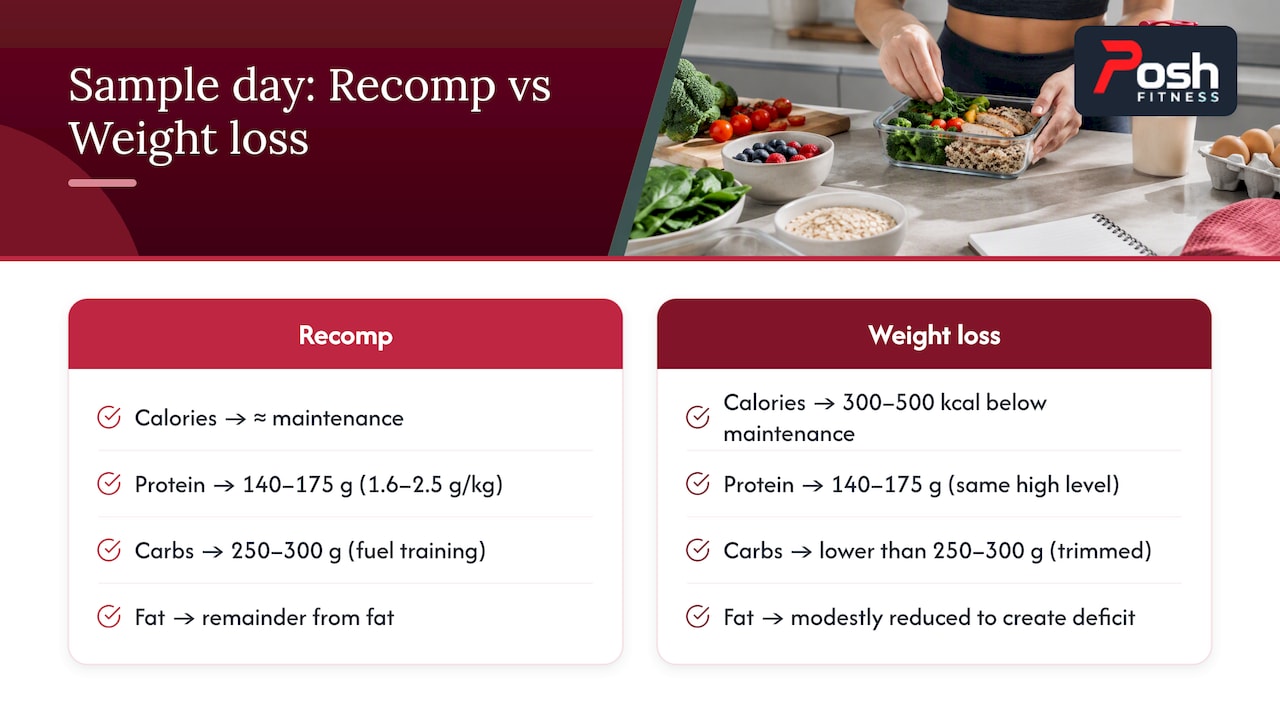
The practical difference is mostly in calorie total, not food choice. Both approaches benefit from protein-forward meals: eggs or Greek yogurt at breakfast, a lean protein source like chicken, fish, or tofu at lunch and dinner, and a serving of complex carbohydrate and vegetables rounding out each plate. Where recomposition allows more room for carbohydrate around training sessions to support performance and recovery, weight loss often means trimming portions evenly across the day rather than cutting protein, since protein is the nutrient doing the most work to preserve muscle during the deficit.
Why age and gender change how each approach performs
Age and gender influence how efficiently your body builds muscle or loses fat, which affects how quickly either approach shows results.
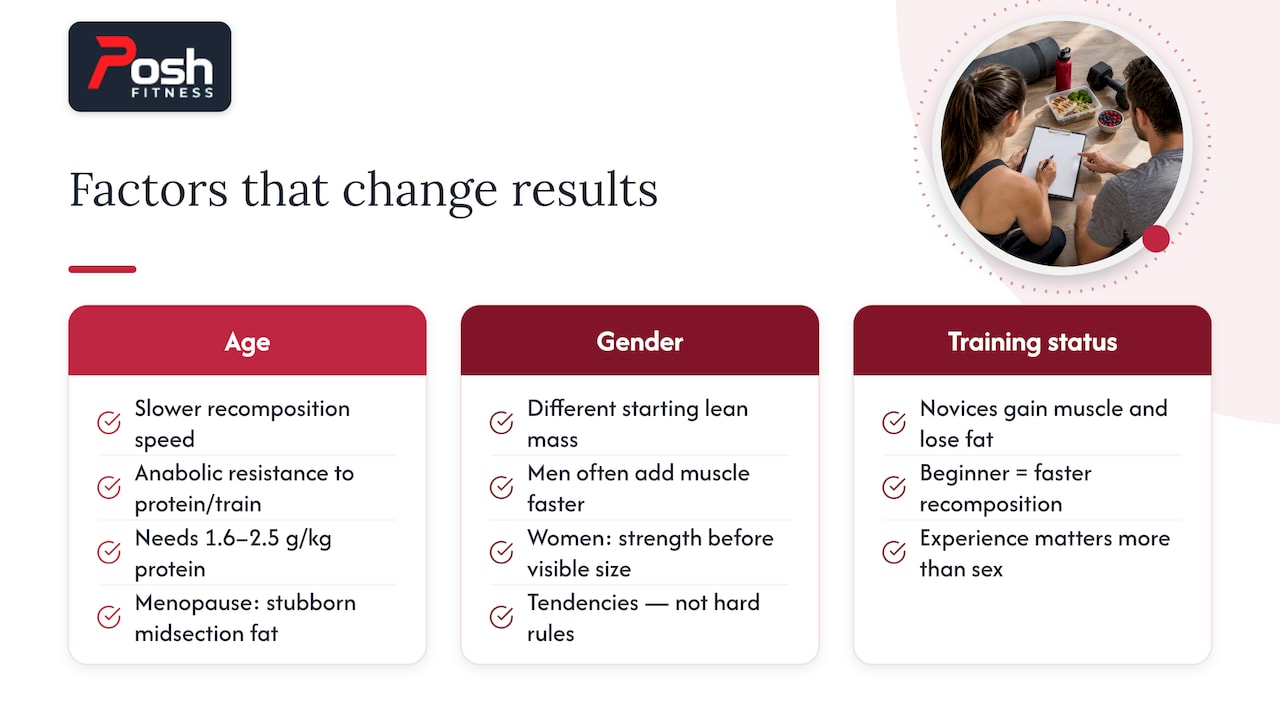
Muscle protein synthesis becomes less responsive to training and protein intake with age, a pattern sometimes called anabolic resistance, which means recomposition tends to move more slowly for older adults and often benefits from protein intake at the higher end of the 1.6 to 2.5 gram range along with consistent resistance training. Hormonal shifts around menopause can also make fat loss, particularly around the midsection, more stubborn, which is part of why the Cleveland Clinic frames recomposition as a long-term lifestyle approach judged by fit, function, and strength rather than quick scale change.
Gender differences show up mainly in starting body composition and typical response to training. Men generally carry a higher baseline of lean mass and can often add muscle a bit faster in the early months of training, while women frequently see strength gains that outpace visible muscle size changes, especially early on. These are tendencies, not rules, and training experience matters more than gender for how fast recomposition progresses. A beginner of either gender tends to build muscle and lose fat simultaneously more easily than an experienced lifter, which is one reason novice status is often a better predictor of recomposition speed than age or sex alone.
Health markers beyond how you look
Both approaches can improve health, but they do so through different mechanisms, and each carries its own trade-offs worth naming honestly.
Weight loss, when it targets excess fat, is linked to improvements in blood pressure, insulin sensitivity, and markers tied to cardiometabolic risk. The drawback is that weight loss achieved without resistance training and adequate protein risks taking a meaningful share of that progress out of muscle rather than fat, which can quietly reduce resting metabolic rate and physical function over time, a cost that outlasts the diet itself.
Recomposition’s health upside centers on preserving or building the muscle that supports metabolic rate, bone density, and functional strength as you age, while still reducing fat mass gradually. Its drawback is pace: because the scale moves slowly, it is harder to use as a quick lever for a health marker that needs to shift fast, such as blood pressure ahead of a medical procedure. Combining resistance training with a moderate deficit, rather than choosing one philosophy in isolation, is often how people capture both the metabolic benefits of fat loss and the functional benefits of muscle preservation in the same program.
Which approach fits your life for the long run
The approach that lasts is usually the one that fits around your schedule, your relationship with food, and how much structure you actually enjoy, not the one that promises the fastest result.
Weight loss phases work well as defined chapters, several months with a clear calorie target and an end date, but sustaining a deficit indefinitely tends to backfire through fatigue, rigid food rules, or eventual rebound. Recomposition, by contrast, is closer to a standing habit than a phase: consistent resistance training, protein-forward meals, and calories near maintenance can be maintained for years without the same burnout risk, which is part of why it suits people focused on long-term health rather than a single event.
In practice, many people move between the two over time, recomposing for a stretch, cutting when a specific target calls for it, then returning to maintenance. What matters most for sustainability is building the resistance-training habit early, since that habit, more than any specific diet, is what carries over regardless of which phase you are in.
A realistic take on what actually moves the needle
The biggest mistake I see isn’t choosing the wrong approach, it’s abandoning a working one too early because the scale didn’t cooperate on schedule. Sustainable habits, consistent training and protein intake, beat any short-term diet trick. For some people, the real barrier isn’t willpower but an unseen biological factor, which is exactly where individualized diagnostics like DNA analysis or bloodwork can surface answers generic advice never will.
— Peter
How personalized coaching turns these principles into results
Knowing the science is one thing, applying it to your own biology is another. Personalized training and nutrition plans can be developed using DNA analysis, bloodwork, and physical assessments, allowing protein targets, training volume, and calorie strategy to be tailored to an individual’s biology rather than a generic template.

This approach fits people who have stalled on standard programs or want a monitored, science-driven path to recomposition rather than guesswork. Services can be delivered in various formats such as in-home, virtually, or in-person at a gym. Explore personal training options to get started.
FAQ
How long does body recomposition take?
Recomposition typically unfolds over several months to a year, since you are building muscle and losing fat at similar, modest rates rather than making one large, fast change. Progress is best judged through strength, waist measurements, and photos rather than a weekly scale check.
What are the biggest body recomposition mistakes?
The two most common mistakes are cutting calories too aggressively, which undermines muscle retention, and skipping resistance training altogether, which removes the main signal that tells your body to keep muscle during fat loss. A meta-analysis of resistance exercise during dieting found that adding structured training preserved fat-free mass far better than diet alone.
Is it normal to lose weight during body recomposition?
Yes, modest weight loss is common during recomposition, especially for people carrying higher body fat, since fat loss often slightly outpaces muscle gain early on. The scale number matters less than whether strength is holding steady or improving alongside the loss.
Is a 500 calorie deficit too much for recomp?
A 500 calorie deficit is generally better suited to a weight-loss phase than true recomposition, since it leaves less energy available for muscle building. For recomposition, maintenance calories or a smaller deficit paired with resistance training and higher protein tend to produce better muscle-preserving results.