
Cortisol can promote visceral fat storage when stress becomes chronic, but it is one factor among diet, activity, sleep, and genetics, never the sole cause of a rounder midsection. The trio that moves the needle most reliably is consistent sleep, balanced exercise, and active stress management. Skip the single-point home cortisol tests and the “cortisol-blocking” supplements: they rarely tell you anything useful, and a persistent cluster of symptoms deserves a clinician’s attention, not a gadget’s.
Key Takeaways
Maintaining consistent sleep, moderate exercise, and managing stress effectively are the most reliable ways to reduce cortisol’s impact on belly fat.
| Point | Details |
|---|---|
| Sleep schedule | Aim for 7 to 9 hours of sleep on a consistent timetable to prevent circadian disruption and cortisol spikes. |
| Regular movement | Engage in moderate aerobic activity and strength training weekly to help regulate stress and cortisol levels. |
| Stress management techniques | Practice slow breathing, mindfulness, or talk therapy to lower cortisol reactivity over time. |
| Dietary choices | Eat fiber- and protein-rich meals and limit high-sugar snacks and excess alcohol to reduce insulin and cortisol interaction. |
| Personalized coaching | Using DNA analysis, bloodwork, and gut microbiome testing, Posh Fitness customizes plans to optimize recovery and metabolic health. |
Table of Contents
- How cortisol works and why it favors abdominal fat
- What the research shows (human studies and experimental findings)
- Evidence-backed strategies to lower cortisol’s impact and reduce belly fat
- A realistic 6-week routine to break the cortisol-belly-fat cycle
- When testing and personalization help: DNA, bloodwork, and coached plans
- Keep the emphasis on sustainable habits, not quick fixes
- How Posh Fitness can help with a tested, personalized program
- Sources
- FAQ
How cortisol works and why it favors abdominal fat
Cortisol follows a daily rhythm set by the hypothalamic-pituitary-adrenal (HPA) axis: it peaks shortly after waking and tapers through the day, reaching its lowest point at night. That rhythm matters because visceral fat, the kind packed around your organs, carries a denser supply of cortisol receptors than fat under the skin. An enzyme called 11β-HSD-1 amplifies the effect further by converting inactive cortisone into active cortisol directly inside fat tissue, according to a review of HPA-axis function and obesity. That local activation means visceral fat can generate its own cortisol exposure almost independent of what is circulating in your blood.
Cortisol also interacts with insulin in ways that steer energy toward abdominal storage rather than burning it off.
- Elevated cortisol can increase appetite and cravings for energy-dense foods.
- It nudges the body toward storing fat viscerally rather than peripherally.
- It can blunt insulin sensitivity, encouraging more fat storage after meals.
It is worth separating this everyday stress response from Cushing’s syndrome, a rare endocrine disorder involving sustained, pathologically high cortisol that requires formal diagnosis, not a description that fits typical work or life stress.
What the research shows (human studies and experimental findings)
Human cohort research has repeatedly tied markers of cortisol metabolism, including production rates and 11β-HSD-1 expression, to visceral fat and insulin resistance in men, though the associations are correlational rather than proof that stress alone causes fat gain. Flattening the normal peak-to-trough cortisol rhythm triggered hyperinsulinemia within three days and more than doubled adipose tissue in three weeks in a mouse model](https://pmc.ncbi.nlm.nih.gov/articles/PMC9391061/), with effects partly or fully reversing once the flattened rhythm was removed. That finding matters because it points to the rhythm itself, not just the average cortisol level, as a driver of fat cell growth.
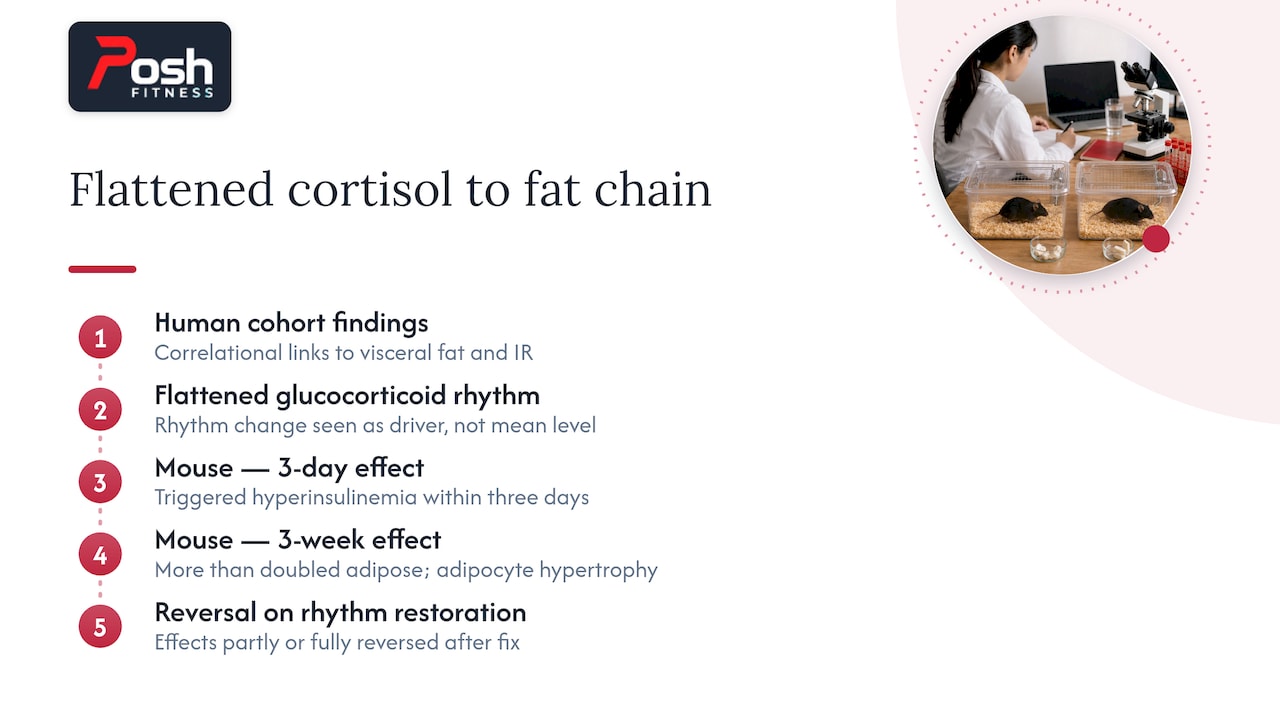
Animal studies like this one clarify a plausible mechanism: a flattened glucocorticoid oscillation appears to drive hyperinsulinemia, which in turn drives adipocyte hypertrophy, the enlargement of individual fat cells rather than simply their number. Extrapolating that directly to people has real limits, since human stress patterns, diets, and genetics are far more variable than a controlled lab setting allows. A population-level correlation between chronic stress and visceral fat does not mean every stressed person will see their waistline change; sleep quality, diet composition, and baseline metabolic health all modify the outcome.
Evidence-backed strategies to lower cortisol’s impact and reduce belly fat
The interventions with the most consistent support are ordinary, unglamorous, and reversible. Here is a rough hierarchy of where to spend your effort.
- Protect your sleep schedule. Aim for 7 to 9 hours on a consistent timetable, since sleep debt and late, irregular bedtimes are closely tied to circadian disruption and elevated evening cortisol.
- Move regularly, not punishingly. The CDC recommends roughly 150 minutes per week of moderate aerobic activity plus two strength sessions, and even short 10-minute walks help regulate stress markers.
- Build in mind-body practice. Slow-paced breathing, brief mindfulness sessions of 2 to 10 minutes, or talk therapy can measurably reduce cortisol reactivity over time.
- Eat to blunt insulin spikes. Favor fiber- and protein-forward meals, and limit late-night high-sugar snacks and excess alcohol, both of which can aggravate the insulin-cortisol interaction described above.
- Skip the shortcuts. Over-the-counter “cortisol blockers” lack reliable evidence, and a single at-home cortisol test cannot diagnose anything meaningful on its own.
Recovery and intensity need to stay in balance. Chronic, high-intensity training without adequate rest can add to the stress load rather than relieve it, a balance Heala’s piece on recovery explores well.
Pro Tip: If you only change one thing this month, fix your bedtime first: a flattened evening cortisol curve appears to matter more for fat cell growth than squeezing in an extra workout.
If symptoms go beyond ordinary stress, such as rapid weight gain concentrated in the face and trunk, muscle weakness, or easy bruising, that combination warrants formal testing for Cushing’s syndrome through a clinician rather than a consumer test kit.
A realistic 6-week routine to break the cortisol-belly-fat cycle
Consistency beats intensity here. A workable weekly structure looks like this:
- Two or three days of moderate aerobic activity, such as brisk walking, cycling, or swimming.
- Two strength training sessions targeting major muscle groups.
- One mobility or light recovery day, and one full active-rest day.
- A 10-minute walk after your largest meal, which helps blunt post-meal insulin spikes.
Pair that with a daily evening ritual: a screen curfew an hour before bed, 30 to 60 minutes of wind-down time, and a few minutes of slow, paced breathing once you are in bed. Florva Health’s guide to evening rituals offers a practical template for building this habit. Throughout the day, a 2-minute breathing break before a stressful meeting or a mindful pause before eating can interrupt the stress-eating loop before it starts.
Track progress with measures that actually reflect what is changing: a weekly waist measurement, a simple sleep-quality note, and your energy levels rather than the bathroom scale alone. Even short bouts of activity, as little as 10 minutes, have been shown to lower stress markers](https://www.cdc.gov/physical-activity-basics/guidelines/index.html), which is encouraging for anyone who cannot commit to long workouts. Expect early wins in sleep and energy within one to two weeks, with visible changes in waist circumference typically taking longer, closer to two or three months of consistent habits.

When testing and personalization help: DNA, bloodwork, and coached plans
Most people do not need lab testing to make progress on the basics above. Deeper testing earns its place when progress stalls despite consistent sleep, training, and nutrition, when symptoms look atypical, or when an endocrine disorder is suspected and needs a clinician’s workup rather than guesswork.
Where testing adds real value is in personalizing the plan itself. DNA analysis and bloodwork can inform recovery needs, flag metabolic markers worth watching, and help set individualized exercise intensity so training supports recovery instead of working against it. Posh Fitness builds its coaching around exactly this kind of diagnostic input, using DNA and bloodwork testing to shape training load, recovery timing, and nutrition rather than issuing a generic template. None of this replaces medical evaluation for a suspected endocrine condition, and no test turns stress management into something you can skip. What it does is translate general guidance into specifics for your own biology.
Keep the emphasis on sustainable habits, not quick fixes
Stress-related weight gain is not a personal failing, and it rarely responds to shame or a 3-day “detox.” What works is smaller and less exciting: the same sleep schedule most nights, movement you can sustain, and stress tools you actually use when it counts. If you want a clearer sense of where you stand before committing to a bigger change, the Weight Loss Readiness Quiz is a low-pressure way to start.
— Peter
How Posh Fitness can help with a tested, personalized program
Generic advice helps most people some of the way, but stubborn cases often need a plan built around your own biology rather than a population average. Posh Fitness uses DNA analysis, bloodwork, and gut microbiome testing to shape training, recovery, and nutrition around your specific metabolic picture.
- Health Coaching for ongoing, personalized guidance on stress, sleep, and nutrition habits.
- 4 Week DNA Coaching to translate genetic data into a concrete training and recovery plan.
- Longevity Coaching, including bloodwork-informed sessions, for readers focused on long-term metabolic health.
- Online plans, including the Truly Personal Plan, for those who want coaching without an in-person visit.
Start with a look at Posh Fitness’s personal training services to see which option fits where you are right now.
Sources
This article draws on the CDC’s physical activity guidelines, a PMC review of the HPA axis and obesity, a PMC study on glucocorticoid rhythm flattening, the Endocrine Society’s Cushing syndrome guideline, and Cleveland Clinic’s overview of cortisol.
This article is general information, not a substitute for advice from a qualified doctor. Consult a qualified healthcare professional about your own circumstances before acting on anything here.
- Physical Activity Guidelines for Americans — CDC
- The hypothalamic–pituitary–adrenal axis, obesity and chronic stress exposure — PMC
- Diagnosis of Cushing syndrome — Endocrine Society clinical guideline
FAQ
How can you flush cortisol out of your body?
There is no way to “flush” cortisol on demand, since it is a normal hormone your body regulates continuously rather than a toxin to clear. The most reliable way to lower elevated cortisol is consistent sleep, regular moderate exercise, and stress-reduction practices like paced breathing or mindfulness, sustained over weeks.
What are 10 warning signs of high cortisol?
Common signs described by Cleveland Clinic include rapid weight gain concentrated in the face and midsection, muscle weakness, fatigue, high blood pressure, mood changes, irregular periods, thin skin that bruises easily, and slow wound healing. A cluster of these symptoms, rather than any single one, is what typically prompts a clinician to test for a disorder like Cushing’s syndrome.
What drink burns the most belly fat?
No drink burns belly fat on its own; fat loss depends on overall activity, diet, and consistent habits rather than a single beverage. Reducing high-sugar drinks and excess alcohol can help by limiting the insulin spikes that interact with cortisol to favor abdominal fat storage.
What foods trigger cortisol?
Diets high in refined sugar and heavy alcohol intake are most commonly linked to the insulin swings that can worsen cortisol’s effect on fat storage, particularly late at night. Favoring fiber- and protein-forward meals throughout the day is the more evidence-aligned approach than trying to eliminate any single food.