


The most reliable morning routine for energy follows a clear order: wake at the same time, get outside for daylight, hydrate before caffeine, move your body for 5 to 15 minutes, then eat a steady breakfast. Each step is manageable on its own, and prior-night sleep remains the single biggest factor in how alert you feel the next morning.
Key Takeaways
The most reliable morning energy routine combines consistent sleep, daylight exposure, hydration, movement, and balanced breakfast tailored to individual biology.
| Point | Details |
|---|---|
| Sleep consistency | Getting at least 7 hours of sleep and waking at the same time each day are crucial for alertness. |
| Morning daylight exposure | Brief morning sunlight or light therapy effectively suppress sleep inertia and improve alertness. |
| Hydrate first | Drinking water before caffeine replenishes fluids and sharpens alertness without stomach irritation. |
| Quick movement | 2 to 15 minutes of light activity in the morning boosts blood flow and reduces grogginess. |
| Personalized approach | Using bloodwork, DNA, and individual responses helps tailor routines for optimal energy and recovery. |
Table of Contents
- Why sleep consistency matters (the night-before foundation)
- Use bright light first: how daylight or light therapy wakes your brain
- Hydrate before caffeine: why water first helps alertness
- Move your body: quick, practical morning movement to raise alertness
- Breakfast and morning fuel: what to eat for steady alertness
- Caffeine timing and smart use: get the lift without the crash
- Phone, mindset, and quick cognitive boosts
- Exercise timing nuance: morning movement vs. longer-term benefits
- How personalization helps: when a tailored plan speeds results
- Morning hydration beyond water: why electrolytes matter too
- Personalized nutrition and supplements based on your own biomarkers
- Aligning your circadian rhythm with your genetic predispositions
- Hydration timing relative to caffeine and exercise
- Tailoring your routine to energy patterns found in bloodwork or DNA
- Testing the routine for two weeks: what to expect
- How we help when habits alone aren’t enough
- FAQ
- Sources
Why sleep consistency matters (the night-before foundation)
Before any morning habit can help, your sleep has to be adequate and your wake time has to be steady. In 2024, [30.5% of U.S. adults reported sleeping less than 7 hours per night](https://www.cdc.gov/nchs/products/databriefs/db559.htm), and a considerable number reported trouble staying asleep, both common contributors to that heavy, foggy start to the day. The American Academy of Sleep Medicine recommends adults get at least 7 hours nightly, and that threshold is the floor, not a target to shave down on busy weeks.
A consistent wake time does more than help you feel rested. It anchors your circadian rhythm so your body learns when to release cortisol, when to drop core temperature for sleep, and when to prepare you for alertness. Waking at wildly different times across the week creates what sleep researchers call social jetlag, a mismatch that leaves you groggy even after a full night’s rest.
If your current wake time feels unsustainable, shift it gradually rather than all at once:
- Move your alarm 15 minutes earlier every two to three days until you reach your target.
- Keep your wake time consistent on weekends, even if bedtime flexes slightly.
- Pair the new wake time with light exposure immediately, which reinforces the shift.
Pro Tip: Set your alarm across the room instead of on your nightstand. The short walk to turn it off makes the first step out of bed automatic.
Use bright light first: how daylight or light therapy wakes your brain
Indoor lighting, even in a bright kitchen, rarely delivers enough intensity to signal your brain that the day has started. Outdoor daylight, even on an overcast morning, is many times stronger and does the job far faster. Clinical guidance on circadian rhythm treatment points to timed bright light exposure as an effective tool for shifting your internal clock and improving daytime alertness when it is used at the right time of day.
A short burst of morning light, somewhere between 5 and 20 minutes, is usually enough to start suppressing the grogginess of sleep inertia. You have a few practical ways to get it:
- Step outside for a short walk or stand on a porch or balcony.
- Open every curtain and blind in your home as soon as you’re up.
- Use a light-therapy lamp near your face if outdoor light isn’t available, especially in winter.
Timing matters here as much as intensity. Light early in the day tends to advance your circadian clock, helping you feel sleepy earlier at night, while bright light or screens late in the evening push your clock later and make mornings harder. Keep that contrast in mind: chase light in the morning, dim it in the evening.
Hydrate before caffeine: why water first helps alertness
You lose fluid overnight through breathing and sweat, and a mildly dehydrated brain feels sluggish before it feels thirsty. Drinking water first, before coffee or tea, gives your body fluid it actually needs rather than a stimulant on an already depleted system. A reasonable target is 300 to 500 milliliters shortly after waking, enough to support cognitive function without overloading your stomach before breakfast.
Hydrating first also reduces the gastric irritation some people feel when coffee hits an empty, dry stomach, and many report that the water itself sharpens perceived alertness before caffeine ever enters the picture.
A few habits make this easier to stick with:
- Keep a filled water bottle or glass on your nightstand the night before.
- Room-temperature water is easier to drink quickly than ice-cold water for most people.
- Add electrolytes only if you wake up dehydrated from heat, illness, or heavy exercise the day before.
For a deeper look at hydration amounts and timing, our hydration and energy guide walks through when 500 to 1,000 milliliters makes sense and how to test your own response.
Move your body: quick, practical morning movement to raise alertness
You don’t need a full workout to feel the benefit of morning movement. Even 2 to 15 minutes of light activity increases blood flow and heart rate enough to cut through sleep inertia and help you feel present instead of foggy. The goal here is consistency, not intensity.
Pick the version that fits your schedule:
- Two-minute mobility reset: a few rounds of arm circles, hip openers, and gentle spinal twists when you’re short on time.
- Eight-minute brisk walk: around the block or up and down stairs, ideal when you want fresh air alongside the movement.
- Twelve to fifteen-minute low-intensity circuit: bodyweight squats, lunges, and push-ups at an easy pace for days when you have a bit more room in your schedule.
Save demanding, high-intensity training for a time of day when it won’t cut your sleep short the night before. Practitioners generally recommend keeping morning sessions light enough to support alertness, while reserving longer or harder training blocks for whatever time best matches your sleep and performance goals.
Pro Tip: Lay out your walking shoes or workout clothes the night before. Removing that one decision point makes the movement habit far easier to keep on tired mornings.
Breakfast and morning fuel: what to eat for steady alertness
Breakfast advice has long been contradictory, but a large prospective study helps clarify the picture. The PREDICT1 study found that morning alertness is independently predicted by the prior night’s sleep, the previous day’s physical activity, breakfast macronutrient composition, and how sharply blood sugar rises after eating.
A lower post-meal glycemic response was linked to steadier alertness in that research, while higher-carbohydrate breakfasts were sometimes associated with a quicker but less stable lift, the kind that can fade into a mid-morning slump.
In practice, that gives you two reasonable templates depending on your goal:
- For a quick acute boost before an early demand like a workout or a morning meeting, a higher-carbohydrate option such as oatmeal with fruit can work well.
- For steadier focus across the morning, pair protein and fiber with slower-digesting carbohydrates, such as eggs with vegetables or a high-fiber, high-protein bowl, which also helps limit sharp glucose swings. Our partners at Homecooked outline several high-fiber, high-protein combinations worth testing.
Since individual responses to the same breakfast vary, pay attention to how you feel 90 minutes after eating. A simple log of what you ate and your energy an hour later, kept for a couple of weeks, tells you more about your own glycemic response than any general rule can.
Caffeine timing and smart use: get the lift without the crash
Caffeine works best as a supplement to a routine you’ve already started, not a substitute for it. Delaying your first cup until after you’ve hydrated and moved a little lets your body’s own alertness systems kick in first, so the caffeine adds to a baseline instead of masking grogginess entirely.
For most people, having caffeine within 60 to 90 minutes of waking, after water and light movement, strikes a good balance between effectiveness and timing. Keep an eye on your afternoon cutoff too, since caffeine late in the day can delay your next night’s sleep and undercut the whole routine.
- Have water and a few minutes of movement before your first cup, not instead of it.
- If you’re sensitive to caffeine, split your usual dose into two smaller servings rather than one large one.
- Set a personal cutoff, often early-to-mid afternoon, to protect that night’s sleep.
Phone, mindset, and quick cognitive boosts
Reaching for your phone the moment you wake up tends to make grogginess feel worse, not better. Notifications, headlines, and messages put your brain into a reactive state before it has had a chance to settle, which can leave you feeling scattered rather than sharp.
A short mental routine works better than scrolling:
- Spend two to three minutes on slow breathing or a brief sit in silence before touching your phone.
- Follow it with a five-minute journal entry or a quick look at your top priority for the day, so you start from intention rather than autopilot.
That small sequence, breathe first, then set intention, shifts your first few minutes from reactive to purposeful, and it costs you less time than scrolling usually does.
Exercise timing nuance: morning movement vs. longer-term benefits
Morning movement and longer exercise sessions serve different purposes, and it helps to separate them. A randomized crossover trial found that morning, pre-breakfast exercise increased fat oxidation during and shortly after the session compared with exercise done at other times, which supports short morning activity as a tool for acute alertness and metabolic shifts.
Separate 12-week trials comparing morning and evening aerobic training found that both schedules improved sleep and cardiometabolic health, though morning training tended to advance sleep timing and reduce triglycerides faster, while evening training produced greater vascular improvements. Neither time is universally better, so the practical rule is simple: use short morning movement for immediate alertness, and schedule your main cardio or strength sessions whenever they fit your goals and protect your sleep quality.
If you have a cardiovascular condition, take medications affected by exercise timing, or you’re adjusting your routine significantly later in life, it’s worth discussing timing with a coach or physician who can account for those factors directly.
How personalization helps: when a tailored plan speeds results
A consistent wake time, daylight, hydration, movement, and a steadier breakfast resolve morning sluggishness for many people within two weeks. When fatigue persists despite those habits, the next step usually isn’t trying harder, it’s understanding your own biology more precisely.
We build personal training, health coaching, and DNA and bloodwork-informed plans around your actual physiology, delivered flexibly in person, at a partner gym, or fully virtually.
A personalized assessment makes the most sense when:
- You sleep enough and still feel persistently fatigued during the day.
- Your energy response to breakfast or exercise seems inconsistent no matter what you try.
- Your fitness progress has stalled despite following a reasonable routine.
That kind of assessment typically draws on bloodwork, your activity history, and a review of current nutrition, and it leads to a short trial period with a coach before any longer commitment.
Morning hydration beyond water: why electrolytes matter too
Plain water handles most mornings, but water alone doesn’t always replace what you lose overnight. Sodium, potassium, and magnesium all help regulate fluid balance, nerve signaling, and muscle function, and a deficit in any of them can leave you feeling tired even after you’ve had enough water.
You’re more likely to need electrolytes alongside water if you sweat heavily during the night, live in a hot climate, drink alcohol the evening before, or exercise hard the previous day. In those situations, plain water can dilute the sodium you have left without replacing it, which sometimes leaves people feeling just as flat as they did before drinking.
For an average morning with no unusual fluid loss, water is enough, and reaching for electrolyte mixes every day isn’t necessary. Save them for mornings after heavy exercise, illness, or a particularly hot night, and otherwise let plain water do the work. Pay attention to signs like persistent dry mouth, dizziness when standing, or an unusually dark morning urine color, any of which suggest your fluid balance needs more than water alone.
Personalized nutrition and supplements based on your own biomarkers
General breakfast and hydration advice works for most people, but it’s built on averages, and your own biology may respond differently. Two people can eat the same oatmeal and see different blood sugar responses, different energy curves, and different afternoon slumps, depending on genetics, gut microbiome composition, and metabolic health.
That’s where biomarker-informed nutrition becomes useful. Bloodwork can reveal nutrient deficiencies, like iron or vitamin D, that mimic ordinary tiredness, while DNA analysis can point to how efficiently you metabolize caffeine or process certain carbohydrates. Gut microbiome testing adds another layer, since digestive efficiency affects how much energy you actually draw from a given breakfast.
Rather than guessing which supplement or macronutrient ratio fits you, a plan built from your own bloodwork and DNA results lets you target the specific gaps showing up in your biology. We build exactly this kind of plan into our DNA and bloodwork-informed coaching, using your actual lab results to shape nutrition recommendations instead of applying a generic template.
Aligning your circadian rhythm with your genetic predispositions
Not everyone’s internal clock runs on the same schedule. Some people are naturally wired as early risers, while others lean toward a later chronotype, and that tendency has a genetic component that influences when your body naturally wants to sleep, wake, and feel alert.
Forcing a rigid 5 a.m. wake time onto someone whose biology favors a later schedule often backfires, producing the same grogginess the routine was meant to fix. Instead, circadian strategies work best when they respect your underlying tendency: a naturally late chronotype may need more deliberate morning light exposure and a later caffeine window to feel sharp, while an early chronotype might do better anchoring workouts and demanding tasks earlier in the day.
DNA analysis can offer insight into these genetic tendencies, giving you a starting point for how aggressively to shift your schedule and how much light exposure you’re likely to need. That insight is part of what we fold into our longevity coaching, aligning light exposure, movement, and wake timing with the patterns your own genetics suggest rather than a one-size-fits-all clock.
Hydration timing relative to caffeine and exercise
The order of hydration, caffeine, and movement matters as much as the amounts. Drinking water before caffeine, as covered earlier, reduces gastric irritation and gives your body fluid before a stimulant. The same logic extends to exercise: hydrating before a morning walk or workout supports blood flow and temperature regulation during the activity itself, rather than trying to catch up afterward.
A practical sequence looks like this: water first thing, a short movement session, then caffeine once you’re up and moving, followed by rehydrating again after exercise if you worked up a sweat. This order lets each step support the next one instead of competing for the same depleted reserves.
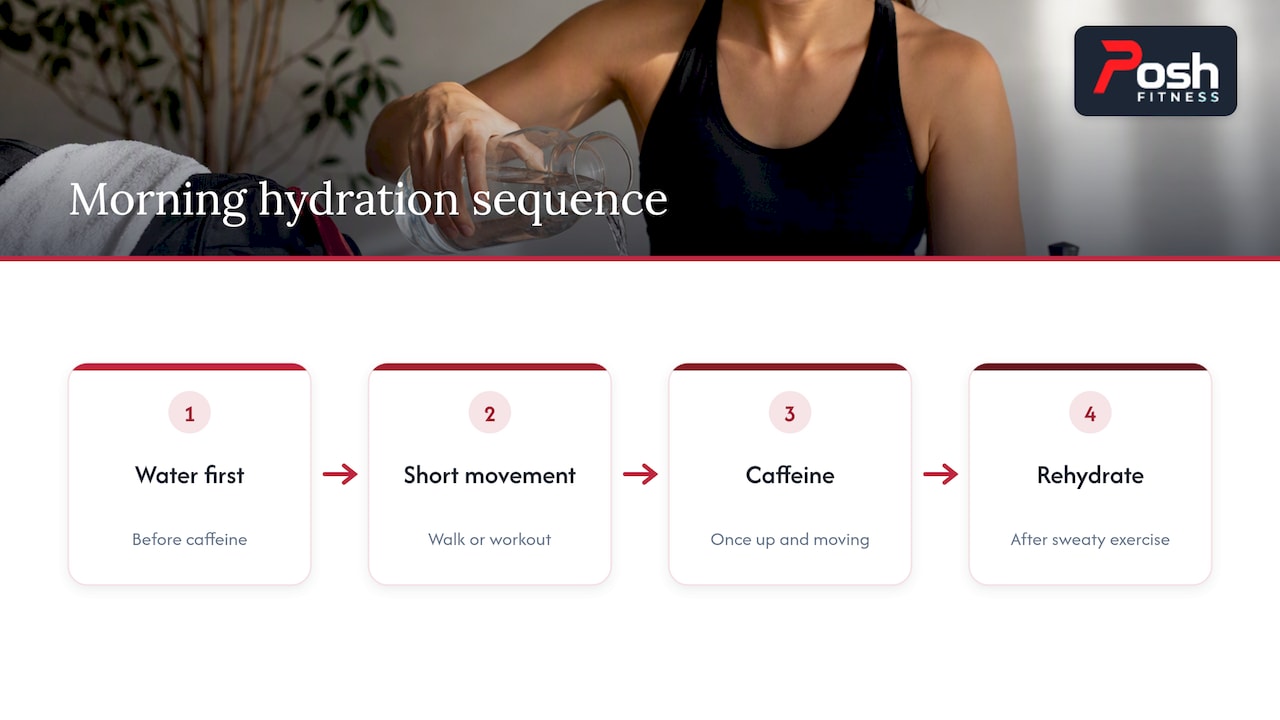
If your morning includes a more demanding workout, consider splitting your hydration across the session rather than drinking it all at once beforehand, which helps you avoid stomach discomfort while still meeting your fluid needs.
Tailoring your routine to energy patterns found in bloodwork or DNA
The routine outlined above works for most people as a starting point, but bloodwork and DNA analysis can reveal why certain steps matter more for you than others. Someone with a genetic tendency toward slow caffeine metabolism, for instance, may need an earlier cutoff than the general afternoon guideline to protect their sleep. Someone with a bloodwork marker for low iron may feel persistently tired no matter how well they time light, movement, and breakfast.
Rather than cycling through generic fixes, a plan informed by your own lab results lets you prioritize the levers most likely to move your particular energy pattern: light exposure for one person, iron repletion for another, caffeine spacing for a third. We build this kind of individualized prioritization into our coaching programs, using bloodwork and DNA results to decide which parts of the routine deserve the most attention in your specific case, rather than asking you to tweak everything at once.
Testing the routine for two weeks: what to expect
Two weeks is enough time to see whether this routine actually moves the needle for you. Here’s a simple way to test it.
- Spend two to three days recording your baseline: usual wake time, rough sleep duration, and a morning energy rating from 1 to 10.
- Adopt the full routine, consistent wake time, daylight, hydration before caffeine, short movement, and a steadier breakfast, for the following 10 to 12 days.
- Rate your morning energy daily and note how long grogginess lasts after waking.
Real improvement usually shows up as faster alertness after waking, fewer afternoon naps, and steadier focus through the late morning rather than a dramatic overnight change. If fatigue persists despite two honest weeks of consistent effort, that’s a reasonable point to loop in a physician or a coach who can look at your bloodwork rather than guessing further.
— Peter
How we help when habits alone aren’t enough
When a solid routine still leaves you running on empty, the next step is usually understanding your own biology rather than adding another habit. We build personal training, health coaching, and DNA and bloodwork-informed programs around your actual physiology, delivered in person or fully virtually.

If you’re ready to find out what’s actually driving your energy, personal training is a straightforward place to start, or explore our 4 Week DNA Coaching for a deeper, lab-informed look at your own patterns.
FAQ
What is the most effective morning routine for energy?
The most effective routine combines a consistent wake time, morning daylight exposure, hydration before caffeine, 5 to 15 minutes of movement, and a steady, lower-glycemic breakfast. Prior-night sleep remains the strongest single factor, so protecting at least 7 hours of sleep supports every other step.
What is the 4AM rule?
The so-called 4AM rule is an informal productivity idea suggesting people wake at 4 a.m. to get a head start on the day, but it isn’t a clinical recommendation and doesn’t suit most chronotypes or work schedules. A consistent wake time that fits your own sleep needs matters far more than any specific hour.
What is the 30-30-30 morning routine?
The 30-30-30 routine is a popular social-media framework suggesting 30 grams of protein, 30 minutes of low-intensity exercise, and avoiding caffeine for the first 30 minutes after waking. It overlaps with evidence-based habits like hydrating before caffeine and moving early, though the specific numbers are a popularized shorthand rather than a clinical standard.
What are five things I can do when I wake up in the morning?
Drink water before coffee, step outside or open your curtains for daylight, move your body for a few minutes, eat a breakfast with protein and fiber, and delay checking your phone until after those steps. Each one targets a different driver of morning sluggishness, from hydration to circadian timing.
Sources
- How people wake up is associated with previous night’s sleep together with physical activity and food intake
- Circadian rhythm practice parameter review