

VO2 max is trainable for most people, and the evidence points to one clear strategy: build a solid aerobic base with Zone 2 work, then layer in structured high-intensity intervals two to three times a week. Genetics shapes how much you gain, but nearly everyone who trains consistently sees measurable improvement within a few months, confirmed through retesting rather than guesswork.
Key Takeaways
Consistent VO2 max improvement relies on a structured balance of aerobic base training and targeted high-intensity intervals, with individual factors like genetics influencing the extent of gains.
| Point | Details |
|---|---|
| Build an aerobic base | Focus on Zone 2 workouts to develop mitochondrial capacity before adding high-intensity intervals. |
| Use appropriate testing methods | Opt for lab-based CPET for precision, or wearable estimates to monitor trends over time. |
| Progress gradually | Increase training volume and intensity slowly, no more than 10% weekly, to optimize gains and avoid injury. |
| Prescribe based on physiological markers | Use threshold heart rate or heart rate reserve to set more accurate effort levels than simple percentages. |
| Personalize training with genetics and data | Customize your VO2 max program based on individual responses and recovery capacity to maximize results. |
Table of Contents
- Why VO2 Max Matters for Your Health and Performance
- How to Test Your VO2 Max: Lab, Field, and Wearable Options
- What Your VO2 Max Number Actually Means
- Training Methods That Actually Raise VO2 Max
- Building a Training Block: Weekly Plans and Realistic Timelines
- Prescribing Intensity: Why Threshold-Based Targets Work Better
- Trainability and Genetics: Setting Realistic Expectations
- Measuring Progress: When and How to Retest
- The Role of Nutrition and Supplementation
- Common Pitfalls That Stall VO2 Max Progress
- How Recovery Shapes Your VO2 Max Gains
- How We Apply VO2 Max Science to Individualized Programs
- Train Smarter With a Plan Built Around Your Biology
- FAQ
- Sources
Why VO2 Max Matters for Your Health and Performance
VO2 max measures how much oxygen your body can use during intense effort, and it turns out to be one of the more telling numbers in exercise medicine. Clinical and public health guidance link higher VO2 max with reduced all-cause mortality and lower chronic disease risk, which is why we treat it as a vital sign worth tracking, not just a performance metric for athletes.
A higher VO2 max also expands your working capacity at every intensity. You can sustain a faster pace at an easy effort, recover quicker between hard efforts, and push your threshold further before fatigue sets in. Several factors shape where you land on the scale.
- Activity history and current training volume strongly influence your baseline and your room to improve.
- Age and sex affect typical values, with VO2 max gradually declining after your 30s absent targeted training.
- Body mass matters because relative VO2 max is expressed per kilogram, so composition changes shift the number independent of fitness.
- Genetics sets a ceiling on how much you can gain, a point we unpack later in this piece.
How to Test Your VO2 Max: Lab, Field, and Wearable Options
Three testing paths exist, each with a different balance of precision, cost, and convenience. Choosing the right one depends on why you want the number and how often you plan to retest it.
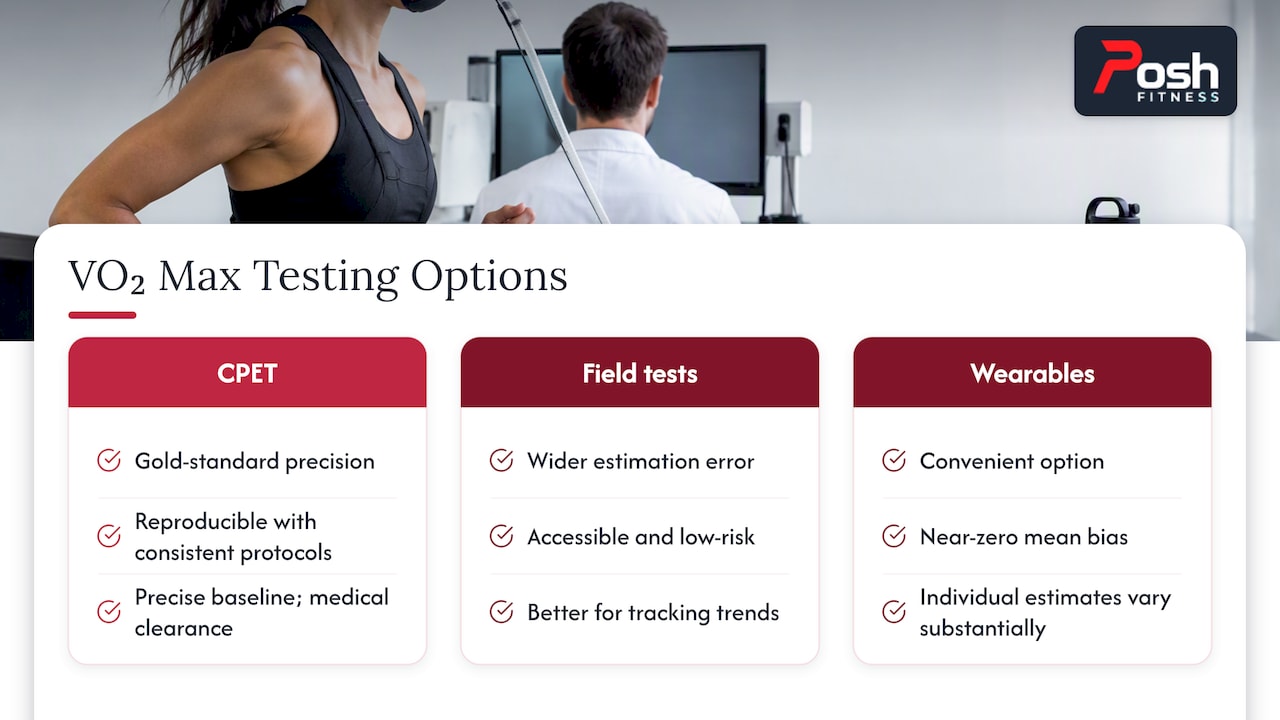
Cardiopulmonary exercise testing (CPET) is the gold standard. You exercise to exhaustion on a treadmill or bike while a mask measures the oxygen you consume and the carbon dioxide you produce. A valid maximal test typically requires a respiratory exchange ratio above 1.10, a plateau in oxygen uptake despite increasing workload, and a heart rate within about 10 beats of your age-predicted max. CPET is highly reproducible when protocols stay consistent, which makes it the right choice if you want a precise baseline before starting a structured block or need medical clearance for underlying conditions.
Submaximal field tests, like time trials or step tests, estimate VO2 max from your heart rate response to a known workload rather than pushing you to failure. They are accessible and low-risk, useful for general fitness tracking, but they carry wider estimation error than CPET and are better suited to spotting trends over time than nailing an exact figure.
Wearable estimates sit at the convenient end of the spectrum. Devices that calculate VO2 max from exercise data rather than resting heart rate alone tend to perform better, and validation research from the INTERLIVE consortium found exercise-based wearable estimates carry a mean bias close to zero, though individual estimates can vary by a substantial margin.
That gap matters. Wearables are reliable for watching your trend line across weeks and months, but a single reading should never be treated as a clinical-grade number.
Before any maximal test, sleep well, stay hydrated, avoid heavy caffeine or stimulants beforehand, and skip hard training the day before so fatigue does not skew your result.
What Your VO2 Max Number Actually Means
VO2 max is reported two ways, and conflating them leads to confusion. Relative VO2 max (mL/kg/min) divides oxygen uptake by body weight, making it the standard for comparing fitness across people of different sizes. Absolute VO2 max (L/min) reflects total oxygen consumption regardless of body mass, which matters more in contexts like rowing or sports where total power output counts.
Normative ranges vary widely by age, sex, and training status, with trained endurance athletes often sitting well above sedentary peers of the same age. Rather than chasing a universal benchmark, track your own trajectory relative to your starting point.
- A change of roughly 3 to 5 mL/kg/min after a dedicated training block is generally considered meaningful rather than noise.
- Day-to-day fluctuations of a point or two often reflect hydration, fatigue, or test conditions rather than real fitness shifts.
- Repeated testing under the same protocol is the only way to separate a genuine improvement from measurement variability.
Training Methods That Actually Raise VO2 Max
The research consensus is refreshingly consistent: a mix of aerobic base training and targeted intervals outperforms either approach alone. Harvard Health’s guidance recommends building the bulk of your weekly volume at an easy, conversational pace, then adding interval sessions two to three times a week for the sharpest gains.
- Aerobic base (Zone 2) training forms the foundation. This is effort you could hold a conversation through, typically 60 to 90 minutes a session, two to four times weekly, building mitochondrial density and fat oxidation capacity that support harder efforts later.
- Norwegian 4x4 intervals involve four minutes at a hard, sustainable pace followed by three minutes of active recovery, repeated four times. This protocol is one of the most studied formats for raising VO2 max efficiently.
- Longer VO2 max intervals of three to five minutes at near-maximal effort, with equal or slightly shorter recovery, build the same adaptation through a different stimulus, useful for runners and cyclists who prefer sustained surges over short bursts.
- Sprint interval training (SIT) uses all-out efforts of 20 to 30 seconds with several minutes of recovery between repeats. It delivers a potent stimulus in less total time, though it demands more recovery between sessions.
- Cross-training across running, cycling, and rowing spreads mechanical load across different muscle groups while still challenging the cardiovascular system, which can reduce injury risk during intensive blocks.
Strength training supports the whole picture, too. Building muscular endurance and resilience in the lower body helps you tolerate higher interval volume without breaking down, and adequate recovery between hard sessions is what actually lets the adaptation take hold.
Pro Tip: Start new interval blocks with three to four repeats rather than the full prescribed volume, then add one repeat weekly once the effort feels controlled.
Building a Training Block: Weekly Plans and Realistic Timelines
Programming VO2 max work is less about any single session and more about how sessions stack across a week and a month. The following templates adapt the same principles to three experience levels.
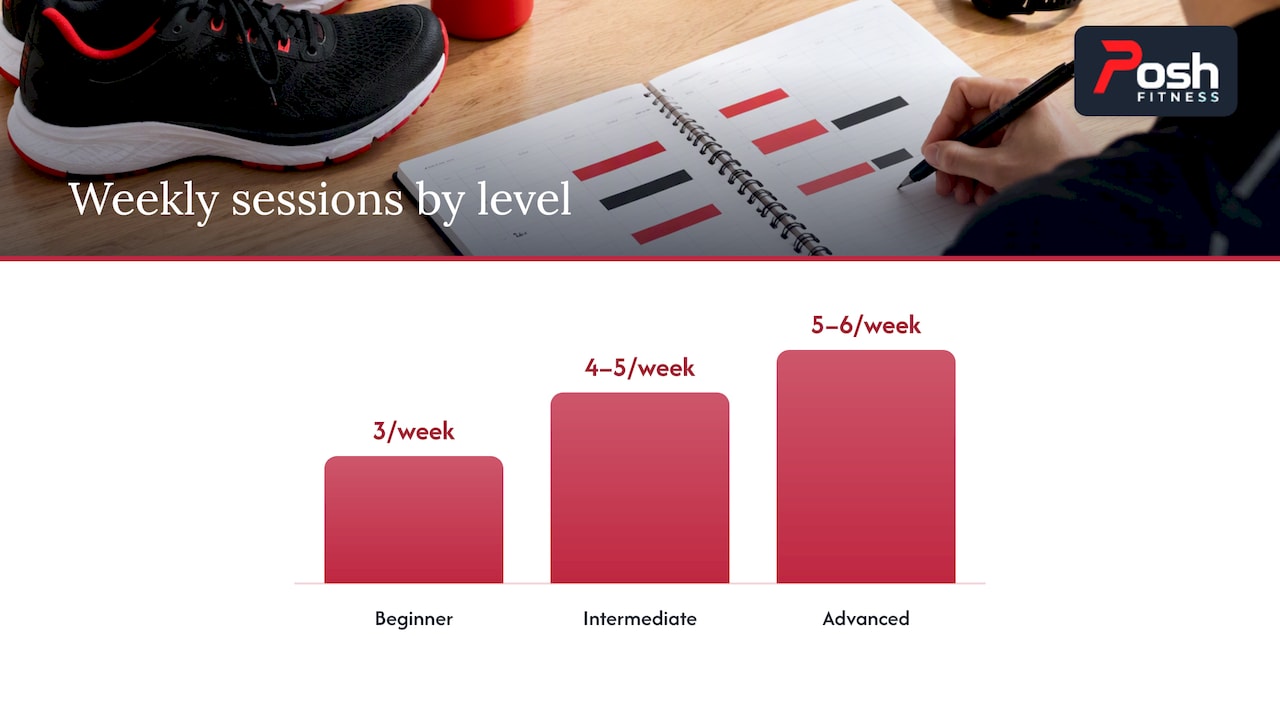
- Beginner: three total sessions weekly, two easy Zone 2 runs or rides of 30 to 45 minutes, one interval session with short intervals (example: 6 x 2 minutes hard, 2 minutes easy), and at least two full rest or active recovery days.
- Intermediate: four to five sessions weekly, three Zone 2 sessions of 45 to 60 minutes, one Norwegian 4x4 session, and one longer tempo or threshold run, with one full rest day built in.
- Advanced: five to six sessions weekly, including two interval sessions (one 4x4 format, one SIT or longer VO2 max intervals), three Zone 2 sessions of 60 or more minutes, and deliberate recovery weeks every third or fourth week to manage accumulated fatigue.
Progress intervals by adding a repeat or slightly increasing work duration every one to two weeks rather than raising intensity and volume simultaneously. Weekly aerobic volume should increase gradually, typically no more than 10% from one week to the next, to avoid overreaching.
Most people who train consistently see measurable VO2 max gains within an 8 to 20 week window. Review evidence on training response suggests typical improvements often fall within a moderate range depending on starting fitness and training intensity, with larger absolute gains common among people starting from a lower baseline. Expect the biggest jumps early in a program, then a slower, steadier climb as your base improves.
Prescribing Intensity: Why Threshold-Based Targets Work Better
How you define “hard” matters as much as how often you train hard. Several anchors exist for prescribing intensity, and they are not interchangeable.
- Percentage of heart rate max (%HRmax) is simple but ignores individual variation in resting and max heart rate, which can misclassify effort for some people.
- Heart rate reserve (HRR), calculated using the Karvonen method, adjusts for resting heart rate and tends to be more individualized than %HRmax alone.
- Ventilatory threshold and lactate threshold heart rate (LTHR) anchor intensity to a physiological marker rather than an arbitrary percentage, which review evidence suggests produces more consistent training responses across individuals with threshold-based prescription associated with higher response rates compared with max-based targets alone.
- The delta method, splitting the gap between threshold and VO2 max, offers another way to standardize hard efforts across fitness levels.
If you want a practical starting point without lab testing, a lactate threshold heart rate calculator based on a field test can estimate your threshold zones closely enough to prescribe intervals that match your actual physiology rather than a generic age-based formula.
Trainability and Genetics: Setting Realistic Expectations
Genetics plays a real role in how much your VO2 max improves, but it rarely eliminates your ability to improve. The landmark HERITAGE Family Study found that after a standardized 20-week training program, heritability of the training response was approximately 47%, meaning roughly half the variation in how people responded came down to genetic factors.
The range of individual outcomes in that study was striking. Participants’ VO2 max changes ranged from a decrease of 114 mL O2/min to an increase of 1,097 mL O2/min, with an average gain of about 400 mL O2/min across the group, despite everyone following the same protocol.
For practical purposes, this means two things. First, do not assume a slow early response means the program is wrong. Second, genetics shapes the ceiling and the pace of your gains, but testing, threshold-based prescription, and progressive overload remain the levers that determine whether you reach your personal potential.
Measuring Progress: When and How to Retest
Retesting turns training from guesswork into feedback. For lab-based CPET, an 8 to 12 week window between tests gives your body enough time to show a real adaptation. Wearable or submaximal trend checks can happen more frequently, every few weeks, since they are tracking direction rather than precision.
- Confirm a meaningful change with two consecutive tests under similar conditions rather than trusting a single reading.
- Keep testing conditions consistent: same time of day, similar sleep, and comparable hydration status each time.
- Avoid testing within 24 to 48 hours of a hard training session, since residual fatigue skews results.
- Log your results alongside training volume so you can connect changes to what you actually did.
The Role of Nutrition and Supplementation
Training stimulus drives VO2 max adaptation, but nutrition determines whether your body can execute and recover from that stimulus. Adequate carbohydrate intake around interval sessions supports the high-intensity efforts that create the training signal in the first place, while chronic under-fueling blunts both performance and recovery.
Protein-forward nutrition supports the muscular and connective tissue adaptations that let you tolerate higher training volume without breaking down. Iron status deserves particular attention, since low iron limits oxygen-carrying capacity and can quietly cap your aerobic gains regardless of how well-structured your training is.
Hydration affects both acute performance and the accuracy of any VO2 max test you take, so consistent fluid intake matters on training days and test days alike. Beyond foundational nutrition, no supplement reliably accelerates VO2 max adaptation on its own. Caffeine can modestly improve performance during a given session, which indirectly supports harder training, but the underlying driver of VO2 max improvement remains the structured work itself.
Where nutrition strategy becomes genuinely individualized is in understanding your own metabolic responses, which is where bloodwork and biomarker tracking can reveal gaps a generic diet plan would miss.
Common Pitfalls That Stall VO2 Max Progress
The most common mistake is skipping the aerobic base and jumping straight to intervals every session. Without a foundation of easy, consistent volume, hard efforts produce diminishing returns and higher injury risk.
A second frequent error is progressing interval volume and intensity at the same time. Add one variable at a time, either more repeats or slightly harder pace, never both in the same week.
Testing inconsistency causes a lot of frustration, too. Comparing a wearable estimate from a rested morning to a submaximal field test done after a poor night’s sleep will produce numbers that look contradictory even when your fitness has not changed.
Finally, many people abandon a protocol before the adaptation window closes. Since meaningful change typically takes 8 to 20 weeks to show up clearly, judging a program after two or three weeks sets you up to quit right before results arrive.
How Recovery Shapes Your VO2 Max Gains
Adaptation happens during recovery, not during the workout itself. Sleep is the single most influential recovery lever, since growth hormone release and tissue repair concentrate during deep sleep stages, directly affecting how well your body consolidates the stimulus from hard interval sessions.
Full rest days, not just lighter training days, give your cardiovascular and muscular systems time to clear accumulated fatigue. Active recovery, light movement like an easy walk or gentle cycling, can support blood flow and reduce stiffness without adding meaningful training stress.
Skipping recovery to fit in more interval sessions tends to backfire, producing stagnant or declining performance rather than faster gains. A well-recovered body executes each hard session with better form and higher quality effort, which is ultimately what drives the adaptation you are training for.
How We Apply VO2 Max Science to Individualized Programs
We build VO2 max programming around individual biology rather than a generic template, structuring intervals and base volume to fit aerobic base, recovery capacity, and genetic response potential. If you want your VO2 max training grounded in your own data rather than averages, we are ready to help you build that plan.
— Peter
Train Smarter With a Plan Built Around Your Biology
Generic VO2 max programs ignore the fact that genetics, bloodwork, and recovery capacity vary between individuals. Coaching can be built around personal analysis and biomarkers, then applied to aerobic and interval protocols delivered in different settings or virtually.
If you are ready for training that reflects your own physiology rather than a one-size-fits-all plan, explore our personal training services and take the next step toward a program built for you.
This article is general information, not a substitute for advice from a qualified doctor. Consult a qualified healthcare professional about your own circumstances before acting on anything here.
FAQ
Is VO2 Max Genetic?
Genetics plays a measurable role in how much your VO2 max improves, with the HERITAGE Family Study estimating heritability of the training response at approximately 47%. That still leaves most people with substantial room to improve through consistent, well-structured training.
What Is the 3-3-3 Rule for Running?
This term is not a standardized, peer-reviewed training protocol, and definitions circulating online vary widely. Rather than follow an informal rule, we recommend anchoring your running intervals to validated formats like Norwegian 4x4 or threshold-based pacing, which have stronger evidence behind them.
What Is the Difference Between Zone 2 Training and 4x4 Norwegian Intervals?
Zone 2 training is sustained, conversational-pace effort that builds your aerobic base and typically makes up the bulk of weekly volume. Norwegian 4x4 intervals are four-minute hard efforts separated by three minutes of recovery, repeated four times, designed specifically to raise VO2 max rather than build base endurance.
What Is a Cardio Fitness Score?
A cardio fitness score is typically a device or app’s estimate of your VO2 max, often generated from exercise heart rate data rather than a lab test. These scores are useful for tracking trends over time, but exercise-based wearable estimates carry wide individual error margins even when average bias across large groups looks small.
Sources
- Validation and recommendations for VO2max estimation from wearables (INTERLIVE consortium) | Sports Medicine
- VO2 max: What it is and how can you improve it | Harvard Health
- Genomic and transcriptomic predictors of response levels to endurance exercise training | PMC