

Heart rate variability (HRV) is the small, constant variation in the time between your heartbeats. Used well, it is a recovery signal that helps you decide whether today calls for a hard session, an easy one, or rest. The method is simple: measure under the same conditions every morning, build a personal baseline, and act on trends over days and weeks rather than on a single number. This guide shows you how, and where HRV stops being useful.
Key Takeaways
- HRV is personal. Compare your reading with your own baseline, not with a friend’s score or an age chart.
- Measure first thing in the morning, in the same position, before caffeine or food. Build a baseline over one to four weeks.
- A short dip after hard training is normal. A sustained drop over several weeks is the signal to pull back and recover.
- Sleep, stress, alcohol, illness and regular aerobic exercise all move HRV. Read it alongside how you feel, not in isolation.
- A persistently low trend with symptoms such as unusual fatigue, dizziness or palpitations belongs with your physician, not in a training app.
Table of Contents
- What HRV Is and Why It Matters for Training
- What HRV-Guided Training Actually Means
- How to Measure HRV and Build Your Baseline
- Reading Your Numbers: Trends, Not Single Days
- How to Adjust Your Workouts Based on HRV
- Does HRV-Guided Training Work Better Than a Fixed Plan?
- What Moves HRV: Sleep, Stress, Alcohol and Fitness
- HRV Breathing Exercises
- How Often Should You Check, and Can Checking Too Much Hurt?
- Our Take on HRV-Guided Training
- Get Coaching Built Around Your Biology
- FAQ
- Sources
What HRV Is and Why It Matters for Training
Your heart does not beat like a metronome. The gap between beats changes constantly. A 2024 narrative review in strength and conditioning defines HRV as the fluctuation of time intervals between adjacent heartbeats, commonly used as a surrogate measure of autonomic function. The autonomic nervous system is the part of your physiology that shifts you between “rest and digest” and “fight or flight.”
That is why HRV is useful for training. The Australian Institute of Sport position statement explains that HRV can inform on how responsive the autonomic nervous system is, which in turn reflects your stress response to training and life demands, your adaptation and your recovery.
At rest, the general pattern looks like this, according to a 2025 review by Esco and colleagues:
- Higher HRV points to more parasympathetic (calming) activity, which suggests a relaxed and recovered state.
- Lower HRV reflects greater sympathetic activation or reduced vagal tone, often associated with stress or fatigue.
A physical therapist at HSS puts it plainly: HRV reflects stress and recovery in the body, and a longer interval between beats is generally more desirable because it shows the body can recover faster from stress.
Two terms are worth separating, because the research does:
- Recovery is the short-term response to a workout: how quickly your body restores balance. It shows up as acute changes in HRV relative to your baseline.
- Adaptation is the long-term adjustment to repeated training. It shows up as gradual shifts in weekly HRV trends.
Both are described in the 2025 Esco review, which is why a single morning number tells you much less than a few weeks of readings.
What HRV-Guided Training Actually Means
HRV-guided training means adjusting the intensity of a session based on your waking HRV. Instead of following a fixed schedule of hard and easy days, you let your readiness decide.
In most studies, as described in a 2022 article in the International Journal of Sports Medicine, a set schedule is compared with one that varies higher-intensity work according to the daily HRV score. Each person first establishes an individual baseline, over a period ranging from three days to four weeks. Moderate and hard workouts are then done only when the score falls within the normal range.
The normal range is often called the smallest worthwhile change (SWC) window. The Addleman review describes the decision rule:
- HRV inside your window: train as planned, including moderate to high intensity.
- HRV outside your window: switch to low intensity, a rest day, or recovery work such as mobility and stretching.
You do not need to calculate statistics yourself. Most apps and devices do the math. What you need to understand is the logic: your own normal is the reference.
How to Measure HRV and Build Your Baseline
Measurement consistency matters more than which device you use. Variation caused by posture, food, caffeine or time of day can swamp the real signal.
The measurement routine
- Measure right after waking. Stanford Lifestyle Medicine recommends measuring immediately on waking, lying in bed, before caffeine or food. Some sources use a seated position instead. Pick one posture and keep it.
- Give it at least five minutes. A cardiologist cited by the Wu Tsai Human Performance Alliance notes that ECG is the gold standard, while chest straps and watches are relatively accurate at rest. He recommends a fasted morning reading of at least five minutes, not during sleep or exercise.
- Take five days in a row to set a starting average. Stanford suggests this, then one reading a week at the same time and position for one to three months, watching upward or downward trends rather than daily swings.
- Check how often you need to measure. The Esco review recommends daily recordings over a full seven days and notes that three to five well-controlled morning readings a week may give a sufficiently accurate weekly profile when daily tracking is not realistic. Research it cites found that recreationally trained exercisers needed at least five recordings per week for a reliable picture.
Choose a calm period for your baseline
A sports cardiologist quoted in Runner’s World suggests setting your baseline during low-stress periods, such as base training or the weeks of recovery after a race. She also recommends learning to read your body first. Keep a training journal and then compare it with what your wearable says.
That last point deserves emphasis. If your number says you are wrecked but you feel great and slept well, or the reverse, the journal helps you learn what the number means for you.
Reading Your Numbers: Trends, Not Single Days
People search for a “good HRV for my age,” and it is the most common question we hear about the topic. The honest answer is that population averages are a poor guide for decisions. HRV varies widely between healthy people, and the strongest interpretive level in training is your own baseline. The Addleman review states that in strength and conditioning, relative differences from an individual’s own baseline are the best interpretive level, and that interpreting further may have limited use.
So a person with an HRV of 35 and a person with an HRV of 90 can both be perfectly healthy. What matters is whether yours is holding steady, rising slowly, or falling.
What a pattern tells you
| Pattern in your own data | Likely meaning | Reasonable response |
|---|---|---|
| One low morning after a hard session | Normal short-term response to training stress | Keep the plan, but keep the next session honest about effort |
| One or two low mornings plus poor sleep or alcohol | Lifestyle load, not necessarily training | Easier day, earlier bedtime, hydrate |
| Readings stay within your usual range | You are absorbing the work | Train as planned |
| Slow upward drift over weeks | Positive adaptation | Keep building gradually |
| Sustained decline for several weeks | Possible inadequate recovery or overreaching | Reduce load, add rest, review sleep and stress |
A Stanford cardiology expert notes that HRV can dip after harder training and that context and trend matter: a short-term dip can be normal, while a sustained drop may signal inadequate recovery or overreaching.
Why a single day can mislead
The Esco review cautions that during prolonged or highly demanding activity, HRV responses can be complicated, with some studies reporting paradoxical increases despite significant stress. It recommends interpreting HRV in the broader training context and across longitudinal trends. In other words, a high number is not always a green light, and a low one is not always a red light.
The same review finds that weekly mean values and the coefficient of variation provide insight into both adaptation and recovery. Rather than guiding single-day adjustments, these patterns help monitor training status across weeks or blocks of training.
How to Adjust Your Workouts Based on HRV
Here is a practical way to use the data without becoming a slave to it.
When HRV is in your normal range
Train as planned. This is the day for your hard interval session, heavy lifts or a long effort, if they are on the schedule. The HSS physical therapist recommends noticing patterns over time and using a high HRV day to push harder.
When HRV is low for a day or two
Turn the day down rather than off. Options include an easy walk, mobility work, light zone 2 cardio or a shorter session. The same HSS source suggests that with a lower number, you choose stretching and breathwork and go to bed early. If you want to know what easy aerobic work should feel like, see our guide to zone 2 training and how to find your pace.
Stanford’s advice is a useful guardrail: rather than chasing a higher HRV with high-intensity workouts, build capacity, protect recovery and let the trend inform your next workout. It also suggests looking at HRV together with how you feel, sleep quality and heart rate recovery.
When HRV stays low for weeks
The Wu Tsai cardiologist says that if HRV takes a nosedive for three to four weeks, it could signal overtraining. Fatigue can compromise your ability to respond to more training, so the decline is a cue to consider a rest period or lighter training days.
The Addleman review adds a caveat for endurance athletes: decreasing HRV may be a sign of overreaching or overtraining syndrome, but in aerobic athletes the metrics may be less sensitive and are best used with secondary markers. Those markers include mood, sleep, resting heart rate, soreness and performance.
If you are constantly drained, our checklist on recovering faster when you are tired after workouts lists the red flags that deserve medical attention.
When to see a physician
HRV is not a diagnostic test. Coaches and trainers should act within their scope, and the Addleman review states that strength coaches and other professionals should refer to a sports medicine physician when an HRV pattern raises health concerns or an ongoing medical issue may need monitoring. If a low trend comes with chest discomfort, fainting, palpitations, shortness of breath out of proportion to effort, or fatigue that does not lift with rest, call your physician before the next workout.
Does HRV-Guided Training Work Better Than a Fixed Plan?
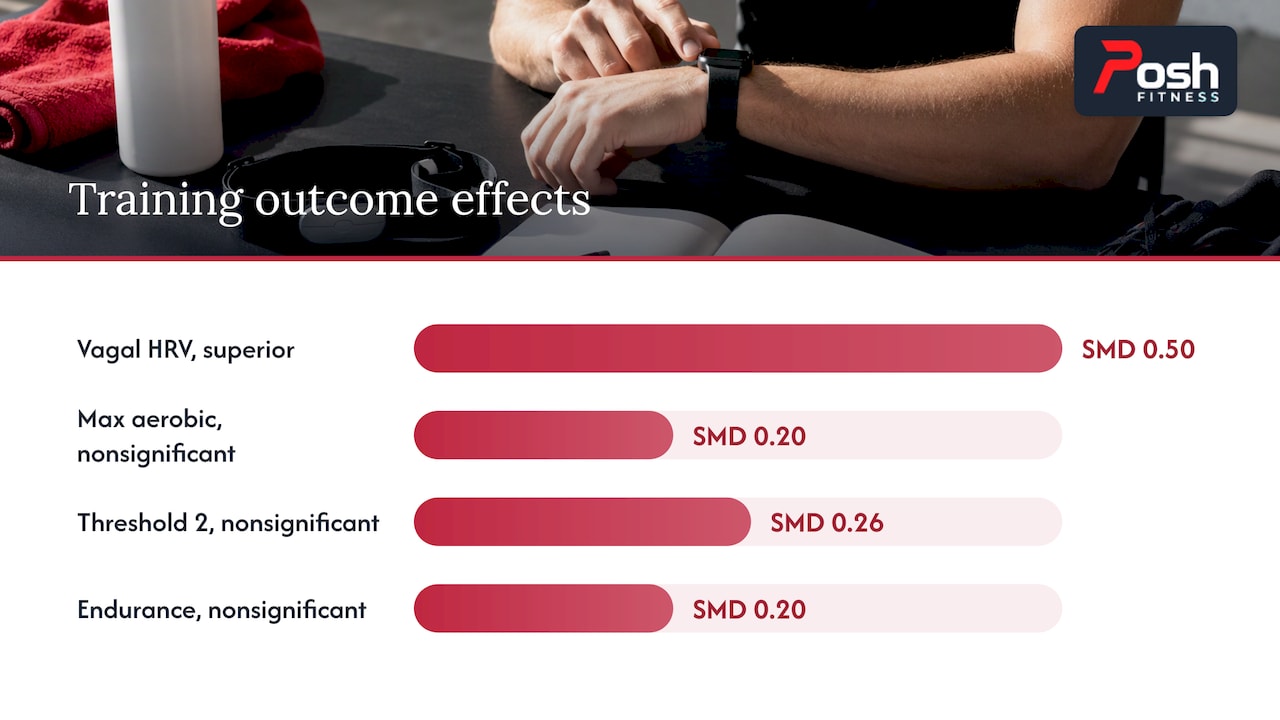
The evidence is encouraging but modest, and it is worth knowing what it shows. A 2021 systematic review and meta-analysis found HRV-guided training was superior for improving vagal-related HRV indices (SMD 0.50) but not resting heart rate. It found small, non-significant differences favoring HRV-guided training for maximal aerobic capacity (SMD 0.20), aerobic capacity at the second ventilatory threshold (SMD 0.26) and endurance performance (SMD 0.20).
The Addleman review concludes there is utility to HRV-guided programming compared with predefined programming in several sports and athletic activities, especially in programs with an aerobic or endurance component. It also says HRV-guided training allows a more individualized approach that adapts to a person’s specific physiology and environment.
What this means for you: HRV is most valuable as a personalization tool and an early warning signal, particularly if your training includes plenty of cardio. Most of the research was done in athletes, so general exercisers should treat the thresholds as starting points and lean on the journal habit described above.
What Moves HRV: Sleep, Stress, Alcohol and Fitness
If your goal is to nudge your HRV in the right direction, the same habits that help you recover are the ones that matter.
- Regular aerobic exercise. A physician interviewed by Verywell Health says that regular aerobic exercise and improved fitness have the strongest evidence for improving HRV, alongside resonance breathing, adequate sleep and stress reduction. She also notes HRV can dip in the first days after intense exercise and tends to rise as fitness improves over weeks, with average HRV increasing over six months. For a weekly structure, see our guide to exercise for longevity.
- Sleep. Consistent bed and wake times make your morning reading more comparable from day to day, and they support recovery itself. If your mornings are sluggish, our morning energy routine is a two-week experiment you can run alongside your HRV baseline.
- Stress. Training is only one of the loads on your nervous system. Work pressure, family demands and poor sleep all show up in the number. Practical ways to stress less can support recovery as much as an easier workout can.
- Alcohol, late meals and illness. These commonly depress overnight and morning readings. If a low number has an obvious explanation, treat it as information about that day, not as a verdict on your fitness.
- Time of day for training. If you are weighing when to work out, our comparison of morning versus evening workouts can help, since a consistent schedule also helps consistent readings.
HRV Breathing Exercises
HRV breathing is a different tool from HRV-guided training. Guided training uses your reading to decide how hard to exercise. Breathing practice is something you do to influence the reading and your stress response directly.
The most studied method is resonance breathing at about six breaths per minute: roughly five seconds in, five seconds out. A 2021 pilot study had participants do five minutes a day over 77 days, and 99 percent of participants completed the practice. The authors note that breathing at this rate also exercises the baroreflex, which helps regulate blood pressure, and adds a mindfulness-like effect from focusing on the breath.
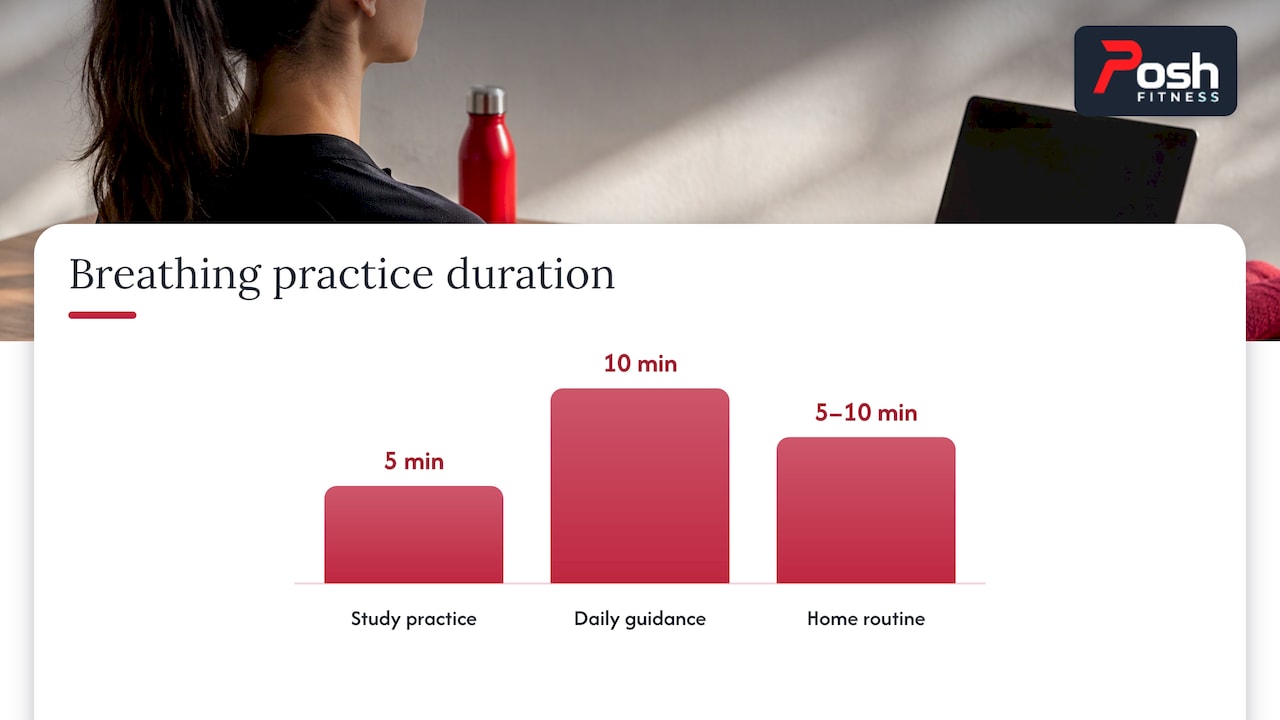
The Verywell Health physician notes that ten minutes a day of resonance breathing can improve HRV within two to three weeks. The HSS therapist likewise says breathing techniques can help manage stress.
A simple routine:
- Sit or lie down comfortably.
- Breathe in through the nose for about five seconds, then out gently for about five seconds.
- Keep going for five to ten minutes, ideally at the same time each day, such as before bed.
- Stop if you feel lightheaded and return to normal breathing.
The Addleman review is careful on one point: formal HRV biofeedback for managing stress or chronic disease should be done by a licensed professional board-certified in the modality. A paced breathing session at home is a relaxation habit, not treatment.
How Often Should You Check, and Can Checking Too Much Hurt?
Yes, it can. The same review warns about excessive checking, on the order of minutes to hours, which may have a stress-inducing effect on athletes. One reading each morning is plenty. If you notice that the number is setting your mood for the day, go back to the weekly reading Stanford describes and lean on the journal.
Here is a sensible rhythm for most exercisers:
- Weeks 1 to 2: Record every morning to learn your range. Do not change your training because of the numbers yet.
- Weeks 3 to 4: Note which habits (sleep, alcohol, hard sessions) line up with your highs and lows.
- Week 5 onward: Use the trend to make small adjustments, such as swapping an interval day for easy cardio when readings sit low for several days.
- Every 4 to 6 weeks: Review the bigger picture. Is your baseline rising, flat or falling? Is your performance following?
Recovery back to baseline after a single workout commonly occurs within the hour, which is one reason the next morning’s reading reflects the whole day and night, not just the session.
Our Take on HRV-Guided Training
We like HRV because it respects the central idea behind everything we do: you are not an average. A number only means something relative to your own baseline, and a plan only works when it fits your biology.
That is also where we would add a caution about leaning on one metric. HRV tells you how your nervous system is coping today. It does not tell you why. For many of the middle-aged adults we work with, the “why” is a mix of sleep, stress, nutrition, hormones and training load. That is the reason our approach starts with a fuller picture: DNA analysis, bloodwork, gut microbiome testing and physical assessments, where they fit a client’s goals.
Used alongside that picture, a trend in HRV becomes a conversation starter. A coach can look at your sleep, your food, your workload and your sessions and decide whether to adjust intensity, add recovery or simply hold steady. We work alongside your physician, and we encourage you to bring any persistent low readings or symptoms to them.
If your results have stalled, or you feel flat despite doing the work, do not guess. Measure consistently, keep a journal, and let a coach help you read what your body is telling you.
Peter
Get Coaching Built Around Your Biology
If you want help turning recovery data into a plan, we offer personal training in your home in Fairfield County, CT, at affiliated gyms, and virtually. Our programs are personalized using diagnostics such as DNA, bloodwork and gut microbiome testing, so intensity and recovery are matched to you rather than to a template.
There are several ways to start:
- Online: The Online Personal Fitness Plan Starter is $40 per month, and the Truly Personal Plan is $99 per month. A Live Virtual Training Session is $80 one-off, listed on our virtual training page.
- High-touch: The Ultra Membership 5 a Week is $2,000 per month. Longevity Coaching and the SystemAge + Coaching Session are described on our pricing page.
- Fatigue and energy: Learn how health coaching for fatigue works.
Ready to talk? Get started with an in-home personal trainer in Fairfield County.
FAQ
Is a lower HRV always bad?
No. A dip after a hard workout is a normal response, and what matters is context and trend. A sustained drop over several weeks, especially with poor sleep, fatigue or mood changes, is the pattern worth acting on by easing training and prioritizing recovery. If it comes with symptoms such as dizziness or palpitations, see your physician.
What is a good HRV for my age?
There is no single number that works for everyone, because HRV differs widely between healthy individuals. For training decisions, the most useful comparison is your own baseline, measured under consistent conditions. Track your normal range for a few weeks, then watch for movement away from it.
How long does it take to improve HRV?
It depends on what you change. A Verywell Health physician says daily resonance breathing can improve HRV in two to three weeks, while fitness-related gains build over weeks to months, with average HRV rising over about six months. Consistent sleep and regular aerobic exercise are the foundation.
Do I need a wearable to use HRV for training?
Not necessarily. A cardiologist cited by Wu Tsai says ECG is the gold standard, but chest straps and watches are relatively accurate at rest. A journal of sleep, soreness, mood and workout quality works alongside any device and is a good check on what the number says.
Sources
- Heart Rate Variability Applications in Strength and Conditioning (Addleman et al., 2024)
- Heart Rate Variability Applications in Strength and Conditioning (full text PDF)
- Monitoring Training Adaptation and Recovery Status (Esco et al., 2025)
- Heart rate variability position statement, Australian Institute of Sport
- How to Use Heart Rate Variability Data in Your Training, HSS
- How to Track HRV on Wearable Devices for Heart Health, Stanford Lifestyle Medicine
- Does Heart Rate Variability Detect Overtraining? Wu Tsai Human Performance Alliance
- International Journal of Sports Medicine, HRV-guided training article (2022)
- My HRV Was Concerningly Low, Runner’s World
- Heart Rate Variability-Guided Training for Enhancing Cardiorespiratory Fitness (2021 meta-analysis)
- Increasing Heart Rate Variability through Progressive Resonance Frequency Training (2021)
- We Asked a Doctor How You Can Improve Your HRV Score, Verywell Health