

Healthspan optimization means building the habits, and measuring the biology, that keep you strong, mobile and mentally sharp for as many of your years as possible. The evidence points to the same core levers: regular exercise that includes strength and balance work, mostly whole foods, seven to nine hours of sleep, stress control, social connection and preventive care. Personalization decides how well you apply them. Here is what the research says and how to put it to work.
Key Takeaways
- Healthspan is the part of your life spent free of disabling disease, pain and serious limitation. Lifespan only counts the years.
- Americans spend roughly 15 years in poor health on average, so the gap between lifespan and healthspan is a practical problem, not an abstract one.
- Exercise, nutrition, sleep, stress and social connection are the foundation. Strength training and balance work matter as much as cardio.
- DNA analysis, bloodwork and biological age testing can show where your own biology needs the most attention, so effort goes where it pays off.
- A consistent 12-week routine beats an ambitious plan you abandon in three weeks.
Table of Contents
- What healthspan means, and why the gap matters
- The habits that move healthspan the most
- Exercise for healthspan: what to do each week
- Nutrition that supports the long game
- Sleep, stress and connection
- Where personalization changes the result
- Our perspective on healthspan
- Work with a coach who starts with your biology
- A 12-week starting plan
- FAQ
- Sources
What healthspan means, and why the gap matters
Lifespan is the number of years between birth and death. Harvard Health describes healthspan as the stretch of life when a person is reasonably free of disabling disease, pain and serious limitation. Mayo Clinic frames it the same way: the years you remain free of significant illness.
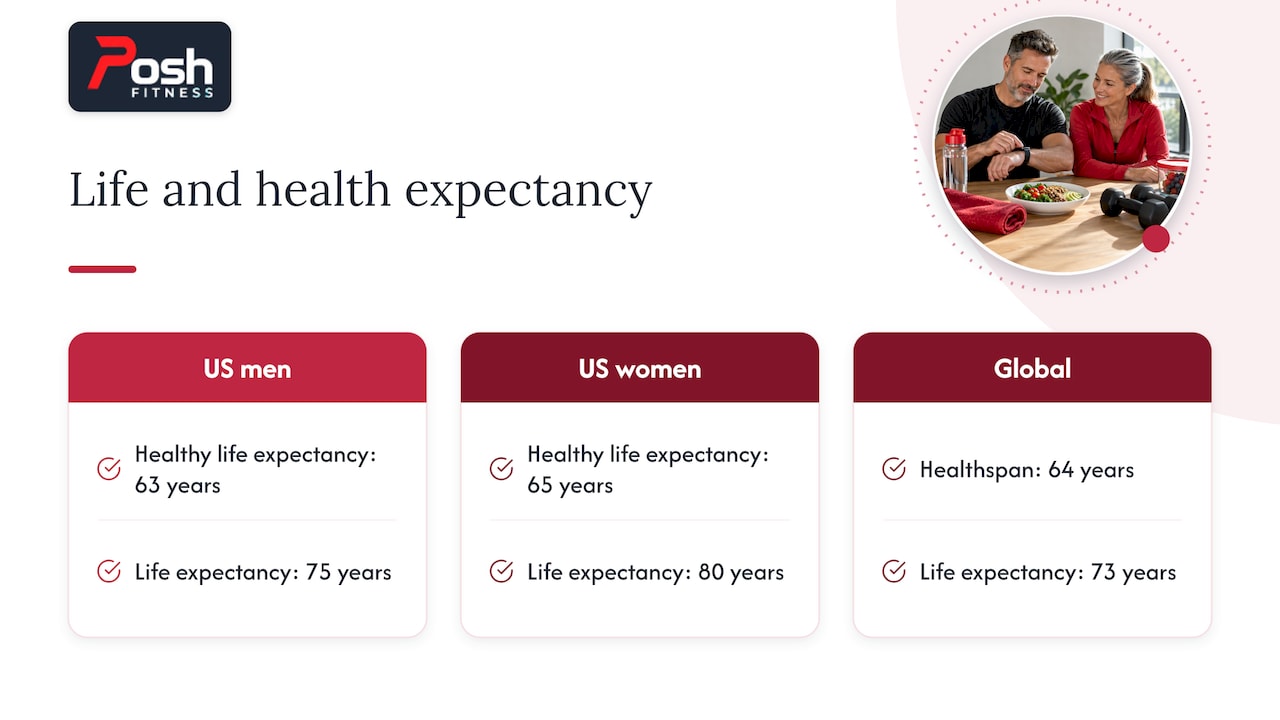
The two numbers have drifted apart. In 1900 a newborn in the United States could expect to live about 47 years, and today that figure is closer to 79, according to the same Harvard Health overview. Living longer is not the same as living well, though. UCLA Health reports, citing WHO calculations, that healthy life expectancy in the US is 63 for men and 65 for women, against life expectancy of 75 and 80. That leaves about 15 years in poor health.
The trend is not encouraging. The American Heart Association reports that average healthspan for US adults fell from 65.3 years in 2000 to 63.9 years in 2021, the latest year with data. Globally, a JAMA Network Open study cited by UCLA Health found a gap of about nine years between life expectancy (73) and healthspan (64).
For a 45-, 55- or 65-year-old, this reframes the goal. You are not trying to add a number to the end of your life. You are trying to protect the years you will actually use: climbing stairs without thinking about it, carrying groceries, playing with grandchildren, traveling, working with a clear head.
Dr. Corey Rovzar of the Stanford Prevention Research Center puts it simply in the AHA article: “Healthspan means living better, not just longer.” There is also good news in how the two connect. Dr. Norrina Allen of Northwestern University notes in the same piece that the factors preventing disease onset are also highly related to preventing death from those diseases. Work on healthspan and lifespan tends to follow.
The habits that move healthspan the most
Harvard Health lists the everyday behaviors that support a longer healthspan:
- Eating mostly whole, minimally processed foods.
- Moving regularly, with aerobic activity, strength training and balance work.
- Avoiding tobacco and limiting or avoiding alcohol.
- Prioritizing seven to nine hours of sleep.
- Managing stress and mood, and staying socially connected.
- Keeping up with preventive care and recommended screenings.
The American Heart Association’s Life’s Essential 8 checklist overlaps heavily. It covers not smoking, staying physically active, sleeping enough, following a healthy eating pattern, maintaining a healthy weight, and controlling cholesterol, blood pressure and blood glucose. According to the AHA, adherence to these components lowers the risk of chronic illness, supports healthy aging and contributes to longer lifespans and healthspans.
Notice that three of the eight are numbers you can measure: cholesterol, blood pressure and blood glucose. That matters later, when we talk about bloodwork.
Dr. Nathan LeBrasseur, who directs the Kogod Center on Aging at Mayo Clinic, says in the Mayo Clinic Q&A that physical activity, healthy nutrition, social connectedness and sleep profoundly affect how well we age. Those four are where we focus first with clients.
Exercise for healthspan: what to do each week
If you change one thing, change how you move. A good weekly plan has four parts: aerobic work, strength training, balance and daily steps.
Aerobic activity and strength
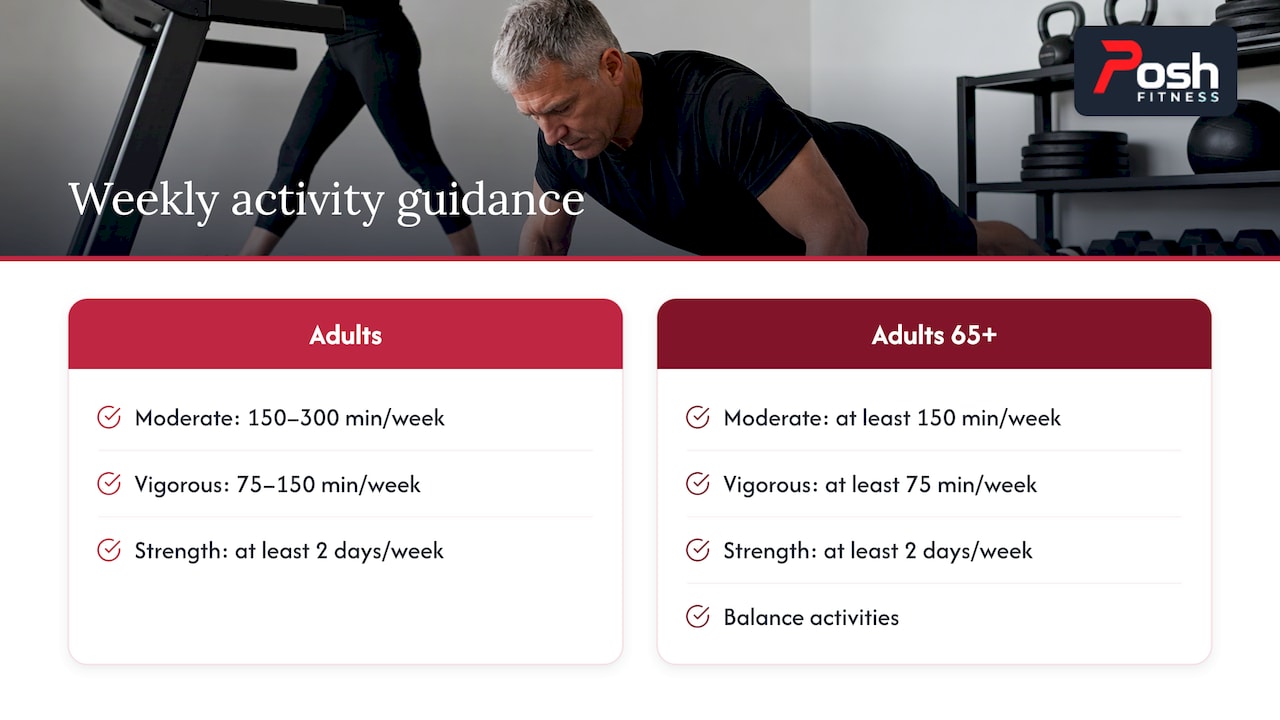
The Physical Activity Guidelines for Americans say adults should get 150 to 300 minutes per week of moderate-intensity aerobic activity, or 75 to 150 minutes of vigorous activity. They also call for muscle-strengthening work involving all major muscle groups on two or more days per week. For adults 65 and older, the CDC recommends at least 150 minutes of moderate aerobic activity (or 75 vigorous), at least two days of muscle strengthening, and activities to improve balance.
Balance
Balance is the piece most people skip until a stumble forces the issue. Older adults are advised to do multicomponent activity that includes it. Simple balance training for older adults such as single-leg stands, heel-to-toe walking and controlled step-ups can be added to a strength session in five to ten minutes.
Daily steps
The National Institute on Aging reports that in a study of adults 40 and older, taking 8,000 or more steps a day, compared with 4,000, was associated with a 51% lower risk of death from all causes. UCLA Health’s Dr. Ercoli suggests people 60 and older aim for around 8,000 steps a day plus strength training twice a week, and notes that aerobic exercise may protect the brain and delay the onset of dementia.
A sample week
| Day | Session | Time |
|---|---|---|
| Monday | Full-body strength (squat, hinge, push, pull, carry) | 40 min |
| Tuesday | Brisk walk or easy cycling | 30 min |
| Wednesday | Strength plus balance drills | 40 min |
| Thursday | Zone 2 cardio, conversational pace | 35 min |
| Friday | Full-body strength, one heavier lift | 40 min |
| Weekend | Longer walk, hike or sport, plus mobility | 45+ min |
That adds up to well over 150 minutes of aerobic work when you count the walks, and three strength days. If you are starting from zero, begin with two strength days and build. For more detail, see our guides on what to do each week for longevity and a practical mobility plan for adults over 40. If you have a thyroid condition, our hypothyroid workout guide shows how to start with 20 minutes and build safely. Anyone with heart disease, joint problems or another medical condition should clear a new program with their physician first.
Nutrition that supports the long game
No single food decides your healthspan. Your overall eating pattern does. The National Institute on Aging notes that Mediterranean-style eating may positively affect health, and that the DASH pattern lowers blood pressure, helps people lose weight and reduces the risk of type 2 diabetes and heart disease. A 2021 analysis of more than 21,000 participants, cited in that same NIA overview, found that people closely following a Mediterranean-style pattern had a significantly lower risk of sudden cardiac death.
Brain health follows a similar pattern. A report in Alzheimer’s & Dementia found that the MIND, DASH and Mediterranean diets are associated with improved cognition, a lower risk of dementia, healthier cardiovascular function and less depression. NIH MedlinePlus Magazine recommends five servings of fruits and vegetables a day to reduce chronic disease risk.
In practice, that translates to a few repeatable rules:
- Build each meal around a protein source, then add vegetables and a whole-food carbohydrate.
- Keep ultra-processed snacks out of the easy-reach spots at home.
- Eat fish, legumes, nuts, olive oil and berries often.
- Plan the week’s meals in advance, because the busiest days are when nutrition falls apart.
Protein-forward eating also supports the strength work above, because muscle needs both a training stimulus and raw material.
Sleep, stress and connection
These three get less attention than exercise, and they quietly undo a good program when they are neglected.
Sleep. The National Institute on Aging says older adults need 7 to 9 hours, and that poor sleep is linked to worse mood and memory and a greater risk of falls. In a prospective study of 13,423 US adults in the Journal of Aging and Health, those meeting the 7 to 9 hour guideline had a 19% lower risk of premature all-cause mortality. More is not always better: a study of 284,754 US adults found that both short and long sleep durations raised mortality risk compared with 7 hours.
The National Sleep Foundation stresses that poor sleep is not an inherent part of aging. Aging raises vulnerability to sleep disturbances but does not cause them. If you snore heavily, wake unrefreshed or struggle to fall asleep most nights, talk with your doctor rather than assuming it is normal.
Stress and mood. Chronic stress works against sleep, appetite control and recovery. Walking outdoors, breathing practices and scheduled downtime all count as healthspan work.
Connection. The Alzheimer’s & Dementia report cited above notes that loneliness is as damaging as smoking 15 cigarettes a day as a risk factor for general health, brain health included. Dr. Allen adds that family support, a strong social network and access to good health care contribute to a longer healthspan. Training with a coach, a partner or a small group serves exercise and connection at once.
Where personalization changes the result
The habits above are universal. How much of each you need, and in what order, is not. Two 50-year-olds can follow the same plan and respond differently, one with steady energy and fat loss, the other stuck.
UCLA Health’s Dr. Ercoli points out that genes affect your risk for hypertension, diabetes and other conditions, but lifestyle changes can help prevent or stave off disease. That is the premise of our approach: use data to decide where your effort goes first.
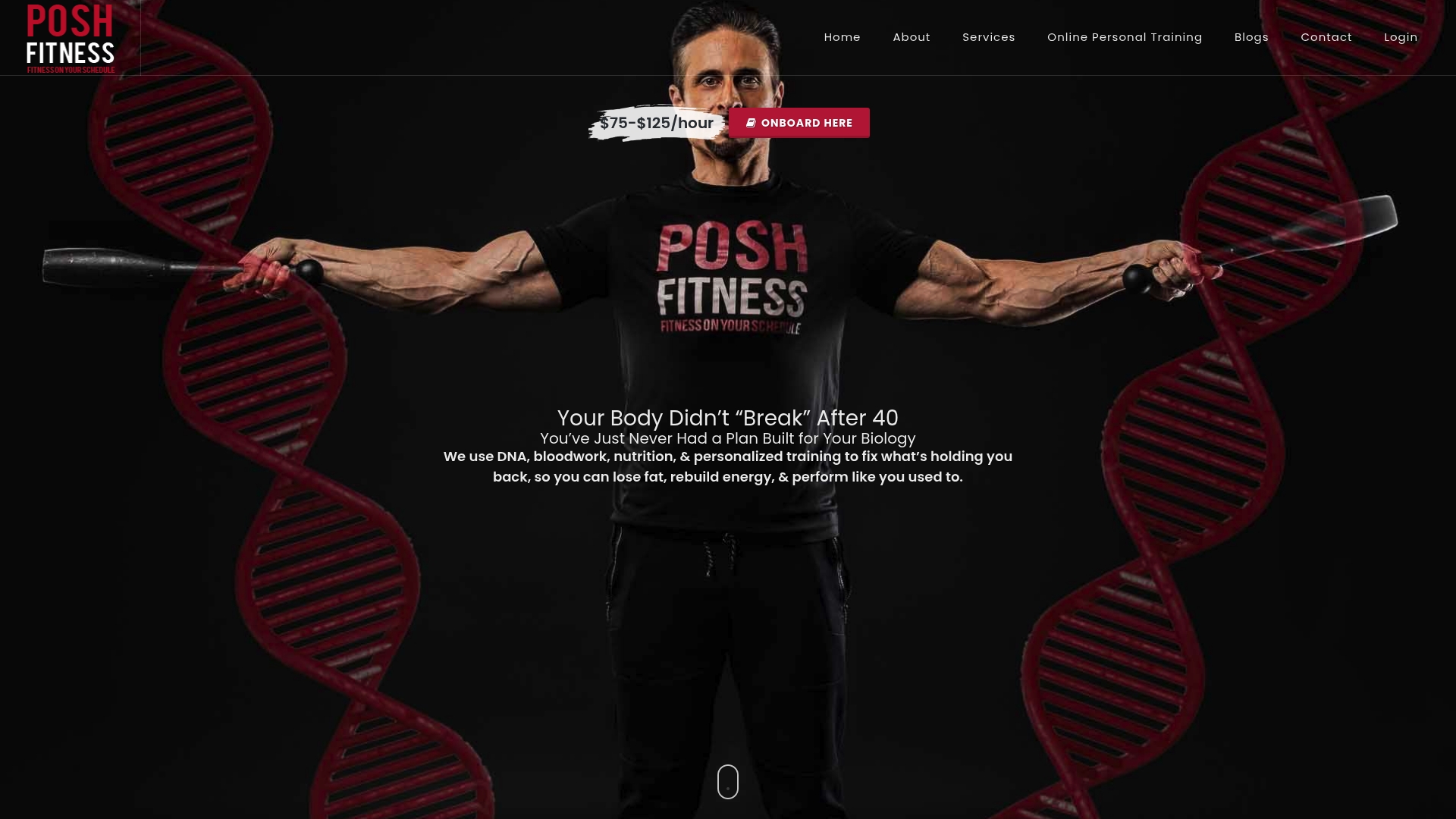
At Posh Fitness, our coaching is designed around DNA analysis, bloodwork, gut microbiome testing and physical assessments. Bloodwork can show the same markers the Life’s Essential 8 names, such as cholesterol and glucose. DNA results can inform how we approach training and nutrition. A baseline also gives you something to compare against after a few months. You can read more about DNA and bloodwork testing for longevity coaching, the SystemAge biological age test, and what the research says about biological age tests. If you are curious about what is realistic, our article on lowering biological age over 3 to 6 months walks through human trials.
Our perspective on healthspan
Most people come to us at the same point: they are tired, their old routine has stopped working, and they feel they should be doing better than they are. They are not lazy, and they are rarely missing information. What they are missing is a plan built for their own body.
We believe healthspan optimization works best when three things come together. First, a baseline: DNA analysis, bloodwork, gut microbiome testing and a physical assessment tell us where to start instead of guessing. Second, a coach who turns that baseline into a weekly routine of strength, aerobic work, mobility and nutrition that fits your schedule, at home, at an affiliated gym or virtually. Third, accountability over months, because biology changes slowly and consistency is what pays off.
Our trainers are scientifically credentialed, and we work alongside your physician, not in place of one. Our goal is to help you regain the energy and performance you remember having earlier in life, and to protect them for decades. That is what a biology reset protocol is designed to do: remove the guesswork, so the effort you put in goes where your body needs it.
Peter
Work with a coach who starts with your biology
If you live in Fairfield County, CT or Westchester County, NY, we come to you. Our in-home personal training in Fairfield County and in-home training in Westchester pair a trainer with your data. Prefer to work remotely? We also train virtually.
Here are the options, with the prices we publish:
- Online Personal Fitness Plan Starter: $40 per month.
- Truly Personal Plan: $99 per month, or the Truly Personal Fitness Plan at $1,000 per year.
- Live Virtual Training Session: $80 one-off.
- Ultra Membership 5 a Week: $2,000 per month, on our pricing page, along with Longevity Coaching and the SystemAge + Coaching Session.
Our 4 Week DNA Coaching is a focused way to begin, and our 16 Week Premium Coaching Plan goes deeper. For nutrition and lifestyle support, see health coaching.
A 12-week starting plan
You do not need to overhaul your life on Monday. Stage it.
- Weeks 1 to 2: baseline. Get your annual physical and bloodwork if you are due. Record your average daily steps, typical sleep hours and how many days you currently lift something heavy. Pick two screenings you have been postponing and book them.
- Weeks 3 to 4: build the floor. Aim for 7,000 steps a day, two strength sessions of 30 minutes, and a fixed bedtime that allows 7 to 9 hours.
- Weeks 5 to 8: add structure. Move to three strength sessions. Add one 30-minute moderate cardio session. Add five minutes of balance work after every workout. Plan dinners for the week on Sunday.
- Weeks 9 to 12: raise the load. Add weight or repetitions gradually, push steps toward 8,000, and reach 150 minutes of aerobic activity a week. Book one social activity weekly.
- Week 12: review. Repeat your baseline measures. Compare energy, strength, sleep and any lab values with your physician.
If a step feels like too much, repeat the previous phase for another two weeks. Progress that sticks is progress you can keep doing.
FAQ
What is the difference between healthspan and lifespan?
Lifespan is the total number of years you live, from birth to death. Healthspan is the portion of those years you spend reasonably free of disabling disease, pain and serious limitation, according to Harvard Health. Optimizing healthspan means improving the quality of your years, not only their number.
How can I improve my healthspan?
Start with the basics that research supports: regular exercise with strength and balance work, a whole-food eating pattern, seven to nine hours of sleep, stress management, social connection and preventive screenings. Then personalize. Bloodwork, DNA analysis and a coach can help you decide which habit to fix first.
How much exercise supports healthspan?
The Physical Activity Guidelines for Americans recommend 150 to 300 minutes a week of moderate aerobic activity, plus muscle strengthening on two or more days. Add balance training if you are an older adult. Build up gradually, and check with your doctor first if you have a health condition.
Does healthspan coaching replace my doctor?
No. We work alongside your physician. Your doctor handles diagnosis, medication and screenings, while coaching turns guidance into a weekly routine of training and nutrition. Share your results and plan with your doctor so both sides work from the same information.
Sources
- Lifespan vs. healthspan, Harvard Health
- Mayo Clinic Q&A: Lifespan vs. healthspan
- What is healthspan? UCLA Health
- Lifespan vs. health span, UCLA Health
- What is healthspan, and how can you maximize yours? American Heart Association
- Physical Activity Guidelines for Americans
- CDC: Older adult activity
- National Institute on Aging: What do we know about healthy aging?
- Alzheimer’s & Dementia: Primary prevention recommendations
- NIH MedlinePlus Magazine: Live long, be well
- Journal of Aging and Health: Meeting sleep guidelines
- Association of sleep duration with all-cause mortality, PubMed
- National Sleep Foundation: Sleep health and aging
- Balance training for seniors