


For most routine and wellness blood work, Quest Diagnostics and Labcorp are close to interchangeable. They are separate companies with national networks, similar cash prices on common tests, and, in many cases, in-network status with the same insurers. The better choice is usually the one that your insurance covers, that has a convenient collection site, and that your clinician or coach can read results from. What matters more for fatigue, stalled fat loss or longevity is what happens after the draw: someone who connects the numbers to your training, nutrition and recovery. That is the work we do with clients in Fairfield County and Westchester, and this guide gives you what you need to pick a lab with confidence.
Key Takeaways
- Quest and Labcorp are independent competitors, not one company, and both run national networks of collection sites and CLIA-certified labs.
- On common tests such as a CBC, HbA1c or lipid panel, a February 2024 consumer cost comparison found identical cash prices at both. Insurance usually decides your real cost.
- Both insurers and employers often treat the two labs as equals. UnitedHealthcare, for example, named both to its 2022 Preferred Laboratory Network, but your plan’s own directory is the final word.
- Pick on coverage, location and convenience, then focus on interpretation: a lab report is a starting point, not a plan.
Table of Contents
- Are Quest and Labcorp the same company?
- Quest vs Labcorp at a glance
- Cost: what blood work really costs at each lab
- Insurance: does UnitedHealthcare prefer Quest or Labcorp?
- Locations and ordering: which is easier to use
- How long do results take?
- So which should you choose?
- What matters more than the lab: reading the numbers
- How Posh Fitness uses diagnostics in your plan
- Our perspective
- Frequently asked questions
- Sources
Are Quest and Labcorp the same company?
No. They are separate, independent lab companies that compete for the same patients, doctors and insurers. Each runs its own testing facilities, its own patient portal and its own consumer ordering channel.
Their public descriptions differ slightly in emphasis. Quest says it provides gene-based and molecular testing, healthcare IT and data analytics, lab services, and wellness and population-health services. Labcorp describes itself as a global life-sciences company covering laboratory diagnostics and drug development. For a person who just wants a cholesterol panel or a thyroid check, those corporate differences rarely matter.
What does matter for a consumer is that tests at both are run in certified labs. Quest states that its health tests are performed in CLIA-certified laboratories and are the same lab tests doctors use. CLIA, the Clinical Laboratory Improvement Amendments, is the federal framework that sets quality standards for U.S. clinical labs.
Quest vs Labcorp at a glance
| What you are comparing | Quest | Labcorp |
|---|---|---|
| Self-ordered tests without a doctor | Quest Health offers 150+ tests you can buy online, with no doctor visit or insurance needed | Labcorp OnDemand lets you buy select wellness, hormone and STI tests without a doctor’s order |
| Collection options | In-person, in-home where available, home collection kits and at-home tests | At-home kits and in-person collection at nearly 2,000 locations for OnDemand |
| Network size | More than 2,000 Quest locations listed on its how-to page | More than 2,200 locations and many at-home services |
| Insurance billing | Quest Health purchases do not require insurance | Traditional Labcorp testing bills insurance; OnDemand is paid upfront and not billed to insurance |
| Results | Online access with an email notification when ready | Results in the Labcorp Patient Portal and delivered to the ordering doctor |
The pattern is clear: the two offer nearly the same menu of ways to get tested. Choosing between them is a logistics decision, not a quality decision.
Cost: what blood work really costs at each lab
There are two different prices to think about: the cash price when you order for yourself, and your out-of-pocket cost when a doctor orders the test and insurance is billed.
Cash prices on common tests
A consumer cost comparison published by ValuePenguin in February 2024 reported matching cash prices at the two labs on several staples:
| Test | Labcorp | Quest |
|---|---|---|
| Complete blood count (CBC) | $29 | $29 |
| HbA1c (three-month blood sugar average) | $39 | $39 |
| Comprehensive metabolic panel | $49 | $49 |
| Cholesterol/lipid panel | $59 | $59 |
| Thyroid function | $49 to $89 | $49 to $109 |
These were the published figures for that month. Lab prices change, so treat them as a sense of scale and check the lab’s own page when you order. Labcorp’s OnDemand page, for instance, lists an HbA1c test at $39 with results one day after the sample reaches the lab, and bundled panels cost more, such as a $219 Men’s Health Test and a $219 Women’s Health Test.
When insurance changes the math
If your doctor orders the test and your plan covers it, what you pay depends on your deductible, copay or coinsurance and on whether the lab is in your network. The same ValuePenguin piece notes that costs for insured blood work depend on the plan, your medical situation and the specific test. That is why two friends with the same panel can get very different bills.
A practical rule: if you have a deductible you have not met, an in-network lab billed through insurance and a cash-price order can land close together on a basic panel. Look at your explanation of benefits, or call the number on your insurance card, before you decide. Paying cash through a consumer channel can make sense for a one-off test your plan would not cover, and HSA and FSA funds are accepted for Labcorp OnDemand purchases.
Insurance: does UnitedHealthcare prefer Quest or Labcorp?
This is one of the most common questions, and the honest answer is that it depends on your plan.
UnitedHealthcare selected both Labcorp and Quest Diagnostics for its 2022 Preferred Laboratory Network, after a quality review, and says choosing a network lab may improve access, quality and service at a lower cost. So at the network level, neither is favored over the other.
Plan-level rules still apply. An Oxford UnitedHealthcare member flier lists both labs as Oxford Preferred Lab Network providers, but says that network is available only with certain New York and New Jersey Oxford non-HSA plans. That matters to readers in Westchester and parts of Fairfield County who commute across state lines. Your plan’s online directory is the authority; UnitedHealthcare says its directories are updated daily, and you can also call the member services number on your card.
The same logic holds for other carriers: confirm the specific lab, and the specific test, against your own plan before you go.
Locations and ordering: which is easier to use
Both labs let you find a nearby site online and book a time. Labcorp’s finder shows nearby locations, hours, services and appointment options, and routine adult blood and urine collection is available at all of its patient service centers, though walk-in availability varies. Labcorp recommends appointments. Quest lists more than 2,000 locations and, where it is available, in-home collection for an additional $99.
If you order a consumer test from Labcorp OnDemand and want in-person collection, you bring the emailed requisition number to the site. Quest Health purchases include independent healthcare-provider oversight of orders and results, with an option to discuss results with a provider.
A few things decide convenience more than brand:
- Distance and hours. Early-morning fasting draws are easiest at a site close to home or work.
- Appointment availability. A short wait beats a slightly lower price if you are fasting.
- Where your doctor sends orders. Many practices have a default lab. Ask whether you can choose.
- Home options. If you have a packed schedule, an at-home kit or in-home collection removes the trip entirely.
How long do results take?
The lab companies publish turnaround times by test, and they vary a lot. Labcorp OnDemand lists a one-day result for HbA1c after the sample arrives at the lab, and one to two days for its Expanded Women’s Health Test. Quest says you can see results online as soon as they are available and receive an email notification.
Specialty testing takes longer. Quest’s provider brochure describes a specialty test turnaround of two to three weeks after lab receipt when the order and clinical history are complete and no prior authorization is needed, and notes that incomplete orders and prior authorization can add delay. The brochure dates from 2018, so use it as an indication of how the process works, not a promise.
What this means for you: routine panels come back in days, advanced panels in weeks, and an incomplete order is the most avoidable cause of delay.
So which should you choose?
Use this short decision path:
- Check your insurance first. If your plan names one lab as in-network, use it. If it names both, move on.
- Pick the closer site with open appointments. For a fasting test, convenience is a real advantage.
- Decide who orders. If a doctor or coach orders the test, follow the order. If you order yourself, compare the specific test’s price on each lab’s page that day.
- Keep your reports. Save every result as a PDF so that you can compare trends over time.
Notice what is not on the list: a belief that one lab is more accurate. Both operate under the same federal quality framework, and the thing that tends to cause confusion is that reports print their own reference ranges. Compare each value against the range on that same report.
What matters more than the lab: reading the numbers
People searching this question are often trying to solve something else: fatigue they cannot explain, fat loss that has stalled, workouts that no longer work the way they did at 35. A blood draw can help, but a page of values with a few flagged in bold does not tell you what to change on Monday morning.
A “normal” result can still leave you short of where you want to feel. A flagged result can be modest and easy to address. Interpreting it takes context: your training load, sleep, protein intake, medications and goals. A few examples of how we look at markers:
- Weight loss and metabolic health. Fasting glucose, HbA1c, lipids and thyroid markers show how your body handles fuel. We explain which ones to track and why in our guide to lab markers for weight loss.
- Omega-3 status. A blood test can show where you stand, and a retest shows whether your changes worked. See our walkthrough of the omega-3 index.
- Biological age. Newer tests estimate how old your biology looks versus your birthday. Here is what biological age test accuracy research shows.
- Genetics. DNA results describe tendencies, not destiny, as we cover in what DNA testing can and cannot tell you.
The most useful bloodwork is the kind you act on, then retest. That loop of measuring, adjusting and measuring again is what turns a lab report into progress.
How Posh Fitness uses diagnostics in your plan
We build personal training, nutrition and health coaching around DNA analysis, bloodwork, gut microbiome testing and physical assessments, with diagnostics arranged through partnered labs. You do not have to decide between two lab brands alone and then wonder what to do with the results.
Here is how that looks across what we offer:
- In-home personal training in Fairfield County, CT and Westchester County, NY, with services also available at affiliated gyms or virtually. Start with our Fairfield County personal trainer page.
- 4 Week DNA Coaching, which uses genetic insight to guide training and nutrition. Details are on our DNA coaching page.
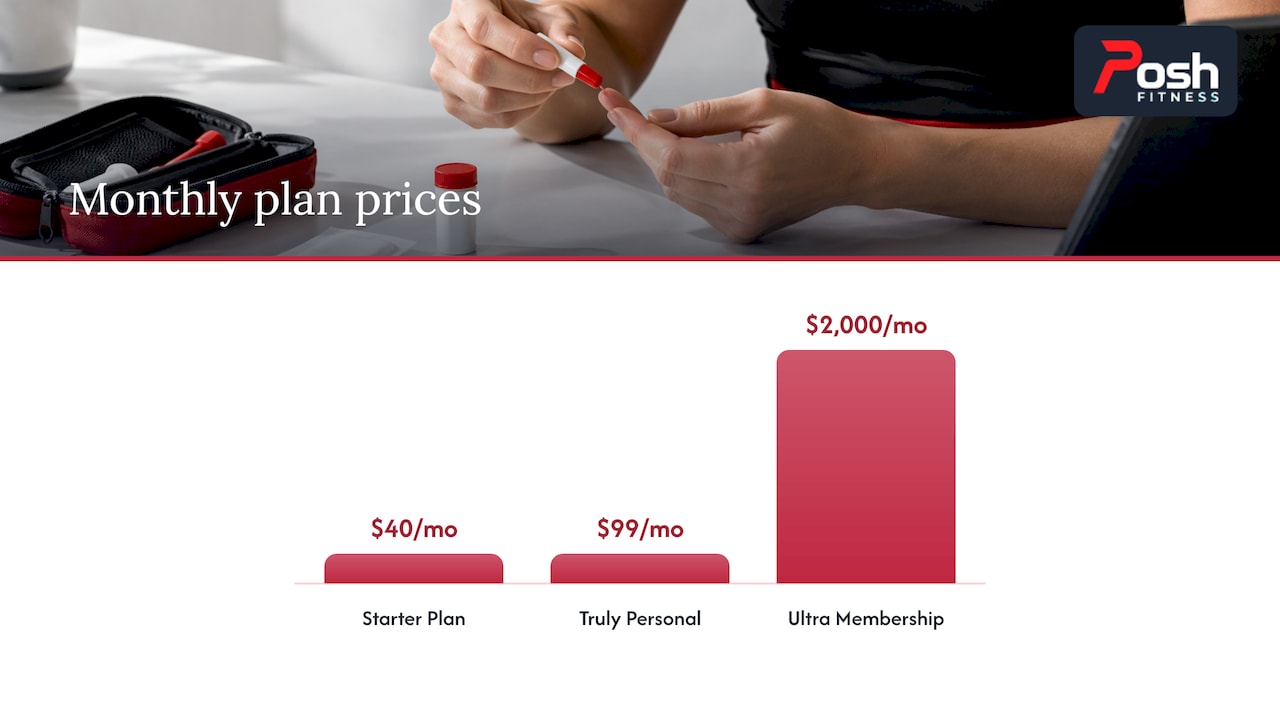
- Longevity Coaching and the SystemAge + Coaching Session, plus the Ultra Membership 5 a Week at $2,000 per month, all listed on our pricing page.
- Online plans from $40 per month (Online Personal Fitness Plan Starter) or $99 per month (Truly Personal Plan), and a Live Virtual Training Session at $80, on our online personal training page.
If you are ready to turn your next lab report into a plan, book through our Fairfield County page and tell us what you have been feeling.
Our perspective
Most people who ask us about Quest and Labcorp are not really asking about labs. They are asking why they feel tired at 3 p.m., why the scale stopped moving, or why the routine that worked for years no longer does.
We think the lab is the easy part. Either one will draw your blood and return numbers. The hard part is deciding what those numbers mean for you, in combination with your genetics, your gut, your schedule and your joints, and then building training and nutrition around that.
That is why we pair bloodwork and DNA analysis with hands-on coaching, at home, at a gym or virtually. We design the program from your biology rather than from a template, and we retest so you can see what changed. Our aim is to help you get back the energy and performance you remember, and to protect your healthspan along the way.
We work alongside your physician. Bring us your results, and we will help you put them to work.
Peter
Frequently asked questions
Is Labcorp different from Quest Diagnostics?
Yes. They are independent companies with separate labs, networks, portals and consumer ordering sites. Both offer a broad menu of routine tests, and both appear in many insurers’ networks, so they overlap heavily for everyday blood work.
How much does a Labcorp test cost out of pocket?
It depends on the test and on whether you pay cash or bill insurance. In February 2024, a consumer cost comparison listed common cash prices of $29 for a CBC and $39 for an HbA1c. Labcorp OnDemand purchases are paid upfront by credit card or HSA/FSA funds and are not billed to insurance.
How long do Labcorp results take?
Simple tests can be quick. Labcorp OnDemand lists a one-day result for its HbA1c test after the sample reaches the lab, and one to two days for some panels. Specialty tests take longer, so ask the ordering provider for the expected timeline.
Does UnitedHealthcare prefer Quest or Labcorp?
At the network level, UnitedHealthcare named both to its 2022 Preferred Laboratory Network. Your own plan can differ, so check its online directory or call the number on your card before your draw.
Can I get blood work without a doctor’s order?
Yes, for selected tests. Quest Health sells more than 150 tests without a doctor visit or insurance, and Labcorp OnDemand sells select wellness, hormone and STI tests without a doctor’s order. If you are managing a medical condition or taking medication, discuss results with your physician.
Sources
- Quest Diagnostics: What we do
- Quest Health: Are Quest’s lab tests the same tests doctors use
- Quest Health: How it works
- Labcorp home page
- Labcorp patients
- Labcorp: Find a lab and schedule an appointment
- Labcorp OnDemand: Health and wellness tests
- Labcorp OnDemand: Shop tests online
- Labcorp OnDemand: HbA1c blood test
- Labcorp OnDemand: Expanded Women’s Health Test
- ValuePenguin: How much does blood work cost
- Quest Diagnostics provider overview brochure
- UnitedHealthcare: Preferred Laboratory Network
- Oxford UnitedHealthcare Preferred Lab Network member flier