


You reset your circadian rhythm by anchoring one fixed wake time, getting bright light soon after waking, dimming light at night, and moving your bedtime in small steps of 15 to 30 minutes. Most people can feel a shift within a week or two. Your body clock responds to timing cues, so consistency matters more than any single trick. The plan below shows how to do it, and how meals, caffeine and workouts fit in. It is written for adults who feel flat, tired and stuck despite doing the “right” things.
Key Takeaways
- Light is the strongest signal for your body clock. Get bright light early in the day and keep evenings dim.
- Start with your wake-up time, not your bedtime. Then shift bedtime 15 to 30 minutes at a time.
- Meal, caffeine and workout timing all act as clock signals, and they affect appetite and fat loss.
- A reset typically takes days to a couple of weeks. Poor sleep for more than a month, or loud snoring with breathing pauses, calls for a doctor.
- A plan built around your own biology, including bloodwork and DNA, can make the routine fit your life instead of fighting it.
Table of Contents
- What your circadian rhythm is and why it drifts
- The 7-day reset, step by step
- Morning sunlight and cortisol
- Circadian rhythm and fat loss
- How long a reset takes
- When to see a doctor instead
- Our perspective
- Make the routine personal
- FAQ
- Sources
What your circadian rhythm is and why it drifts
Your circadian rhythm is the 24-hour cycle of physical, mental and behavioral changes that your body runs on. The National Institute of General Medical Sciences explains that it is driven by a biological clock made of proteins, and that light and dark have the biggest influence, with food, stress, physical activity, social environment and temperature also playing a part.
The Cleveland Clinic adds that this clock governs more than sleep. It also shapes hormones, digestion and body temperature. When light enters your eye, it signals your brain to stop producing melatonin, the hormone that promotes sleep.
The clock drifts when your signals become irregular. The NHLBI lists night-shift work, frequent travel, alcohol and chronic caffeine use, and too little natural light during the day among the risk factors. Evening light from devices is another common cause. Short-term, the result is drowsiness and poor focus. Over the long term, the NIGMS notes, disrupted rhythms are linked with higher risks of obesity, diabetes, mood disorders and heart problems.
For many middle-aged adults, the pattern looks familiar: a late bedtime on weekends, an alarm that varies, coffee at 3 p.m., a bright screen in bed, and a morning spent indoors. None of these is dramatic. Together they leave your clock without a clear signal.
The 7-day reset, step by step
This plan follows the logic of the Mayo Clinic’s seven-day plan for resetting sleep and the guidance of the Sleep Foundation. Adjust it to your schedule, but keep the order.
Day 1: Fix your wake-up time
Pick a wake-up time you can keep every day, including weekends, that leaves room for at least seven hours of sleep. Ascension’s primary care guidance, from Dr. Pratumngern, recommends starting with the wake time because one reliable morning cue lets everything else build around it.
Where it goes wrong: people try to force an early bedtime first. If you are not sleepy, you lie awake, and the frustration makes the problem worse. Anchor the morning and let sleepiness arrive on its own.
Day 2: Get light soon after waking
Go outside, or sit by a bright window, within the first hour of the day. The NHLBI calls light the strongest environmental signal for resetting the sleep-wake cycle. Some people use a dedicated light device for dark winter mornings, and a red light morning routine is one way to build light into the start of the day as a cue for energy.
In Connecticut, sunrise comes late in December, so a 10-minute walk after waking may be all the daylight you get before work. Make it a fixed part of the morning.
Day 3: Protect a seven to nine hour sleep window
Work backward from your wake time. If you wake at 6:30 a.m., your target bedtime is no later than 11:30 p.m. for seven hours. You do not have to hit it yet. Move your bedtime earlier by 15 to 30 minutes every few nights, which is the pace the Sleep Foundation recommends.
Day 4: Line up meals and caffeine
Eat at consistent times and avoid heavy meals in the two to three hours before sleep. Keep caffeine to the first half of your waking day, as the Mayo Clinic plan suggests. Johns Hopkins Medicine advises cutting caffeine off an hour earlier than normal when you are shifting your schedule.
Caffeine tolerance differs from person to person. If you wonder why your friend sleeps fine after an evening espresso and you do not, our article on caffeine sensitivity and genetics explains what DNA can and cannot tell you.
Day 5: Dim the evening
Lower the lights an hour or two before bed and put screens away. Create a cool, dark, quiet wind-down routine. The NHLBI also advises a relaxing bedtime routine and limiting caffeine, alcohol and nicotine near bedtime. Alcohol may feel like a sleep aid, but it is on the NHLBI’s list of risk factors for a drifting clock.
Day 6: Move earlier in the day
Physical activity helps anchor your rhythm, but timing matters. The Mayo Clinic plan suggests exercising earlier in your waking period and avoiding vigorous activity within a few hours of bed. If you are unsure which time suits you, see our guide to morning versus evening workouts.
Day 7: Hold the line, then keep shifting
Repeat the same wake time and the same morning light. Keep a short sleep diary: bedtime, wake time, how rested you feel. If you are still short of your target, keep shifting bedtime in small steps. Avoid long afternoon naps while you do.
Morning sunlight and cortisol
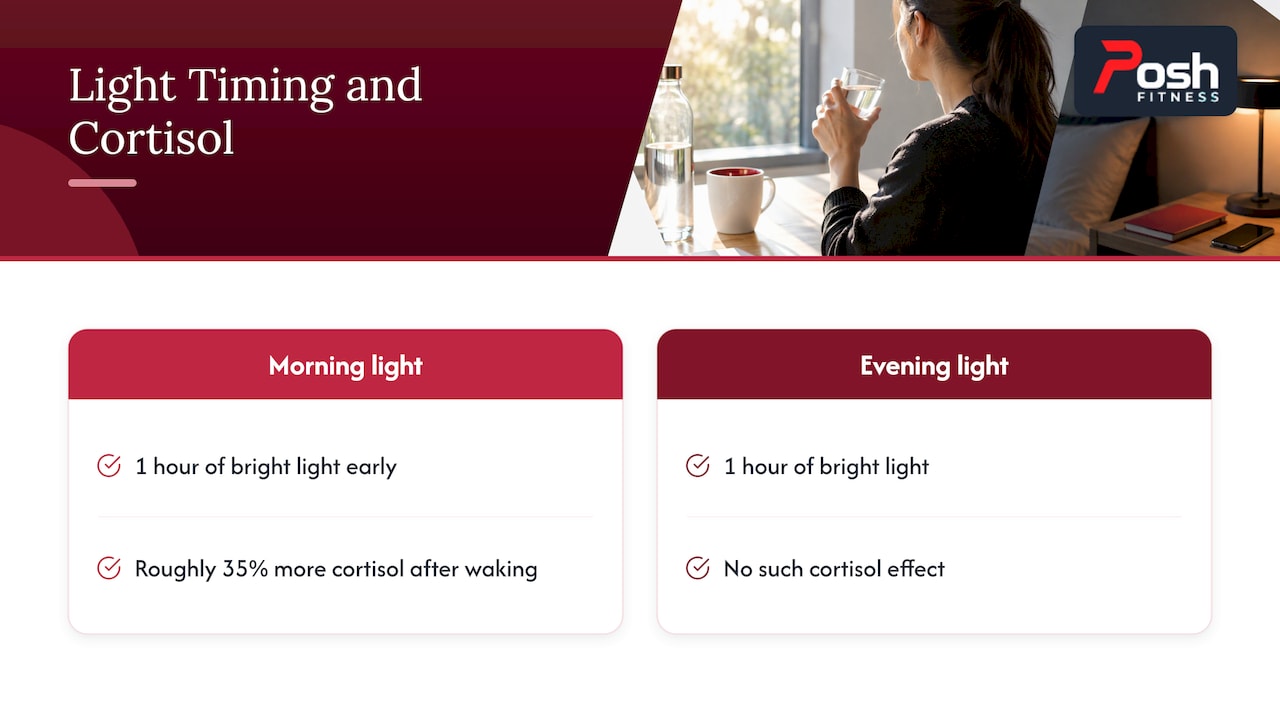
Cortisol is a stress hormone, but it also has a healthy daily rhythm: it rises in the first hour after waking to help you feel alert, then falls through the day. Morning light seems to support this rise.
In a 1999 study of 14 healthy men, one hour of bright light in the early morning produced a roughly 35% further increase in salivary cortisol after waking. The same light in the evening had no such effect. A 2012 study found that light after waking enhanced the cortisol awakening response in sleep-restricted adolescents, compared with dim light.
What this means for you: a bright morning is a signal that the day has started. Indoor lighting is much dimmer than daylight. The American Heart Association’s 2025 scientific statement recommends morning bright light to synchronize circadian rhythms and avoiding evening light, since these are the key timing cues for the body.
Circadian rhythm and fat loss
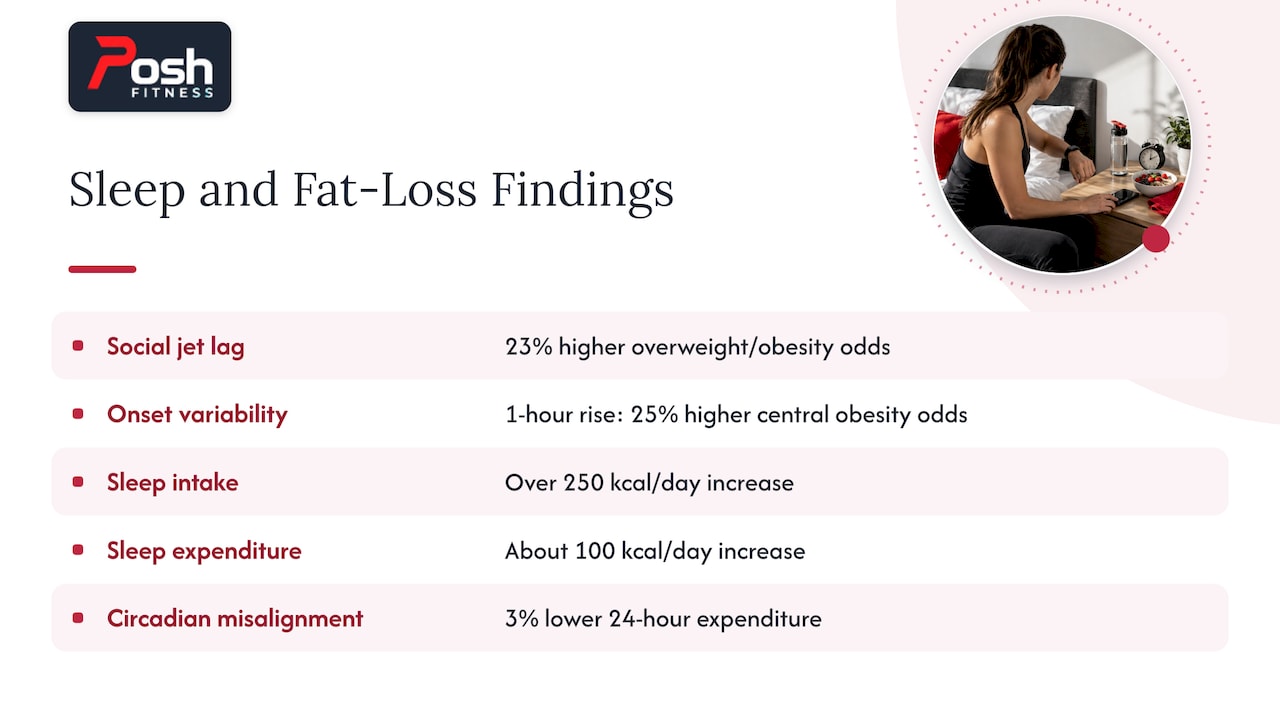
If fat loss has stalled, your clock may be part of the story. The same AHA statement reports that social jet lag, the gap between your weekday and weekend sleep schedule, was associated with 23% higher odds of overweight or obesity in a meta-analysis. A one-hour increase in day-to-day variability in sleep onset was associated with 25% higher odds of central obesity. These are associations, not proof that a late Saturday causes weight gain, but they point to the value of regularity.
A 2022 review in Nature Reviews Endocrinology found that insufficient sleep raises energy intake by more than 250 kcal a day, far more than the roughly 100 kcal a day it adds to energy expenditure. It also found that circadian misalignment lowers 24-hour energy expenditure by about 3%, alters appetite hormones and promotes less healthy food choices.
Meal timing plays a role too. In a small study of 11 overweight adults, eating between 8 a.m. and 2 p.m. did not change calories burned over 24 hours, but it lowered the hunger hormone ghrelin. The authors conclude that timing helps mainly by reducing appetite. A 2024 review in the Journal of Clinical Investigation describes a meta-analysis of 19 time-restricted feeding trials that found reductions in body weight and fat mass.
The practical lesson: a consistent schedule makes hunger easier to manage. Our related reading covers how sleep affects fat loss, how short nights change your body and meal timing around workouts.
How long a reset takes
A useful rule of thumb comes from a sleep physician quoted by the Los Angeles Times: roughly one day per hour of adjustment. A two-hour shift, such as moving from a 1 a.m. to an 11 p.m. bedtime, may take two to four days of consistent wake times, morning light and good sleep habits. Most adults are back on track within a week or two.
What changes the pace:
- Size of the shift. A 30-minute move is easy. A three-hour move takes longer.
- Age and chronotype. The NHLBI notes that age-related changes and a family history of early or late bedtime preference affect your natural timing.
- Consistency on weekends. Two late nights can undo several good ones.
- Evening habits. Alcohol, late caffeine and bright screens all push the clock later.
If you are also dealing with low energy, the cause may not be your clock alone. Our guides on low energy at 40 and a two-week morning routine for energy cover the other checks worth making.
When to see a doctor instead
A habit reset is not a treatment for a sleep disorder. Sleep Education advises talking to a doctor if your sleep has been poor for more than a month, if you feel very tired during the day, if you fall asleep while driving, or if you are told that you snore or stop breathing in your sleep. These can be signs of a sleep disorder that needs treatment. Bring your two-week sleep diary to the appointment.
The NHLBI says treatment for diagnosed circadian rhythm disorders most commonly combines lifestyle changes, bright light therapy and melatonin, which is a decision for you and your physician. Do not start melatonin or a light therapy device for a diagnosed condition without that conversation.
Our perspective
Most people who come to us with a tired body clock have already tried the usual advice: go to bed earlier, skip the late coffee, get outside. It works for some, and it stalls for others, because the starting point is different for each person.
We think the timing of light, meals, caffeine and training should be set around your biology and your real week, not a template. That is why our approach starts with the measurements: DNA analysis, bloodwork, gut microbiome testing and a physical assessment. Those results shape your training, your nutrition and the daily routine around them.
For a reader in Fairfield County or Westchester, the routine also has to fit a commute, a family and a schedule that changes. We train in your home, at affiliated gyms or virtually, so the morning walk, the workout and the meal plan become one rhythm instead of three separate chores.
A steady wake time, morning light, protein-forward meals at consistent times and resistance training at a sensible hour is a plan you can repeat. Repetition is what moves the clock.
Peter
Make the routine personal
If you would rather not build this alone, we can build it around your biology. Our Health Coaching and 4 Week DNA Coaching use DNA analysis and bloodwork to tailor your training and nutrition. Our trainers are scientifically credentialed, and sessions take place in your home, at an affiliated gym or virtually.

For a flexible start, the Online Personal Fitness Plan Starter is $40 per month, and the Truly Personal Plan is $99 per month. A Live Virtual Training Session is $80 one-off. You can see the options on our online personal training page, or get started with an in-home trainer in Fairfield County.
FAQ
What is the fastest way to reset my circadian rhythm?
Fix your wake-up time, get bright light within the first hour, and keep evenings dim. Shift bedtime by 15 to 30 minutes every few days. A one-hour shift typically takes about a day, per the sleep physician quoted by the Los Angeles Times, so small adjustments are quicker than they look.
Does morning sunlight really help with sleep?
Yes. The NHLBI identifies light as the strongest signal for resetting the sleep-wake cycle and recommends more sunlight during the day and less artificial light at night. Morning light also raises cortisol after waking, which supports alertness. Aim for a daily outdoor walk soon after you get up.
Can fixing my body clock help with fat loss?
It can help indirectly. Irregular sleep timing is associated with higher odds of overweight and central obesity in the American Heart Association’s 2025 statement. Regular sleep, consistent meals and earlier eating windows appear to help mainly by easing appetite, so pair them with resistance training and protein-forward nutrition.
What does circadian rhythm coaching involve?
A good coaching process looks at your sleep window, light exposure, meals, caffeine and training times, then builds a routine you can keep. At Posh Fitness, we use DNA analysis, bloodwork and physical assessments to tailor training and nutrition. Persistent sleep problems still belong with your doctor.
Sources
- Circadian Rhythms, National Institute of General Medical Sciences
- Circadian Rhythm Disorders: Causes and Risk Factors, NHLBI
- Circadian Rhythm Disorders: Treatment, NHLBI
- Circadian Rhythm: What It Is, How It Works, Cleveland Clinic
- A Seven Day Plan for Resetting Sleep, Mayo Clinic
- How to Fix Your Sleep Schedule, Sleep Foundation
- How to Sleep Well Despite Changes in Your Schedule, Johns Hopkins Medicine
- How to reset your sleep schedule, Ascension
- Light affects morning salivary cortisol in humans, PubMed
- Short-Wavelength Light Enhances Cortisol Awakening Response, PMC
- Role of Circadian Health in Cardiometabolic Health and Disease Risk, American Heart Association
- The role of insufficient sleep and circadian misalignment, Nature Reviews Endocrinology
- Early Time-Restricted Feeding Reduces Appetite and Increases Fat Oxidation, PMC
- Circadian disruption, clock genes, and metabolic health, Journal of Clinical Investigation
- How to Reset Your Sleep Schedule, Los Angeles Times
- How to use a sleep diary to improve your sleep, Sleep Education
- Red Light Morning Routine