

Choose a trainer in three moves. Define the result you want, confirm the trainer’s credentials and experience with people like you, then book a few sessions before you commit to anything long. For adults in their 40s, 50s and beyond, one more test matters: does the trainer build your program around your own biology, or hand you the same template everyone gets? That question separates a trainer who keeps you busy from one who gets you results, and it is why we start every client with data about their body rather than a generic plan.
Below, you will find what to check, what to ask, how in-home, gym and virtual training compare, and what to expect to pay.
Key Takeaways
- The title “personal trainer” is not regulated by a national standard, so verify the credential, not the job title.
- Match the trainer’s experience to your situation: your age, energy, health history, injuries and goals.
- Start with a few sessions, not a long contract, and judge the trainer by how well they listen and adapt.
- In-home and virtual training remove the biggest barrier for busy adults: getting to the gym and keeping it up.
- Personalized data (DNA, bloodwork, gut microbiome) can turn guesswork into a plan built for your body.
Table of Contents
- Start With What You Actually Want
- Check the Credentials, Not the Title
- Questions to Ask in a First Consultation
- Know What a Trainer Can and Cannot Do
- In-Home, Gym, Virtual or Group: Which Format Fits You?
- Choosing in Stamford, Greenwich, Westport or Westchester
- What Personal Training Costs
- Why Personalization Beats a Standard Routine
- A Trainer Selection Checklist
- Start With a Plan Built for Your Body
- FAQ
- Sources
Start With What You Actually Want
Before you compare trainers, write down what you want from the next six months. The National Center on Health, Physical Activity and Disability recommends setting SMART goals (specific, measurable, achievable, relevant and time-bound) and then finding a trainer whose specialty fits them.
Compare these two goals:
- Vague: “Get in shape.”
- SMART: “Lose 12 pounds of body fat and add strength so I can carry groceries and play with my kids without fatigue by the end of the 16 weeks.”
The second tells a trainer what to measure and tells you whether the trainer is delivering. If your real problem is that you feel tired most of the day, have lost motivation, or have stopped seeing results from workouts that used to work, say so. A good trainer treats that as information, not as an excuse.
If your goal is more specific, such as fall prevention or balance, look for someone who works on that. A resource like balance training for seniors shows how specific a program can get when the goal is clear.
Check the Credentials, Not the Title
The American College of Sports Medicine (ACSM) notes that there is no national standard or minimum requirement for using the title “personal trainer,” and that working with an under-qualified trainer can compromise your safety. Anyone can print business cards. So verify these things:
- A certification from a nationally recognized organization. MedlinePlus advises looking for NCCA-accredited certification (accredited by the National Commission for Certifying Agencies, an independent body that reviews certification programs) and, ideally, a college degree in exercise science, physical education or a related field. NCHPAD names NASM, ACE and ACSM as examples of reputable certifiers.
- How rigorous the certification is. CNN reports that reputable agencies such as NASM, ACSM and ACE require weeks of education and a passed test, while lesser organizations may require only a few hours of reading and an online quiz.
- First aid and CPR, liability insurance and continuing education. ACSM lists all three as things to confirm, along with whether the certification requires continuing-education credits to stay current.
- Experience with people like you. Ask how long they have trained clients and what kinds of clients. The same CNN article quotes a certified trainer advising older adults, or anyone with diabetes, joint or heart issues, to ask whether the trainer has worked with clients like them.
Credentials are the floor, not the ceiling. They tell you a trainer knows exercise safely. They do not tell you whether the trainer can work out why your progress stalled.
Questions to Ask in a First Consultation
A consultation is a two-way interview. Cleveland Clinic suggests asking how long the trainer has worked, what certifications or degrees they hold, whether they have experience with your health conditions, what they specialize in, and whether you can speak with current or former clients. Add these:
- How will you assess me before the first workout? A thorough trainer looks at movement, strength, history and goals before prescribing anything. A trainer who hands you a routine in minute one is working from a template.
- How will we know it is working? Look for measurable markers: strength, body composition, energy, sleep, lab numbers, not only the scale.
- What happens when I have a bad week, travel, or get injured? Flexible plans matter for working adults. Ask whether sessions can move between your home, a gym and video.
- How do you handle nutrition? Training and food are tied together. We cover the boundary below.
- What is the cancellation policy and the full cost? Get it in writing.
Signs You Have Found a Good Fit
- They ask about your history, injuries and daily life before they talk about exercises.
- They explain why each part of the program is there.
- Your program changes as you do.
- You feel comfortable discussing goals and concerns with them.
Red Flags
- A vague or unverifiable credential, or one that is only a short online course with no recognized accreditation.
- Pressure to sign a long contract immediately. Cleveland Clinic advises against buying several-month or year-long contracts right out of the gate, and ACSM also advises avoiding long-term contracts.
- Diagnosing conditions, advising you to change prescription medication, or selling supplements to treat a named condition.
- The same workout for every client.
Know What a Trainer Can and Cannot Do
A good trainer works alongside your doctor, not in place of one. MedlinePlus says a trainer can give healthy-lifestyle tips but should not tell you how to treat a medical condition, and that only providers and dietitians are qualified to give specific nutritional advice.
What that means for you:
- If you have heart disease, diabetes, high blood pressure, joint problems or any condition that affects exercise, talk to your physician before you start, and share what you learn with your trainer.
- Stop and call your doctor if you have chest pain, dizziness or fainting, or unexplained shortness of breath. Safety guidance for fitness professionals lists these as reasons to refer a client to a medical provider.
- Tell your trainer about everything: medications, injuries, surgeries and fitness history.
If you want nutrition guidance as well, our guide on choosing between a nutrition coach and a dietitian explains where each fits.
In-Home, Gym, Virtual or Group: Which Format Fits You?
The right format is the one you will actually keep doing. NCHPAD describes the tradeoffs: at-home workouts are more private and need no transportation, while a gym has more equipment and more social interaction. Harvard Health adds that many trainers will come to your house and design a plan even if you own no machines.
| Format | Best for | What to weigh |
|---|---|---|
| In-home | Busy schedules, privacy, no commute, joint-friendly starts | Space at home and the equipment the trainer brings or you own |
| Gym-based | People who like equipment variety and a social setting | Travel time and the gym’s own fees |
| Virtual | Travel, tight schedules, steady accountability at a lower cost | A quiet space and a decent camera |
| Small group | Splitting cost with friends at a similar fitness level | Less individual attention |
If you live in Fairfield County or Westchester, the commute is a real factor. Between traffic on I-95 and the Merritt Parkway and a packed calendar, a session that arrives at your door is a session you are far less likely to skip. A trainer who can mix formats is more useful than one locked into a single location. Our in-home training in Fairfield County and Westchester pages explain how that works, and if you are setting up space yourself, our home gym guide covers what to buy and what to skip.
Choosing in Stamford, Greenwich, Westport or Westchester
The local checklist is the same one above, with a few practical additions:
- Ask where they train. In wealthier towns many trainers work only inside one gym or studio. If you want sessions at home, confirm the trainer travels to your town (Greenwich, Stamford, Darien, Westport, Norwalk or across the line in Westchester) and what, if anything, is added for travel.
- Ask about scheduling. Early-morning and late-afternoon slots fill fast. Ask how rescheduling works.
- Ask about your age group. If you are in midlife and your energy, sleep or recovery have changed, you want someone who has coached that exact pattern.
- If you want a health coach, check the coaching credential. The title “coach” alone says nothing about qualifications. Look for a recognized credential such as board certification in health and wellness coaching (NBC-HWC), which signals standards for knowledge, skill and ethical conduct but does not make a coach a physician or dietitian. Good coaches support behavior change, accountability and wellness goals, and they send medical questions to your doctor.
What Personal Training Costs
Prices vary by city, trainer experience and format. Harvard Health reports personal training typically runs $75 to $125 per hour depending on where you live and gym affiliations. ACSM puts the range at $20 to $100 an hour, shaped by qualifications, experience, location, session length and specialization. Boutique studios usually cost more than local gyms, according to Cleveland Clinic. Prepaid packages often lower the per-session rate, but check the refund and expiration terms before you pay for many sessions at once.
When you compare quotes, compare what is included. An hourly rate for a trainer who only counts repetitions is not the same product as a program with assessments, nutrition support and regular check-ins.
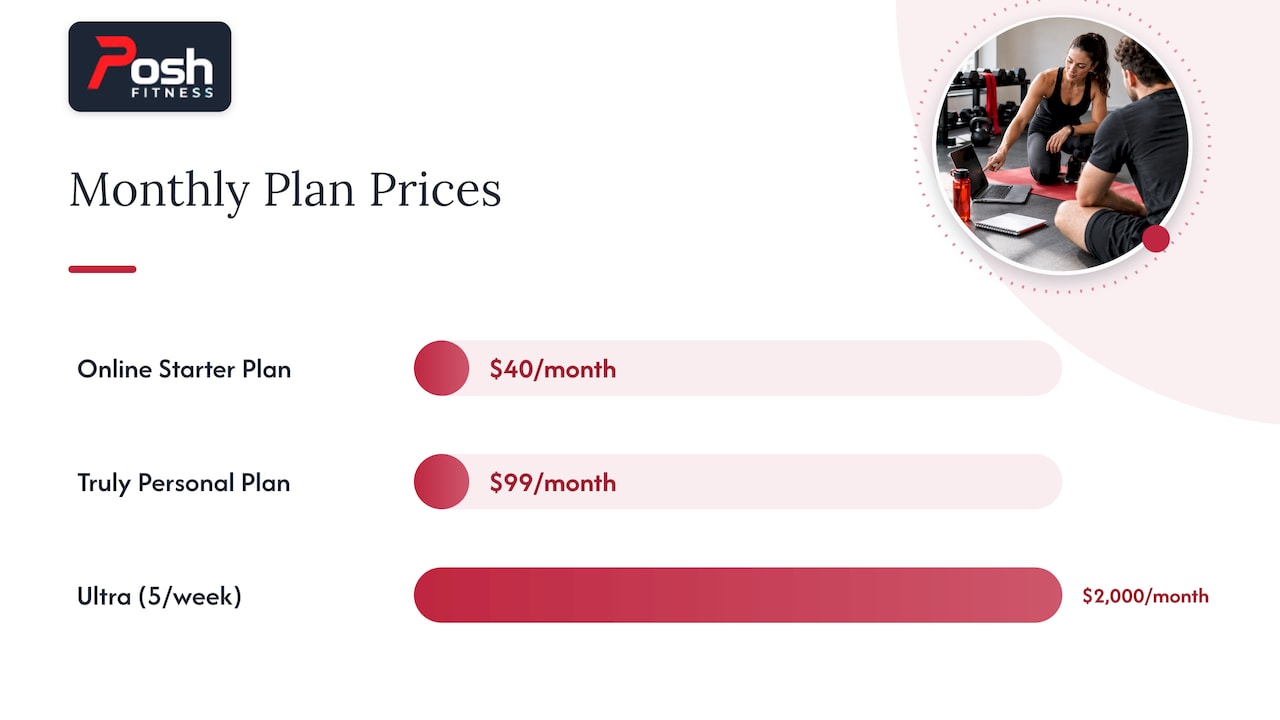
Here is what we publish at Posh Fitness:
| Option | Price |
|---|---|
| Online Personal Fitness Plan Starter | $40 per month |
| Truly Personal Plan | $99 per month |
| Truly Personal Fitness Plan | $1,000 per year |
| Live Virtual Training Session | $80 one-off |
| Ultra Membership, 5 a week | $2,000 per month |
Other services, including in-home personal training, health coaching, longevity coaching and DNA coaching, are priced on our pricing page or quoted individually.
Why Personalization Beats a Standard Routine
If you have already tried standard programs and they stopped working, the problem is rarely effort. Two people can follow the same plan and respond very differently, because sleep, hormones, genetics, stress, gut health and nutrient status all shape how you recover and where your body stores fat. A program that ignores those factors treats you as an average person, and you are not one.
This is the question to put to any trainer you interview: what do you know about my body, beyond my weight and my goal? At minimum, a good trainer should use a movement and strength assessment and a thorough health history. Some programs go further, using DNA analysis, bloodwork and gut microbiome testing to shape training and nutrition. Lab results should be reviewed with your physician, and your trainer should coordinate with that care rather than replace it.
A Trainer Selection Checklist
Use this list as you speak with each candidate:
- I wrote a SMART goal and shared it.
- The trainer holds a nationally recognized, ideally NCCA-accredited, certification, plus CPR and first aid.
- The trainer carries liability insurance.
- The trainer has experience with my age group, my health conditions or my goal.
- The first session includes an assessment, not just a workout.
- I can start with a few sessions and leave without a penalty.
- The format (home, gym, virtual) fits my real schedule.
- The trainer talks about working with my physician, not around them.
- I know the full cost, in writing.
Our Perspective
When people come to us, they have usually done the “right” things. They exercised, they cut calories, they hired a trainer once, and the results stalled or the energy never came back. The usual response is to push harder. We think the better response is to find out why.
That is why we build programs from data about your biology: DNA analysis, bloodwork, gut microbiome testing and physical assessments, delivered at your home, at an affiliated gym or virtually. Our trainers are scientifically credentialed, and our goal is to help you reset your biology and extend your healthspan, so you can regain the energy and performance you had earlier in life.
A trainer who knows your numbers can stop guessing. That is the standard we would hold any trainer to, and the one we hold ourselves to.
Peter
Start With a Plan Built for Your Body
If you live in Fairfield County or Westchester and want a trainer who comes to you, we offer in-home personal training, health coaching, DNA coaching and longevity coaching, along with virtual plans if your week is unpredictable. Our 4 Week DNA Coaching and 16 Week Premium Coaching Plan are designed to give you a clear starting point and a structured path.
To get started, book an in-home consultation in Fairfield County, or see our personal training options and pricing. If you prefer to begin online, our virtual personal training programs start at $40 per month.
FAQ
How do I know if a personal trainer is right for me?
The right trainer listens, assesses you before programming, explains the reasons behind your plan and adjusts it as you progress. Harvard Health suggests signing up for a few sessions first to gauge fit. If you leave sessions feeling heard and challenged, that is a good sign.
What certifications should a personal trainer have?
Look for a certification from an NCCA-accredited organization, such as NASM, ACE or ACSM, and ideally a degree in exercise science or a related field. Also confirm current CPR and first aid certification and liability insurance. See the ACSM checklist for the full list.
How much should I spend on a personal trainer?
Published ranges run from $20 to $100 an hour (ACSM) up to $75 to $125 an hour (Harvard Health), with the high end more typical of metro areas and boutique studios. Compare what is included, not just the hourly rate, and avoid committing to a long contract before you have tried the trainer.
Can a personal trainer give me a meal plan?
A trainer can offer general healthy-lifestyle guidance. Individualized meal planning and medical nutrition advice generally require nutrition credentials, and treatment of medical conditions belongs to your physician or a dietitian. Our personalized meal plan cost guide explains what a plan involves.
Is in-home training worth it?
For many busy adults, yes, because it removes the commute and keeps sessions private. Harvard Health notes trainers can create a plan even if you own no equipment. See our FAQ page for how in-home sessions work with us.
Sources
- How to Find a Personal Trainer, National Center on Health, Physical Activity and Disability
- Working with a personal trainer, MedlinePlus
- Investing in a Personal Trainer, American College of Sports Medicine
- How to select a personal trainer, CNN
- How To Find a Personal Trainer, Cleveland Clinic
- How a personal trainer can enhance your workouts, Harvard Health
- Understanding the NBHWC Scope of Practice, ANHCO
- When To Refer A Fitness Client To A Medical Professional
- Balance Training for Seniors: Safe Exercises to Prevent Falls