
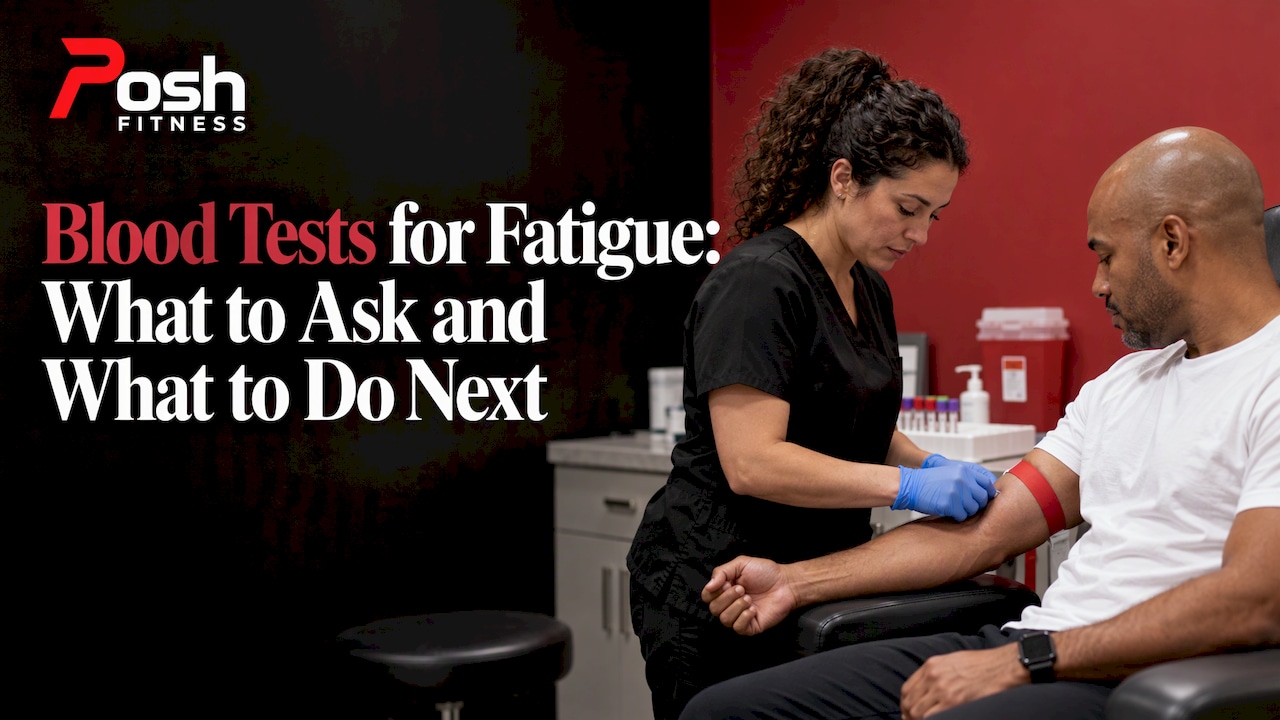

If you are tired in a way sleep does not fix, start with your primary care clinician, who can order a targeted set of blood tests: a complete blood count, a metabolic panel, thyroid, iron markers, B12 and blood sugar are the usual first stops. The results either find a medical cause or narrow the field. Once the medical basics are covered, your bloodwork can also guide how you train, eat and recover, and that is where we pick up with clients in Fairfield County.
Key Takeaways
- Fatigue is a symptom, not a diagnosis. A clinician chooses blood tests based on your history, exam and likely causes, not from a fixed menu.
- The usual first-line tests look for anemia, thyroid problems, diabetes, kidney and liver issues, inflammation and low iron, B12 or folate.
- A normal result does not mean nothing is wrong. Sleep, stress, training load, nutrition and low iron stores can all leave you drained.
- Once serious causes are addressed, bloodwork can help shape training, nutrition and recovery for you specifically.
- Fatigue with chest pain, shortness of breath, a racing heartbeat or fainting needs emergency care, not a lab order.
Table of Contents
- Which Blood Tests Are Used for Fatigue
- Why the Order Matters: Rule Out the Medical Causes First
- Why You Can Feel Awful With Normal Bloodwork
- Non-Lab Factors Worth Looking At Alongside Your Results
- How to Prepare for the Appointment
- From Results to a Training and Nutrition Plan
- Longevity Blood Tests: What They Can and Cannot Tell You
- When to Retest
- Personal Training and Coaching Built Around Your Bloodwork
- FAQ
- Sources
Which Blood Tests Are Used for Fatigue
There is no single “fatigue test.” A 2023 review from the American Academy of Family Physicians says the initial workup should follow your history, physical exam and the most common causes. Its evaluation options include a complete blood count, ferritin, folate, an iron panel and vitamin B12, plus a metabolic panel, thyroid-stimulating hormone (TSH), A1C and inflammatory markers when the picture points that way.
The CDC’s evaluation guidance for ME/CFS lists a similar set of routine tests used to rule out other illnesses. Vanderbilt’s internal medicine handbook suggests that for fatigue lasting more than a month, the first round should include a comprehensive metabolic panel, a CBC with differential, iron studies and TSH, alongside mood and sleep screening questionnaires.
Here is what the common tests are looking for, in plain terms.
| Test | What it checks | Fatigue-related problem it can flag |
|---|---|---|
| Complete blood count (CBC) | Red cells, white cells, platelets | Anemia, signs of infection or inflammation |
| Ferritin and iron panel | Stored and circulating iron | Low iron, with or without anemia |
| Vitamin B12 and folate | Nutrients needed for red blood cells and nerves | Deficiency |
| Comprehensive metabolic panel | Electrolytes, kidney and liver function, glucose | Kidney or liver trouble, blood sugar problems |
| TSH (sometimes free T4) | Thyroid signaling | Underactive or overactive thyroid |
| A1C or fasting glucose | Blood sugar over time or at one moment | Prediabetes, diabetes |
| ESR or CRP | General inflammation | Inflammatory or autoimmune conditions |
Not everyone needs every row. A premenopausal woman may be checked for iron more closely, while someone with a family history of diabetes may have blood sugar looked at first. That is the reason the ordering decision belongs with a clinician who has examined you.
Why the Order Matters: Rule Out the Medical Causes First
MedlinePlus describes fatigue as a symptom with many possible sources, including diabetes, heart, liver, kidney and thyroid disease, anemia, infections, sleep apnea, depression and anxiety. Mayo Clinic adds that most fatigue traces back to lifestyle factors such as poor sleep habits or too little exercise, but that medical causes, including low vitamin D and hypothyroidism, are common enough to check.
A reasonable rule: if rest, less stress, regular meals and hydration have not helped after about two weeks, Mayo Clinic advises scheduling a doctor’s visit. Do not wait that long if any of the following apply.
- Chest, arm or upper-back pain, shortness of breath, a fast or irregular heartbeat, or feeling like you might pass out. Mayo Clinic says to call 911.
- Fatigue that comes on suddenly, or comes with unexplained weight loss. Cleveland Clinic lists both as reasons to contact a provider, along with fatigue that has no clear reason or disrupts daily activities.
- Thoughts of harming yourself. In the US, call or text 988.
This is also why we do not order a lab panel and start coaching on day one with someone whose symptoms are unexplained. Your doctor comes first for the medical workup. Our work begins from there.
Why You Can Feel Awful With Normal Bloodwork
This is the most common frustration we hear from middle-aged adults: the labs came back “fine,” and the exhaustion did not leave.
There are several reasons that can be true at once.
Low iron stores without anemia. A hospital physician writing for Temple Health explains that basic tests can miss iron deficiency before it shows up as anemia. Low iron stores can still cause fatigue, dizziness, weakness and headaches while the CBC looks normal. If ferritin was not part of your panel, it is a fair question for your clinician.
Lab results that sit inside the reference range. The CDC notes that most people with ME/CFS have routine lab results within normal ranges even though they are substantially limited by symptoms. There is also no confirmatory blood test for ME/CFS. Diagnosis rests on history, exam and a targeted workup, with symptoms lasting six months or longer.
Causes blood cannot show. Sleep disorders, mood, stress, medications and training habits do not appear on a lab slip. Vanderbilt’s guidance pairs labs with validated screens for depression, anxiety and sleep apnea for this reason.
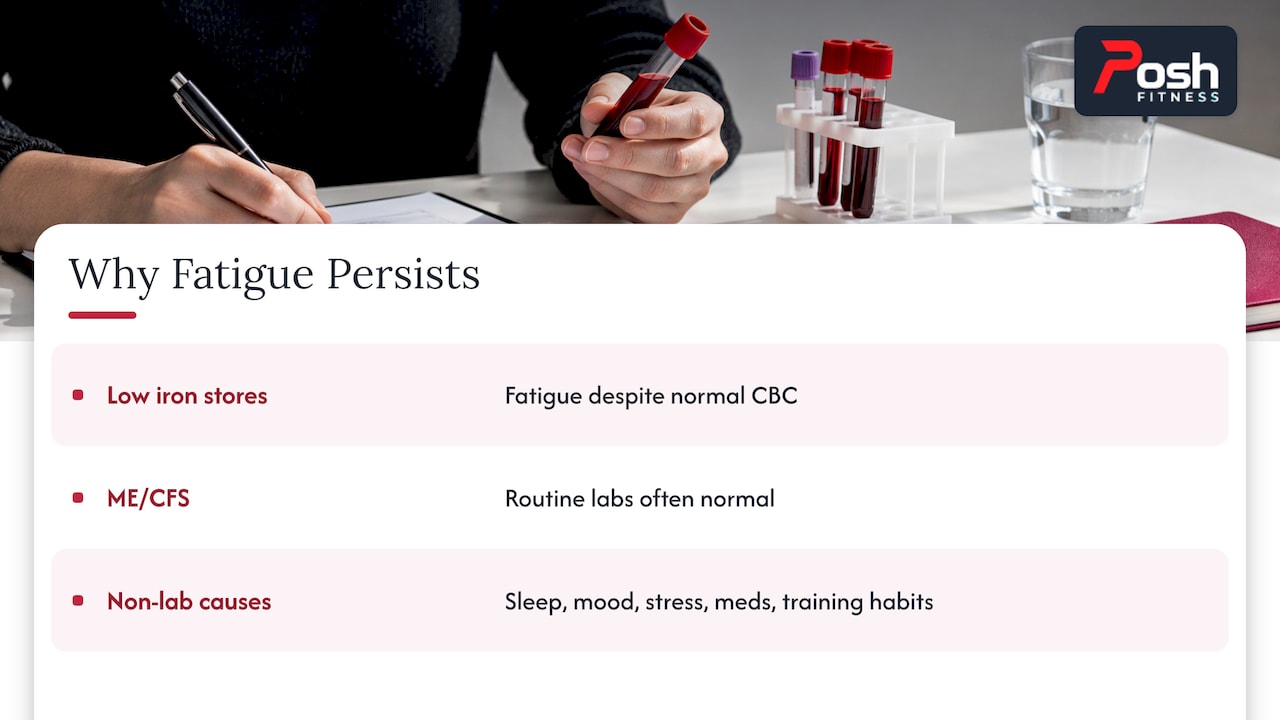
A normal result does not end the investigation. The Temple Health physician describes continuing with a detailed history, exam and further tests or referrals as needed. Researchers writing in a 2021 review also recommend regular follow-up every four to six weeks when the cause remains unknown, so the plan can adapt as symptoms change.
Non-Lab Factors Worth Looking At Alongside Your Results
If you are active, driven and still running on empty, the cause may be how you live rather than what is in your blood. Consistently short sleep, heavy training with too little recovery, skipped meals and constant work pressure all produce the same flat, unmotivated feeling. Our guide to feeling tired after workouts lists the recovery checks and red flags we use, and seven hours of sleep and what it changes covers the sleep side.
When the exhaustion is tied to never switching off, it helps to understand why high performers struggle to rest, since rest is a skill that pressure-driven people often have to relearn.
How to Prepare for the Appointment
A clinician orders better tests when the story is clear. Before your visit, write down:
- When the fatigue started and whether it is constant or comes in waves.
- Your sleep: hours, wake-ups, snoring, how you feel in the morning.
- Your medications and supplements, including doses.
- Changes in weight, appetite, mood, bowel habits or menstrual cycle.
- Prior lab results, so your clinician can compare trends.
Keeping results in one place makes that last step easy. A medical summary for your doctor pulls these details into a form a clinician can read quickly, and it shows why a focused first conversation beats asking for every test available.
Ask two questions at the end: what are you looking for with these tests, and what happens next if they are normal?
From Results to a Training and Nutrition Plan
Once your doctor has addressed any medical cause, the numbers on your report become useful in a second way. They describe your starting point.
What can reasonably be done with results, working together with your clinician:
- Match training load to recovery. If your iron, thyroid or blood sugar is a concern your doctor is managing, we can scale sessions so you are building capacity, not digging a deeper hole. Our piece on hypothyroid workouts shows what a 20-minute start looks like.
- Build meals around your numbers. A protein-forward plan looks different for someone managing blood sugar than for someone with low iron intake. Our overview of lab markers for weight loss explains which markers we pay attention to and why.
- Time food around sessions. Energy dips during workouts often come down to what and when you ate, covered in our meal timing guide.
Two cautions keep this honest. An out-of-range value does not automatically mean a deficiency, and an in-range one does not prove everything is optimal. Food, medication, supplements, hydration and fasting status all influence a single draw. Do not begin high-dose supplements because of one lab value; take it to your clinician first.
Longevity Blood Tests: What They Can and Cannot Tell You
Many people searching for fatigue answers also want to know how well their body is aging. That is a reasonable goal, and the right framing is the one a careful clinician uses: ask what decision a result will change. Lipid markers such as ApoB and Lp(a), blood sugar measures and thyroid and iron status all feed concrete decisions about prevention, nutrition and training. No single panel measures healthspan on its own.
In our work, biological age and DNA-based insights are one input among several. Our SystemAge DNA test page explains how that testing fits into a longevity coaching plan, and exercise for longevity describes the weekly training that supports it. Fatigue is a separate question from long-term screening, so if you are exhausted now, the medical workup above comes first.
When to Retest
There is no universal schedule. Retesting depends on what was found and what is changing.
- Unexplained fatigue with normal first-round results: the 2021 review mentioned above suggests follow-up every four to six weeks, which usually means a conversation and reassessment, not a repeat of every lab.
- Abnormal result: your clinician decides the interval. After a treatment such as iron or a thyroid dose change, they set the recheck based on the condition and the medication.
- After starting a new training and nutrition plan: ask your clinician whether a follow-up is worthwhile, and bring the results into your coaching so the plan keeps matching you.
A repeat panel makes sense when the result could change what you do next. Otherwise, symptoms, energy, sleep and performance tell you a lot between draws.
Our Perspective
We meet a lot of people who have done the right thing: they saw a doctor, had labs, and heard that everything looked normal. They still wake up flat, lose motivation by mid-afternoon and feel that workouts which used to energize them now take too much.
We do not treat that as a reason to push harder. We start from biology. DNA analysis, bloodwork, gut microbiome testing and physical assessments tell us how your body is built and where it is under strain, and a plan built on that can change the order of things: sleep and recovery before intensity, protein-forward meals before extra cardio, strength work sized to what you can recover from.
We work alongside your physician, not in place of one. Medical causes of fatigue belong with your doctor. Once those are handled, a plan made for your body gives you something generic programs cannot: a reason to expect progress, because the plan was built from your own data.
Peter
Personal Training and Coaching Built Around Your Bloodwork
Posh Fitness builds personal training, health coaching and nutrition plans from DNA analysis, bloodwork, gut microbiome testing and physical assessments. We train clients at home in Fairfield County, including Greenwich, Stamford, Darien, Westport and Norwalk, at affiliated gyms, or virtually. Our in-home personal training page for Fairfield County shows how that works, and health coaching for fatigue explains what the coaching side looks like week to week.

Diagnostics such as DNA tests and bloodwork are arranged through partnered labs. If you want to start with a flexible option, the online personal fitness plans are $40 per month for the Starter plan and $99 per month for the Truly Personal Plan, and a live virtual training session is $80. For in-person, five-sessions-a-week support, the Ultra Membership is $2,000 per month, listed on our pricing page. Our 4-week DNA coaching program is a focused way to begin with your biology.
FAQ
What blood tests should I ask for if I am always tired?
Ask your clinician which tests fit your history rather than asking for everything. Common first-round tests include a CBC, ferritin and iron, B12, a metabolic panel, TSH and A1C or glucose. Your clinician may add others based on your symptoms and risk.
Why am I tired when my bloodwork is normal?
Standard panels can miss low iron stores, and they do not capture sleep problems, stress, mood, medications or training load. A normal result narrows the search without ending it. Keep following up with your clinician and look at sleep, food and recovery in the meantime.
Can a blood test diagnose chronic fatigue syndrome?
No. The CDC states that no blood test confirms ME/CFS. Diagnosis rests on history, exam and a targeted workup that rules out other causes, with symptoms lasting six months or longer.
Can bloodwork help me build a nutrition plan?
Yes, alongside your symptoms and history. Results show where to focus, for example blood sugar or iron intake, and a coach can turn that into meals and training. Avoid starting high-dose supplements from a single value without your clinician’s input.
When should I get an urgent medical check instead of just labs?
Get emergency care for fatigue with chest pain, shortness of breath, an irregular or fast heartbeat, fainting, severe abdominal pain or severe headache. Call or text 988 for thoughts of self-harm. See a clinician soon for fatigue that is sudden, unexplained or paired with weight loss.
Sources
- Fatigue in Adults: Evaluation and Management, American Family Physician (2023)
- Evaluation of ME/CFS, CDC
- Diagnosing ME/CFS, CDC
- Fatigue, Internal Medicine Residency Handbook, Vanderbilt
- Fatigue, MedlinePlus
- Fatigue causes, Mayo Clinic
- Fatigue when to see a doctor, Mayo Clinic
- Fatigue: Causes and Treatment, Cleveland Clinic
- When Lab Results Don’t Offer Clear Answers, Temple Health
- Fatigue as the Chief Complaint, Deutsches Ärzteblatt review (PMC)
- Why High Performers Struggle to Rest
- Medical Summary for Your Doctor: What to Include