

Eat a full meal 3 to 4 hours before you train, or a small carbohydrate-based snack 30 to 60 minutes before. Then have a meal with protein and carbohydrate within about two hours after. That pattern covers most people. The details, such as how long your session runs, what time you train and what your goal is, decide how much it matters and where you can relax.
Below we cover what the research supports, what it does not, and how to turn it into a plan you can follow on a busy weekday.
Key Takeaways
- Large meals go 3 to 4 hours before exercise; small meals or snacks fit 1 to 3 hours before, according to Mayo Clinic guidance.
- Close to a session, choose easy carbohydrates and go light on fat, fiber and protein to avoid stomach trouble.
- After training, aim for protein and carbohydrate within roughly two hours. Total daily protein matters more than hitting a precise minute.
- For fat loss, timing is a refinement. Total calories, protein intake and consistency do most of the work.
- Your own response is data. Adjust based on how you feel during training, not on a rule from a poster.
Table of Contents
- Does meal timing matter for workouts?
- How long before a workout should you eat?
- When to eat if you work out in the morning
- Eating during longer sessions
- Protein timing after a workout
- Meal timing for fat loss
- Three sample days
- Common mistakes
- Our perspective
- Get a plan built around your schedule and biology
- FAQ
- Sources
Does meal timing matter for workouts?
Yes, but unevenly. Timing matters most when sessions are long, hard or frequent, when you train first thing in the morning on an empty stomach, or when you train twice in a day. It matters least for a 40-minute strength session at lunchtime after a normal breakfast.
The International Society of Sports Nutrition’s position stand says nutrient timing may enhance recovery, tissue repair, muscle protein synthesis and mood after high-volume or intense exercise. The same document says total daily protein intake should be the primary emphasis for people who exercise. In other words, get the day right first, then fine-tune around training.
A 2025 systematic review on protein timing found that timing did not change lean body mass gains. Some evidence suggested protein before resistance training might improve leg press one-rep max compared with protein afterward. That is a small, specific effect, not a reason to panic if you eat after your session.
How long before a workout should you eat?
The gap between eating and exercising is the part most readers get wrong. Eat too close and the food sits heavy. Eat too far out and you run low on fuel.
| Time before training | What fits | Example |
|---|---|---|
| 3 to 4 hours | A full meal | Chicken, rice and vegetables; oatmeal with eggs |
| 1 to 3 hours | A small meal or snack | Greek yogurt with fruit; a turkey sandwich on one slice of bread |
| 30 to 60 minutes | A light, mostly carbohydrate snack | Banana, graham crackers, a small granola bar |
The ranges come from Mayo Clinic: large meals at least 3 to 4 hours out, small meals or snacks about 1 to 3 hours out. The Cleveland Clinic adds that if you are short on time or not hungry, a snack such as fruit, a granola bar or graham crackers 30 minutes to an hour before works.
These are starting points. Some people feel fine training 90 minutes after a meal; others need three hours. Run the same session a few times with different gaps and note how you feel at minute 20 and minute 40.
What to eat 30 minutes before a workout
Keep it small, simple and carbohydrate-led. The US Anti-Doping Agency advises focusing on carbohydrate-containing foods that are not too high in fiber before exercise, and notes that foods high in protein, fiber and fat can cause cramps, bloating and discomfort within 1 to 2 hours of training.
Practical choices at the 30-minute mark:
- A banana or a handful of grapes
- Two or three graham crackers
- A small slice of toast with a thin layer of jam
- A few dates
Skip the large salad, the bean burrito and the protein bar loaded with fiber. They are fine foods, just poorly timed.
When to eat if you work out in the morning
Early sessions are where most people stall. You have been fasting overnight, you have little time, and a big breakfast feels unthinkable.
The Cleveland Clinic suggests that for an early workout, fruit or a granola bar when you wake up can give your blood sugar a needed boost. For a session of 45 minutes or less at moderate effort, that small snack is usually enough. Then eat a proper breakfast afterward.
If you train hard before work, try this order:
- Drink water when you wake up.
- Eat the small carbohydrate snack 20 to 30 minutes before you start.
- Train.
- Eat a breakfast with protein and carbohydrate within about two hours.
What you do around breakfast also affects how the rest of the morning goes. If you take supplements with your first meal, this guide to morning supplement routines walks through how breakfast habits can affect absorption. For a broader look at the first hours of the day, see our post on testing a simple morning routine for energy.
Some people do well training fasted; others feel dizzy and flat. If you feel lightheaded, shaky or nauseated, eat before training and consider talking with your physician, especially if you have diabetes or take medication that affects blood sugar.
Eating during longer sessions
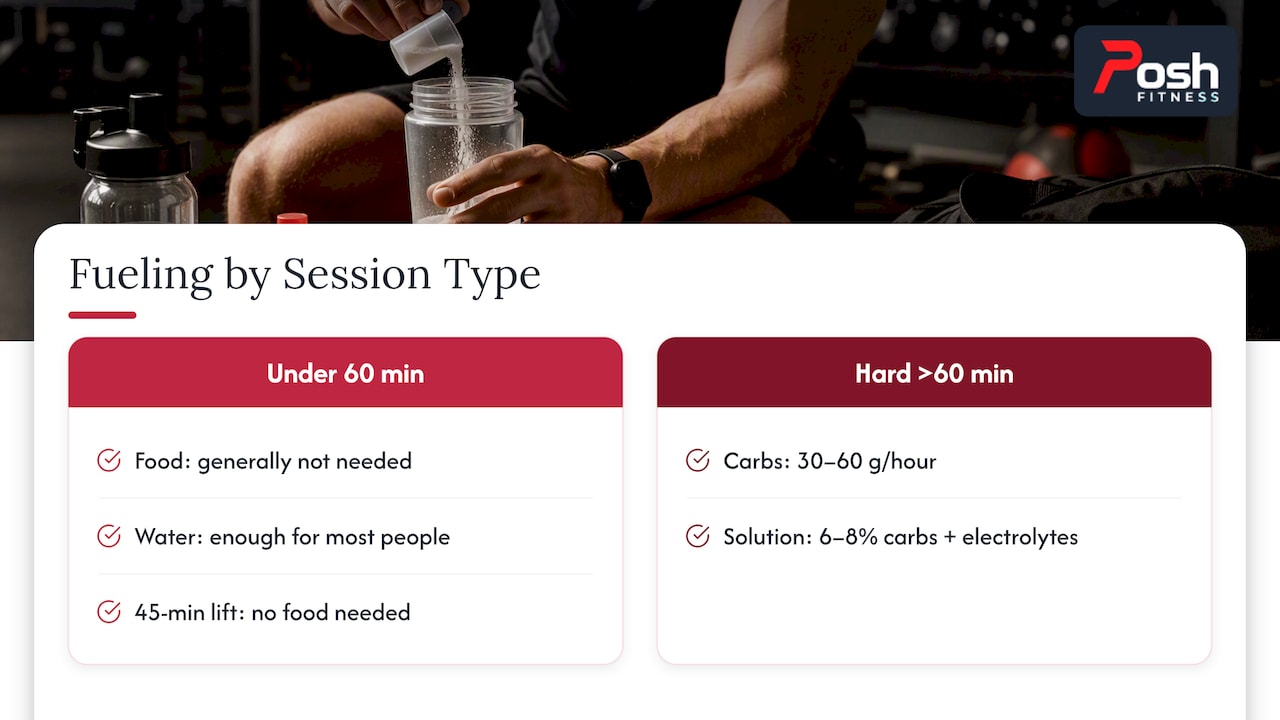
Most workouts under an hour do not need food during the session. Water is enough for most people. Hydration still matters, and our post on hydration and energy covers how to tell whether you are under-drinking.
Things change once you pass about an hour of hard effort. The ISSN position stand says extended high-intensity bouts lasting more than 60 minutes challenge fuel supply and fluid regulation, and it suggests about 30 to 60 grams of carbohydrate per hour, ideally in a 6 to 8 percent carbohydrate-electrolyte solution. That is relevant to a long bike ride, a half-marathon training run or a long tennis match. It is not needed for a 45-minute lift.
The joint position of the American Dietetic Association, Dietitians of Canada and the American College of Sports Medicine makes the broader point: adequate fluid and food before, during and after exercise helps maintain blood glucose and performance.
Protein timing after a workout
After training, your muscles are primed to use protein. The ISSN reports that high-quality protein consumed immediately to 2 hours after exercise stimulates muscle protein synthesis, and that 20 to 40 grams every 3 to 4 hours appears to favor muscle protein synthesis across the day.
Other guidance is in the same range:
- Mayo Clinic suggests a meal with both carbohydrate and protein within two hours of finishing.
- Illinois Extension recommends a recovery snack with 10 to 30 grams of protein and 30 to 60 grams of carbohydrate within 60 minutes after exercise.
The two ranges differ because they serve different situations. The one-hour snack is useful if your next meal is far off or you trained hard. If a normal meal is coming within a couple of hours, you do not need a separate shake.
A simple post-workout plate
- A palm to two palms of protein (eggs, fish, chicken, tofu, Greek yogurt)
- A fist or two of carbohydrate (rice, potatoes, fruit, oats)
- Vegetables and a little fat
There is no magic 30-minute anabolic window. There is a sensible window of a couple of hours, and a daily total that matters more. If you are tired after workouts regardless of how you eat, read our recovery checklist and four red flags.
Meal timing for fat loss
This is where claims run ahead of evidence, so it helps to be exact.
Does protein timing affect fat loss?
The evidence says the amount of protein and your total calories matter most. The ISSN notes that in non-exercising scenarios, changing meal frequency has had limited impact on weight loss and body composition, with stronger evidence that it can improve appetite and satiety. If spreading protein across three or four meals helps you feel full and avoid snacking, that is a real benefit. It is a behavior tool, not a metabolic trick.
Protein also protects muscle while you lose weight, which is why we pay attention to it. Our post on body recomposition versus weight loss explains how to aim for a steady loss while keeping muscle.
Carb timing for fat loss
The popular idea is that carbohydrates should be concentrated around training and trimmed elsewhere, or avoided in the evening. The research is less tidy. One randomized trial on carbohydrate timing in trained participants compared different within-the-day carbohydrate distributions. Body fat percentage fell and fat-free mass rose across the board, but there were no significant differences among the interventions. Participants improved because they trained and ate in a structured way, not because of the exact timing of carbohydrates.
A practical reading: place most of your carbohydrate before and after training because it helps you perform and recover, and that performance is what drives fat loss. Do not feel guilty about carbohydrate at dinner. If you struggle with energy dips or stalled progress, that is a conversation about your metabolism, and our guide on a metabolic flexibility diet is a good place to begin.
Does a protein breakfast help weight loss?
It can help you feel full. A randomized crossover study in overweight to obese young women found that a high-protein, low-carbohydrate breakfast increased satiety in the hours afterward, but did not reduce total daily energy intake compared with a low-protein, high-carbohydrate breakfast or skipping breakfast. So a protein breakfast is a good way to feel steady until lunch, particularly if mid-morning snacking is your weak spot, but it will not produce weight loss on its own.
A useful test: eat 25 to 35 grams of protein at breakfast for two weeks and watch your hunger at 10 a.m. and 3 p.m. If it helps, keep it. If not, put your protein where it fits your life.
Order of training also matters
If fat loss is the goal, what you do in the gym can matter as much as what you eat around it. See cardio versus weights for fat loss for how we structure the week.
Three sample days
These are templates, not prescriptions. Portions depend on your size, goal, medical history and appetite.
Early morning lifter (6:00 a.m. session)
- 5:30 a.m.: banana and water
- 6:00 to 6:50 a.m.: strength training
- 7:30 a.m.: eggs, oats and berries
- 12:30 p.m.: chicken, rice and vegetables
- 3:30 p.m.: Greek yogurt with fruit
- 7:00 p.m.: salmon, potatoes and a large salad
Lunchtime trainer (12:30 p.m. session)
- 7:30 a.m.: protein-forward breakfast with some carbohydrate
- 10:30 a.m.: light snack if hungry
- 11:45 a.m.: graham crackers or fruit if the last meal was more than 3 hours earlier
- 12:30 to 1:15 p.m.: training
- 1:45 p.m.: lunch with protein and carbohydrate
- 7:00 p.m.: dinner
Evening trainer (6:00 p.m. session)
- 12:30 p.m.: full lunch
- 3:30 p.m.: small snack with carbohydrate and some protein
- 5:15 p.m.: fruit or a few crackers
- 6:00 to 6:50 p.m.: training
- 7:30 p.m.: dinner with protein, carbohydrate and vegetables
Evening trainers often skip the post-workout meal because it is late, then wake up depleted. Dinner can be your recovery meal. Just do not let it drift past a couple of hours.
Common mistakes
- Training right after a large meal. Leave 3 to 4 hours or move to a light snack.
- Loading up on protein bars and fiber before a session. They tend to sit heavily in the stomach.
- Skipping the recovery meal to save calories. You pay for it in the next session.
- Copying a pro athlete’s plan. Their volume is far higher than most adults’ training.
- Ignoring total daily protein. Perfect timing around too little protein does not help.
- Tracking nothing. A short log of meal time, session quality and energy shows patterns fast. If you want to log meals and estimate how much to eat on training days, this guide to eating back exercise calories is a practical read.
Our perspective
We see the same pattern in midlife clients. They train hard, eat what they believe is right, and still feel tired, stuck or inconsistent. Generic timing rules are a reasonable starting point, but they are built on averages. Your digestion, sleep, hormones, stress load and training history shape how you respond.
That is why we rely on data before opinions. Our approach uses DNA analysis, bloodwork and physical assessments to inform training and nutrition, so that decisions about when and what you eat are based on your biology and not a rule that worked for someone else. Timing is rarely the first lever. We usually look first at total protein, sleep, recovery and how well the plan fits your schedule, and then refine the timing around sessions.
We also work alongside your physician. If you have a thyroid condition, diabetes or take medication, your fueling plan should reflect it, and our post on starting hypothyroid workouts safely shows how we think about that kind of case.
— Peter
Get a plan built around your schedule and biology
If you want to stop guessing, we can build the timing, the training and the meals around you. We train clients in Fairfield County, CT and Westchester County, NY, at home, at affiliated gyms or virtually. See our in-home personal training in Westchester or our health coaching services in Fairfield County.
If you prefer to start online, the online personal training programs include a Starter plan at $40 per month and a Truly Personal Plan at $99 per month. A live virtual training session is $80 one-off. For DNA-informed coaching, see our 4 week DNA coaching.
FAQ
How many hours before a workout should I eat?
Eat a large meal at least 3 to 4 hours before training. A small meal or snack can be eaten about 1 to 3 hours before. If you are rushed, a light carbohydrate snack 30 to 60 minutes before is a workable option.
What should I eat 30 minutes before my workout?
Choose a small carbohydrate-based snack such as a banana, graham crackers or a granola bar. Avoid heavy protein, fat and fiber that close to exercise, since they can cause cramping or bloating. Drink water as well.
Does meal timing matter for building muscle?
A little, but total daily protein and training quality matter more. Reviews find protein timing does not clearly change lean mass gains. Eating protein within a couple of hours after training and spreading 20 to 40 grams across the day is a sound approach.
When should I eat if I work out in the morning?
Have a small snack like fruit or a granola bar when you wake up, then train, then eat a full breakfast with protein and carbohydrate within about two hours. If you feel dizzy or unwell fasted, eat before you start and check with your doctor if it continues.
Sources
- International Society of Sports Nutrition position stand: nutrient timing
- Does protein ingestion timing affect exercise-induced adaptations? (2025 systematic review)
- Mayo Clinic: Eating and exercise, 5 tips to maximize your workouts
- Cleveland Clinic: Should you eat before or after a workout?
- US Anti-Doping Agency: Nutrient timing around training
- Position of the American Dietetic Association, Dietitians of Canada and the American College of Sports Medicine
- Illinois Extension: Fueling for fitness
- Within-the-day carbohydrate periodization and body composition (European Journal of Nutrition)
- Protein-rich breakfast and satiety randomized crossover study (Journal of Dairy Science)