
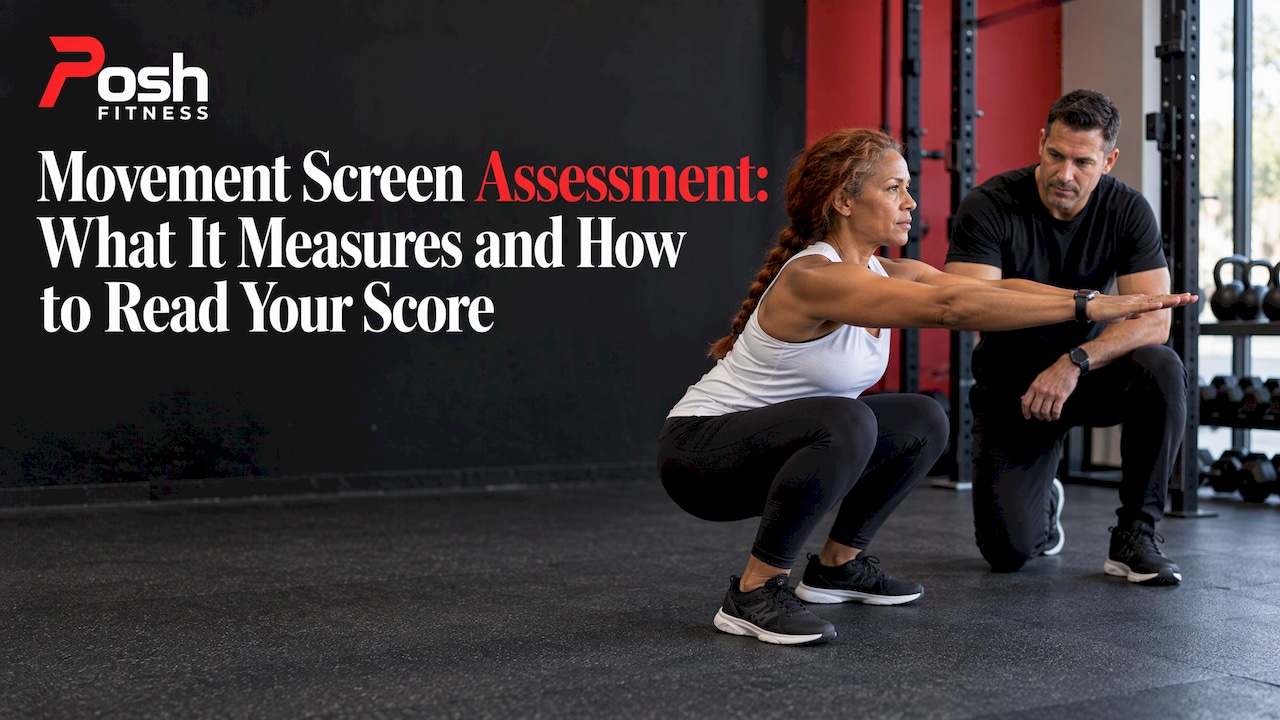

A movement screen assessment is a short, standardized check of how you perform basic movements such as a squat, a lunge or an overhead reach. A trained examiner scores each one for pain, completion and compensation. The most widely used version, the Functional Movement Screen (FMS), takes seven movements and produces a score from 0 to 21. That score is a starting point for a conversation about training. It is not a diagnosis, and it is not a reliable crystal ball for injury.
Below, we explain what each test looks at, how scoring works, what the research says about its limits, and how to turn the results into a better training plan.
Key Takeaways
- A movement screen scores fundamental patterns for pain, completion and compensation. It is built for people who are not currently injured, and it does not diagnose orthopedic problems.
- The FMS uses seven tests, each scored 0 to 3, for a maximum of 21. Pain scores a 0 and calls for further professional assessment.
- Asymmetry between left and right matters as much as the total. Keep the side-by-side scores, not just the sum.
- A total of 14 or lower has been studied as an injury-risk cutoff, but the evidence for it is inconsistent. Treat it as directional.
- The best use of a screen is to shape your warm-up, exercise selection and progression, ideally alongside the rest of your health data.
Table of Contents
- What a movement screen assessment is
- The seven tests and what each one looks at
- How the screen is performed and who can give it
- How to interpret your score
- What a screen can and cannot tell you
- What to do with your results
- Our perspective on movement screening
- Put your results to work with in-home or virtual coaching
- FAQ
- Sources
What a movement screen assessment is
A movement screen is a quick, low-equipment way to watch how you move. A 2024 clinical-practice review describes these tools as typically quick, requiring minimal equipment, and assessing movement relevant to sport, work or daily life. The examiner demonstrates and explains each movement, you perform it, and the examiner scores the attempt on an ordinal scale for completion, compensations or pain.
The FMS is the best-known example. Its developers describe it as a system built on seven fundamental movement patterns that require a balance of mobility, stability and neuromuscular control. A later review of adult and youth research adds that it aims to identify deficiencies in functional movement, balance, compensatory patterns and left-right asymmetries.
Two points shape everything that follows:
- A screen is not a clinical exam. Its creators state that it is intended for uninjured individuals to show movement limitations and asymmetries, not to diagnose orthopedic problems. If you have a known injury or ongoing pain, you need a clinician, not a screen.
- A screen describes how you move today. It does not describe how you are built, how fit you are, or what you can become with consistent training.
For middle-aged adults who feel stiff, tired or stuck after years of workouts that did not deliver, a screen is a useful first look. It tells a coach where to start, which movements to clean up, and which areas deserve a closer look from a medical professional.
The seven tests and what each one looks at
The official FMS introduction names the seven patterns: deep squat, hurdle step, inline lunge, shoulder mobility, active straight-leg raise, trunk stability push-up and rotary stability. The table below summarizes what each is designed to reveal, based on that source and the peer-reviewed FMS description.
| Test | What it looks at | Scored per side? |
|---|---|---|
| Deep squat | Hip, knee and ankle mobility, overhead shoulder and thoracic mobility, core control | No |
| Hurdle step | Stride mechanics, hip-torso coordination, single-leg stance, hip, knee and ankle mobility and stability | Yes |
| Inline lunge | Rotational, decelerating and lateral stresses, alignment, hip and ankle mobility and stability, quadriceps flexibility, knee stability | Yes |
| Shoulder mobility | Reciprocal shoulder movement involving the shoulder blade region, thoracic spine, rib cage and shoulder range of motion | Yes |
| Active straight-leg raise | Hamstring and hip flexibility while the opposite leg and trunk stay stable | Yes |
| Trunk stability push-up | Ability to keep the trunk rigid while pressing | No |
| Rotary stability | Coordination and stability of the trunk when arm and leg move together | Yes |
Five of the seven tests, the hurdle step, inline lunge, shoulder mobility, active straight-leg raise and rotary stability, are bilateral, meaning each side is tested separately.
Why these movements
These are not exotic exercises. Squatting to sit and stand, stepping over obstacles, reaching overhead, lifting a leg and keeping your torso steady while your limbs move are everyday demands. If one of them is limited or painful, it tends to show up as a compensation in workouts, in stairs, in carrying groceries or in a golf swing.
How the screen is performed and who can give it
A session is short. One review of clinical screening tests reports administration and scoring times of roughly 12 to 15 minutes, with little equipment and training required. The examiner shows you the movement, explains it verbally, and then watches you attempt it, often with a few repetitions.
The 2024 review notes that physical therapists, athletic trainers and strength coaches implement movement screens. Training matters, though. A reliability study found that raters from different backgrounds could score the FMS consistently after training, and it singled out the hurdle step as the test needing particular attention to keep different raters in agreement.
What can change your score
The same clinical-practice review warns that several factors can shift results: your warm-up status, who is scoring, whether you have practiced the tests before, and how the instructions are worded. Its advice for tracking change over time is to use consistent scripts and check reliability locally.
In practical terms, if you want to compare your results in three months:
- Test at a similar time of day and with a similar warm-up.
- Ask for the same examiner, or at least the same instructions.
- Compare the individual test scores and left-right differences, not only the total.
How to interpret your score
Each test is scored from 0 to 3, and the criteria are consistent across the system, as the FMS creators describe:
- 0: pain occurs during the movement.
- 1: you cannot complete the movement pattern.
- 2: you complete it, but with a compensation.
- 3: you complete it correctly, with no compensation.
For the five bilateral tests, both sides are recorded and the lower side becomes the score for that test. The seven final scores add up to a composite of up to 21 points. The same review recommends keeping the raw left and right scores, because they show asymmetry that the total hides.
A worked example
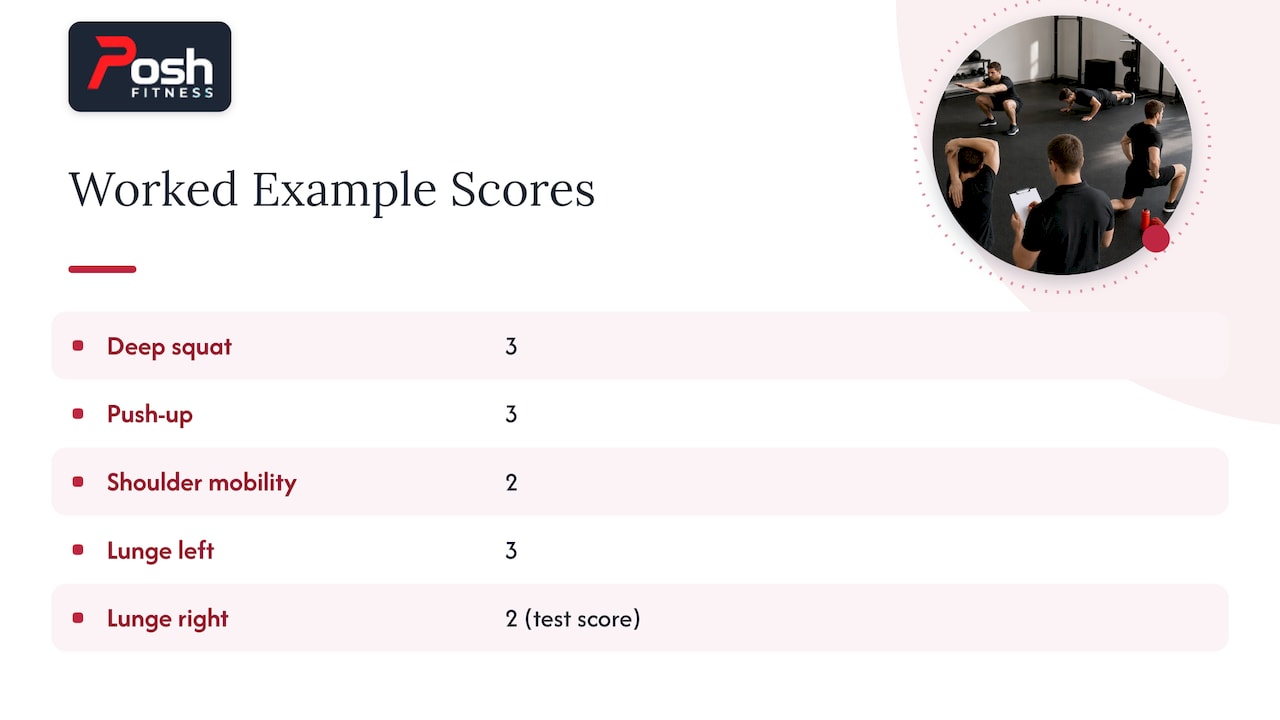
Imagine a 52-year-old with a desk job. She scores a 3 on the deep squat and the push-up, a 2 on the shoulder mobility test, and on the inline lunge she scores 3 on the left and 2 on the right, so the test counts as a 2. Her total looks healthy. But the raw data show a right-sided lunge limitation and a shoulder restriction. A coach reading only the total would miss the one thing worth working on: single-leg control and hip mobility on the right, and thoracic and shoulder range for overhead work.
Pain changes the picture
A 0 is not a bad grade. It is a flag. The creators state that a pain score requires further professional assessment, and they distinguish screening from clinical assessment: a different system, the Selective Functional Movement Assessment, is meant for people with known disability, injury or pain.
The 14-point cutoff
You will often see a total of 14 or lower described as a warning sign. The 2024 clinical-practice review notes that a score at or below 14 has been linked to increased injury rates in some populations, while also saying the usefulness of the cutoff is disputed. An NSCA review adds that a cutoff can make studies easier to compare, but a universal 14-point threshold does not consistently give the best prediction across different samples. The sensible reading: a low total is a reason to look closer, not a verdict.
What a screen can and cannot tell you
A movement screen can tell you which patterns look clean and which show compensations. According to the 2024 review, it can also give a window into capabilities such as strength, flexibility, coordination and endurance. That is useful for choosing exercises and sequencing a program.
What it does poorly is predict who will get hurt. The numbers are worth knowing:
- A 2025 review of the FMS and injury prediction reports inconsistent accuracy across populations and notes that broad composite scores can neglect age, sex, fitness, prior injuries and context. It reports a sensitivity of 24.7%, a positive predictive value of 42.8% and a negative predictive value of 72.5%.
- The NSCA review found that studies using the 14-point cutoff reported sensitivity ranging from 16% to 84%, with a median of 54%. That is a wide spread and means the cutoff misses many people who go on to be injured.
- A 2026 prospective study of university basketball players found the conventional total of 14 or lower was not significantly associated with injury (AUC 0.52). Individual items told a different story: deep-squat scores of 2 or lower were associated with higher injury risk (odds ratio 3.47), and a weighted model combining items improved discrimination to an AUC of 0.75.
The takeaway is not that screens are useless. It is that individual patterns and asymmetries carry more information than one summed number, and that a screen works best as one input among several. The creators themselves frame the tool as a way to expose limitations so professionals can pursue further evaluation or proactive intervention, rather than name the underlying disorder.
What to do with your results
The creators’ guidance is to use the screen directionally, not diagnostically. Here is how that plays out.
If you scored 0 on any test
Stop training that pattern and see a licensed clinician, such as a physical therapist or a physician, before loading it. Pain during a simple movement deserves a proper work-up. For a sense of how a structured clinical evaluation proceeds after an injury, this accident injury recovery assessment workflow walks through the steps a clinic follows.
If you scored 1 or 2 on a pattern
This is where coaching earns its keep. A 1 means the pattern is not available yet, so the program should regress it, for example box squats before deep squats, or supported single-leg work before lunges. A 2 means the pattern works with compensation, so we clean it up with lighter loads, slower tempos and targeted mobility or stability drills.
If one side is weaker than the other
Fix the weaker side first and keep the stronger side from running away with the work. Unilateral exercises, such as split squats, single-leg Romanian deadlifts and half-kneeling presses, make asymmetries visible and give you a way to close them.
If you scored well
Good news, with a caveat from the clinical-practice review: it cautions against automatically trying to increase range of motion. If you function well after your normal warm-up, extra flexibility work could waste time or even create excessive mobility. A clean screen is a cue to progress your strength, power and conditioning, not to chase more stretching.
Build the rest of the picture
Movement is one layer. Energy, recovery, body composition and how you respond to training also depend on sleep, nutrition, hormones and genetics. If you are curious how those layers fit together, our guide to DNA testing for personalized fitness and nutrition coaching explains what we look at, and our piece on metabolic flexibility and steady energy covers the eating side.
Our perspective on movement screening
We like movement screens for one reason: they make the first conversation about training specific. Instead of guessing why your knee bothers you on stairs or why your shoulders feel locked after a long week at a desk, you get a few clear observations to work from.
What we do not like is treating a score as a fate. The research is honest about this. Totals do not predict injury reliably, and the individual patterns and left-right differences tell you more. So we read a screen the way a careful coach should: as a starting hypothesis that training either confirms or corrects.
That is also why we do not stop at movement. Many of the people who come to us are in their 40s, 50s and 60s, tired, frustrated and stuck after programs that treated them like everyone else. Movement quality is one piece. We combine physical assessments with DNA analysis, bloodwork and gut microbiome testing so that exercise, nutrition and recovery are all matched to your biology, not an average. When a screen flags pain, we send you to the right medical professional first, and we work alongside them.
A screen should end with a plan you can act on this week. If it ends with a number on a form, it did not do its job.
Peter
Put your results to work with in-home or virtual coaching
If you live in Fairfield County, CT, or Westchester County, NY, we bring personal training to your home, to an affiliated gym, or to your screen. Each program starts with a physical assessment and builds from there, using diagnostics such as DNA, bloodwork and gut microbiome testing when you want a deeper picture of your biology. Our trainers are scientifically credentialed, and our approach is designed to help you rebuild the energy and performance you had earlier in life.
If you prefer to train remotely, our online plans start at $40 per month for the Starter plan, and the Truly Personal plan is $99 per month. A single live virtual training session is $80. You can see the online personal training programs, or start with an in-home personal trainer in Fairfield County.
FAQ
What are the 7 functional movement screen tests?
The seven tests are the deep squat, hurdle step, inline lunge, shoulder mobility, active straight-leg raise, trunk stability push-up and rotary stability. Each looks at a basic pattern that combines mobility, stability and control. Five of them are scored on both sides.
How do you interpret a Functional Movement Screen score?
Each test earns 0 to 3 points: 0 for pain, 1 for being unable to complete the pattern, 2 for completing it with compensation, and 3 for a clean performance. The seven scores add up to a maximum of 21. Look at asymmetries and individual patterns, not just the total, and treat a 14 or lower as a prompt for a closer look rather than a diagnosis.
Can a movement screen predict injury?
Not reliably. Studies show inconsistent accuracy across populations, and the 14-point cutoff has missed many people who were later injured. Some individual items, such as a low deep-squat score, have shown stronger links to injury in specific groups, so the pattern-level detail is worth more than the total.
Who can give a movement screen assessment?
Physical therapists, athletic trainers and strength coaches commonly administer screens. Training in the scoring criteria matters, because consistency between examiners is what makes your results comparable over time. If you have pain or a known injury, see a clinician instead.
How long does a movement screen take?
A full FMS typically takes around 12 to 15 minutes to administer and score. It needs little equipment, which makes it easy to do at the start of an in-home or virtual training session.
Sources
- Functional Movement Screening: The Use of Fundamental Movements as an Assessment of Function, Part 1
- Functional Movement Screening: The Use of Fundamental Movements as an Assessment of Function, Part 2
- An Introduction to the Functional Movement Screen
- Suggestions and Considerations for Application of Movement Screens (2024)
- Assessment of Dysfunctional Movements and Asymmetries (2021)
- Use of Clinical Movement Screening Tests to Predict Injury (2016)
- Interrater and Intrarater Reliability of the Functional Movement Screen (2013)
- The Functional Movement Screen: A Review (NSCA, 2014)
- Predictive Utility of the Functional Movement Screen
- Association Between Individual Functional Movement Screen Tasks and Sports Injury Occurrence in University Basketball Players (2026)