

There is no single “APOE diet” proven to prevent Alzheimer’s disease. But the research points in a consistent direction for people who carry the APOE4 variant. Keep saturated fat modest, eat fish regularly, build meals around plants and whole foods in a Mediterranean pattern, and keep blood sugar steady. This guide explains what each of those recommendations rests on, where the evidence is still thin, and how to turn it into a plan you can follow.
Key Takeaways
- In a U.S. cohort of older adults, APOE-e4 carriers whose saturated fat intake rose by 5% of calories declined 21% faster in global cognition. That is an association, not proof of cause.
- A Mediterranean-style pattern and fish intake have the most consistent support for APOE4 carriers.
- Fish looks more promising than fish oil capsules, and the trials on DHA supplements are mixed.
- Long-term human trials of an APOE4-specific diet do not exist yet, so work with your physician or a registered dietitian before making big changes, especially if you take cholesterol medication.
- Personalizing food, training and lab markers to your own biology is a practical way to apply a general finding.
Table of Contents
- What an APOE diet actually means
- Saturated fat: the clearest signal
- The Mediterranean pattern: the best-supported overall approach
- Fats at a glance
- Fish versus fish oil
- Low-glycemic eating and the ketogenic question
- What the evidence cannot tell you yet
- Should you get tested first?
- A practical week of APOE4-aware eating
- Our perspective on eating for your biology
- How Posh Fitness can help
- FAQ
- Sources
What an APOE diet actually means
APOE is a gene that helps your body build apolipoprotein E, a protein that carries cholesterol and other fats. It comes in three common forms: e2, e3 and e4. Most people carry e3. APOE4 is the form linked to a higher risk of Alzheimer’s disease and cardiovascular disease.
An “APOE diet” is not a branded program. It is shorthand for adjusting how you eat in light of your APOE genotype, mainly the type and amount of fat, the quality of your carbohydrates and your intake of omega-3s.
Why would a gene change how food affects you? A 2020 review in Frontiers in Aging Neuroscience explains that APOE4 is the ancestral human allele. In settings with frequent infection, uncertain food supply and shorter life expectancy it may have been adaptive. In modern environments with longer lives, it raises the risk of aging-related disease, particularly in the arteries and the brain. The same review notes that APOE4 alters how cell receptors involved in lipid and glucose metabolism are trafficked inside cells. So the gene touches both fat handling and blood sugar handling, which is why diet research on APOE4 focuses on both.
If you carry one copy of e4, you are a heterozygote (e3/e4). Two copies (e4/e4) is a homozygote. Studies often group them together, but some findings differ between the two, so keep that in mind when you read headlines.
Saturated fat: the clearest signal
The most repeated finding is about saturated fat, the kind found in fatty red meat, butter, cheese, cream and many processed foods.
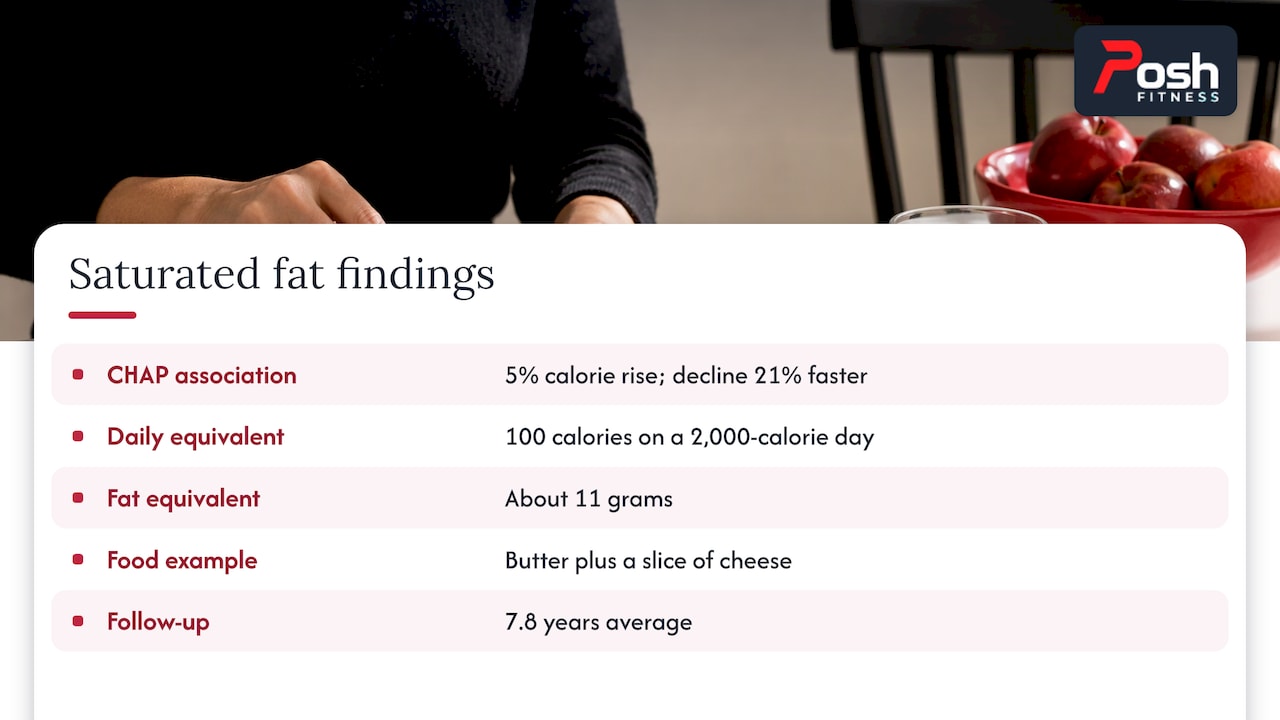
A 2021 scoping review found that diets high in saturated fats may be particularly harmful for APOE ε4 carriers. A 2024 study by Liu and colleagues followed 3,360 participants of the Chicago Health and Aging Project for an average of 7.8 years. Among APOE-e4 carriers, a 5% increase in calories from saturated fat was associated with a 21% faster decline in global cognition. The same study found that higher intake of long-chain omega-3 fats was linked to slower decline.
To make that 5% concrete: on a 2,000-calorie day, 5% is 100 calories, or roughly 11 grams of fat. That is about a tablespoon of butter plus a slice of cheese. Small swaps add up.
The cholesterol angle supports the same direction. In the 24-week RISCK randomized trial, APOE4 carriers saw bigger drops in total cholesterol and apolipoprotein B than E3/E3 participants when saturated fat was replaced with low-glycemic-index carbohydrate on a lower-fat diet. That is a UK trial measuring blood lipids, not dementia, but it shows APOE4 carriers can respond strongly to this particular swap.
A wrinkle: the meat study
Research is not unanimous. A 2026 JAMA Network Open study from Sweden followed 2,157 older adults for up to 15 years. In carriers of APOE34 or APOE44 genotypes, higher total meat consumption was associated with better cognitive trajectories and lower dementia risk, with no such pattern in other genotypes.
This does not cancel the saturated fat findings. It measured total meat, not fat type or cut, in a Swedish population, and it is observational. It does show why one study should not set your whole eating pattern, and why a careful look at your own labs and history beats a rule from a headline.
The Mediterranean pattern: the best-supported overall approach
If you want one eating pattern to start from, the evidence points to the Mediterranean diet. The scoping review found evidence suggesting that Mediterranean diet adherence may reduce cognitive decline among APOE ε4 carriers.
A 2025 study integrating genetic, blood metabolite and diet data from 4,215 women and 1,490 men found that Mediterranean diet adherence more effectively modulated dementia-related metabolites in APOE4 homozygotes. About 39.5% of the link between Mediterranean diet adherence and dementia risk was mediated by a set of metabolites among APOE4 carriers. The finding supports the idea that the same food may do different things in different genotypes.
In practice, a Mediterranean pattern looks like this:
- Vegetables and fruit at most meals, with plenty of leafy greens and colorful produce.
- Whole grains and legumes in place of refined starches.
- Nuts and seeds as the everyday snack.
- Fish at least twice a week.
- Olive oil as the main added fat.
- Red meat, butter and processed meats as occasional foods rather than staples.
For fitness-minded adults over 50, the practical details of building meals like this alongside strength training matter as much as the list. The approach to lifestyle-first healthy aging is a good example of how food and loading work together for older adults.
Fats at a glance
| Fat type | Common sources | What the APOE4 research suggests |
|---|---|---|
| Saturated | Fatty red meat, butter, cheese, cream, many baked goods | Higher intake linked to faster cognitive decline in APOE-e4 carriers; swapping it out lowered cholesterol more in e4 carriers |
| Long-chain omega-3 (EPA, DHA) | Salmon, sardines, trout, mackerel | Higher intake linked to slower decline in e4 carriers; fish shows consistent benefit across observational studies |
| Monounsaturated and polyunsaturated from plants | Olive oil, nuts, seeds, avocado | Core of the Mediterranean pattern with the best overall support |
| Trans fat | Some fried and packaged foods | General heart-health advice applies to everyone |
Fish versus fish oil
The Liu study found that for every 1% of energy from long-chain omega-3s, annual cognitive decline was about 30.4% slower among APOE-e4 carriers. That is a strong association, but it came from food intake across a population, not from capsules.
Supplements have a more complicated record. In an 18-month DHA trial, APOE4 carriers with mild probable Alzheimer’s showed no cognitive improvement over placebo, while non-carriers did benefit. Carriers with two e4 copies also had a smaller rise in plasma DHA after supplementing. The scoping review summarized the pattern: fish consumption showed consistent benefit, while omega-3 supplementation gave mixed results.
Timing may matter. A 2024 review discussed evidence that adequate DHA intake early in life may slow progression to dementia in cognitively normal APOE4 carriers, including a trial of 1.16 g per day of DHA in adults with a mean age of 33 that found improved retention times in carriers. Starting early is better than waiting for symptoms.
The practical conclusion: make fish a regular part of your week first. If you are considering a supplement, ask your physician, and measure rather than guess. Our guide to raising and retesting your omega-3 index shows how to track your actual levels.
Low-glycemic eating and the ketogenic question
Because APOE4 is tied to glucose regulation and insulin resistance, many researchers think blood sugar control matters as much as fat. In a 2021 review, Norwitz and colleagues used what is known about how ApoE4 affects inflammation, lipid metabolism, the blood-brain barrier and insulin resistance to propose a precision nutrition approach: a low-glycemic diet with a ketogenic option and Mediterranean-style food choices. The authors themselves present it as speculation, noting that no long-term human studies have tested effective nutritional protocols for APOE4 carriers.
That last point matters for ketogenic diets. Some guidance for APOE4 carriers advises against very high-fat eating, and the saturated fat data above explains why. If you are drawn to lower-carbohydrate eating, the evidence-consistent version leans on olive oil, nuts, fish and non-starchy vegetables rather than butter, cream and fatty meat. Discuss it with your physician first, because it changes cholesterol in some people.
The low-glycemic idea is easier to apply. Choose intact grains, beans, berries and vegetables over refined flour and sugary drinks, and pair carbohydrates with protein and fiber.
What the evidence cannot tell you yet
Be wary of anyone who sells a certain answer.
- Most findings are observational. They show associations between eating patterns and outcomes, not that a food caused them.
- Long-term human trials of APOE4-specific diets have not been done, as the Norwitz review states.
- A 2025 systematic review of 15 randomized trials found that lifestyle changes such as exercise and diet might improve cognition, but whether the effects differ between APOE-e4 carriers and non-carriers is still inconclusive.
- Studies differ in country, age and diet quality, which is partly why the Swedish meat result and the American saturated fat result do not line up neatly.
This is not a reason to wait. The shared advice, plant-forward Mediterranean eating, fish, limited saturated fat and steady blood sugar, supports heart health, body composition and energy for every genotype. Carrying APOE4 simply raises the value of getting it right.
Should you get tested first?
Knowing your genotype can sharpen the plan, but it is not a prerequisite for eating well. Genetic risk information deserves a conversation with your physician or a genetic counselor, since APOE4 status is linked to Alzheimer’s risk and some people prefer not to learn it.
Nutrigenetics is also still maturing. A 2022 clinical practice guideline using GRADE identified only two gene-diet associations with strong enough evidence for clinical use, one of which involves male APOE-E4 carriers and triglyceride changes in response to EPA and DHA. That is an encouraging sign for omega-3 tracking, and it tells you to expect nuance rather than a single rule for everyone.
What you can measure today is more useful than guessing: LDL cholesterol, apolipoprotein B, triglycerides, fasting glucose and insulin, and your omega-3 index. Your results show how your body responds to what you eat, whatever your genotype.
A practical week of APOE4-aware eating
Here is a template we use as a starting point in coaching conversations. Adjust it with your clinician.
- Breakfast: Greek yogurt or oats with berries, walnuts and ground flax, or eggs with sautéed greens and a slice of whole-grain bread.
- Lunch: A large salad or grain bowl with beans or chickpeas, vegetables, olive oil and lemon, plus grilled chicken or canned sardines.
- Dinner, three nights a week: Salmon, trout or mackerel with roasted vegetables and a whole grain.
- Other dinners: Poultry, legumes or tofu with vegetables. Keep red meat as an occasional meal, in a modest portion.
- Snacks: A handful of nuts, fruit, hummus with vegetables.
- Fat swaps: Olive oil in place of butter for cooking, nut butter in place of cream cheese, avocado in place of mayonnaise-heavy spreads.
If cooking all of this feels like a lot, a weekly structure helps. Our microbiome-friendly meal plan and our weekly meal prep plan both fit this pattern easily, and meal timing around workouts shows how to place protein and carbohydrates on training days.
Diet is only one lever. Resistance and aerobic training also matter for metabolic and brain health, which is why we pair food guidance with a weekly exercise plan for longevity.
Our perspective on eating for your biology
Many of the people who come to us have done everything “right” with a standard plan and still feel tired, stuck or unmotivated. Often the plan was written for an average person, and they are not one.
The APOE research is a good illustration. The same fat, the same carbohydrate and the same supplement can behave differently depending on genotype, and the studies do not all agree. That is why we do not hand out one diet. We start from your DNA analysis, bloodwork, gut microbiome testing and physical assessment, then build training and nutrition around what your own results show.
We work alongside your physician. Genetic and lab data should inform decisions with your care team, not replace them. Our trainers are scientifically credentialed, and our approach is designed to help you reset your biology and extend your healthspan, so that you can regain the energy and performance you had earlier in life.
A food list is a starting point. Coaching, retesting and adjusting every few weeks is how it becomes a result you can feel.
Peter
How Posh Fitness can help
If you live in Fairfield County, CT or Westchester County, NY, we can bring personal training to your home, work with you at an affiliated gym or coach you virtually. We combine DNA analysis, bloodwork, gut microbiome testing and physical assessments to shape both your training and your nutrition, with meal delivery and app support available.

Where you start depends on how much guidance you want:
- 4 Week DNA Coaching is a focused way to see how your biology shapes your plan.
- Longevity Coaching, SystemAge sessions and the Ultra Membership 5 a Week are for deeper work. The Ultra Membership 5 a Week is $2,000 per month.
- Our online personal fitness plans start with the Starter plan at $40 per month, the Truly Personal Plan is $99 per month, and the Truly Personal Fitness Plan is $1,000 per year.
- A live virtual training session is $80 per session.
Curious about the DNA side? Read about DNA testing for SystemAge, or get started with an in-home trainer in Fairfield County.
FAQ
What is the best diet for APOE4?
The best-supported option is a Mediterranean-style pattern with regular fish, plenty of vegetables, whole grains and nuts, and limited saturated fat. A scoping review found evidence that Mediterranean diet adherence may reduce cognitive decline in APOE ε4 carriers. No long-term trial has proven a single best diet, so use it as a framework and personalize with your physician.
Should APOE4 carriers avoid saturated fat?
Keeping it modest is the safest reading of the evidence. In one cohort, APOE-e4 carriers with higher saturated fat intake declined faster cognitively. Replace some butter, cream and fatty meat with olive oil, nuts and fish, and review your lipid results with your clinician.
Is a ketogenic diet a good idea with APOE4?
It has been proposed in theory, but researchers describe the approach as speculative because no long-term human studies exist. A low-glycemic, Mediterranean-style version based on olive oil, fish, nuts and vegetables is more consistent with the data. Talk with your physician first, since high-fat eating can raise cholesterol in some people.
Do I need an APOE test before changing my diet?
No. The core habits, fish, plants, whole grains and less saturated fat, are sound for most adults. If you want to know your genotype, discuss it with your physician or a genetic counselor first. Bloodwork such as LDL, apolipoprotein B and glucose gives practical feedback on how you respond.
Do omega-3 supplements help APOE4 carriers?
The results are mixed. An 18-month trial found that APOE4 carriers with mild Alzheimer’s did not improve on DHA, while eating fish shows more consistent benefit. Ask your physician before starting a supplement, and track your omega-3 index if you do.
Sources
- APOE Alleles and Diet in Brain Aging and Alzheimer’s Disease, Frontiers in Aging Neuroscience (2020)
- A Scoping Review of Dietary Factors Conferring Risk or Protection in APOE ε4 Carriers
- Dietary fats and the APOE-e4 risk allele in relation to cognitive decline (Liu et al., 2024)
- Meat Consumption and Cognitive Health by APOE Genotype, JAMA Network Open (2026)
- APOE4 Genotype Exerts Greater Benefit in Lowering Plasma Cholesterol (RISCK study, 2018)
- Interplay of genetic predisposition, plasma metabolome and Mediterranean diet (2025)
- Effect of APOE Genotype on Plasma Docosahexaenoic Acid (DHA) trial
- Effects of APOE4 on Omega-3 Brain Metabolism Across the Lifespan (2024)
- Precision Nutrition for Alzheimer’s Prevention in ApoE4 Carriers (Norwitz et al., 2021)
- Lifestyle, APOE-e4, and cognitive performance: a systematic review (2025)
- Clinical Practice Guidelines Using GRADE and Nutrigenetics, Frontiers in Nutrition (2022)
- Lifestyle-first healthy aging and bones for 50+