


An elimination diet can show you which foods are behind your bloating, but only when it is run as a short, structured experiment: remove suspected foods for a few weeks, bring them back one at a time, and write down what happens. Skip the reintroduction, or keep the restrictions for months, and you end up with a smaller menu and no answers. Below you will find how long each phase lasts, how the low FODMAP version works, how to keep training while you do it, and when bloating needs a medical evaluation before you change anything. If you want the process built around your own biology, our health coaching uses DNA analysis, bloodwork and gut microbiome testing to tailor nutrition and training to you.
Key Takeaways
- An elimination diet is a short-term test, not a lifestyle: most guidance puts food removal at roughly two to eight weeks, followed by careful reintroduction.
- Reintroduction is the part that gives you answers. Test one food at a time, record the amount and your symptoms, and wait before moving on.
- The low FODMAP diet is the best-studied version for bloating. It has three phases: elimination, reintroduction and personalization.
- Talk with a physician or a registered dietitian first if you have unexplained weight loss, ongoing diarrhea or constipation, a history of disordered eating, or a suspected food allergy.
- You do not have to stop exercising. A short low FODMAP window before training has been studied for reducing exercise-related gut symptoms.
Table of Contents
- What an elimination diet is, and what it is not
- Why foods cause bloating in the first place
- Before you start: who should have guidance first
- The elimination diet, step by step
- What you can eat during a low FODMAP elimination phase
- Low FODMAP workouts: keep training without feeding the bloat
- Fiber, pace and other quick adjustments
- What the diet cannot tell you
- Our perspective
- How we can help in Fairfield County and Westchester
- FAQ
- Sources
What an elimination diet is, and what it is not
An elimination diet removes certain foods or food groups for a few weeks, then reintroduces them one at a time to see which ones may be connected with your symptoms. Banner Health notes that the approach may help with bloating, fatigue, diarrhea, joint pain and rashes, and that it is neither a quick fix nor a weight-loss diet.
Three points shape everything else in this guide.
- It is temporary. The Academy of Nutrition and Dietetics describes elimination diets as short-term plans of four to eight weeks.
- It identifies triggers, not causes. The same Banner Health source explains that the diet cannot tell you why a food bothers you. The reason could be a food allergy, a food intolerance, trouble breaking down a sugar such as lactose, or an inflammatory condition such as celiac disease. Finding the trigger is the first step, not the last.
- It works through reintroduction. Removing foods usually makes you feel better for a while. The information comes when you add foods back and see which ones bring the bloating back.
Why foods cause bloating in the first place
Most elimination plans for bloating are built around FODMAPs. These are carbohydrates that are hard to absorb in the small intestine. According to the American College of Gastroenterology, gut bacteria break them down in the colon and produce gas, which stretches the colon walls and can cause bloating, distension, cramping, pain, diarrhea or constipation.
That explains why two people can eat the same lunch and feel completely different afterward. Your tolerance for each FODMAP group is individual, so a list that works for a friend may be wrong for you. It is also the reason a broad, general plan, such as cutting gluten, dairy and sugar all at once, often leaves people unsure which change helped.
Before you start: who should have guidance first
This is the step people skip, and it matters most.
The Cleveland Clinic advises doing an elimination diet with a medical professional’s guidance. One of its specialists warns that going alone can delay treatment of underlying issues such as celiac disease and inflammatory bowel disease, and that a poorly planned diet can become deficient in nutrients.
See your physician or a registered dietitian before you begin if any of these apply:
- Unexplained weight loss, ongoing diarrhea or constipation, or ongoing nausea or vomiting. The Mayo Clinic lists these among the reasons to talk with a healthcare professional about gas and gas pains, along with symptoms that will not go away or interfere with daily life.
- A known or suspected food allergy. Healthline warns that reintroducing an allergen can trigger anaphylaxis, so the process should be medically supervised.
- A history of an eating disorder, fear of food, or malnutrition risk. The AGA says the three-phase low FODMAP process is not usually recommended for people with a history of eating disorder or food fear.
- Being underweight. Johns Hopkins Medicine cautions that the diet is not meant for weight loss and can cause dangerous weight loss in people who are already underweight.
The ACG’s clinical guideline gives a conditional recommendation for a limited trial of a low FODMAP diet in irritable bowel syndrome, and states that teaching all three phases calls for a properly trained GI dietitian. If you have a diagnosis or suspect one, that is your starting point. Once your clinician has cleared you, coaching can help you carry the plan out day to day.
The elimination diet, step by step

Step 1: Keep a one-week baseline diary
Before removing anything, log what you eat, when you eat, how fast you eat, and how you feel: bloating on a 1 to 5 scale, bowel habits, energy, sleep and stress. Add your training sessions. Many people discover that bloating clusters around a meal pattern, a poor night of sleep or a hard workout, which changes where you look.
Where it goes wrong: relying on memory. Symptoms can lag behind the meal, so a written record is the only reliable comparison once you reach reintroduction.
Step 2: Pick one approach
Choose either a low FODMAP plan, which is targeted at gut symptoms, or a broader plan that removes a defined list of common triggers such as dairy, gluten, eggs and soy. For bloating specifically, the low FODMAP approach has the stronger gastroenterology backing. The AGA says it may help bloating, belly pain, gas, diarrhea and constipation in IBS, and in IBD or celiac disease when symptoms persist despite remission or a gluten-free diet. It also stresses that it is not a cure and not a weight-loss diet.
Do not combine approaches. Removing twenty foods at once makes it nearly impossible to learn anything and raises the risk of eating too little.
Step 3: Run the elimination phase
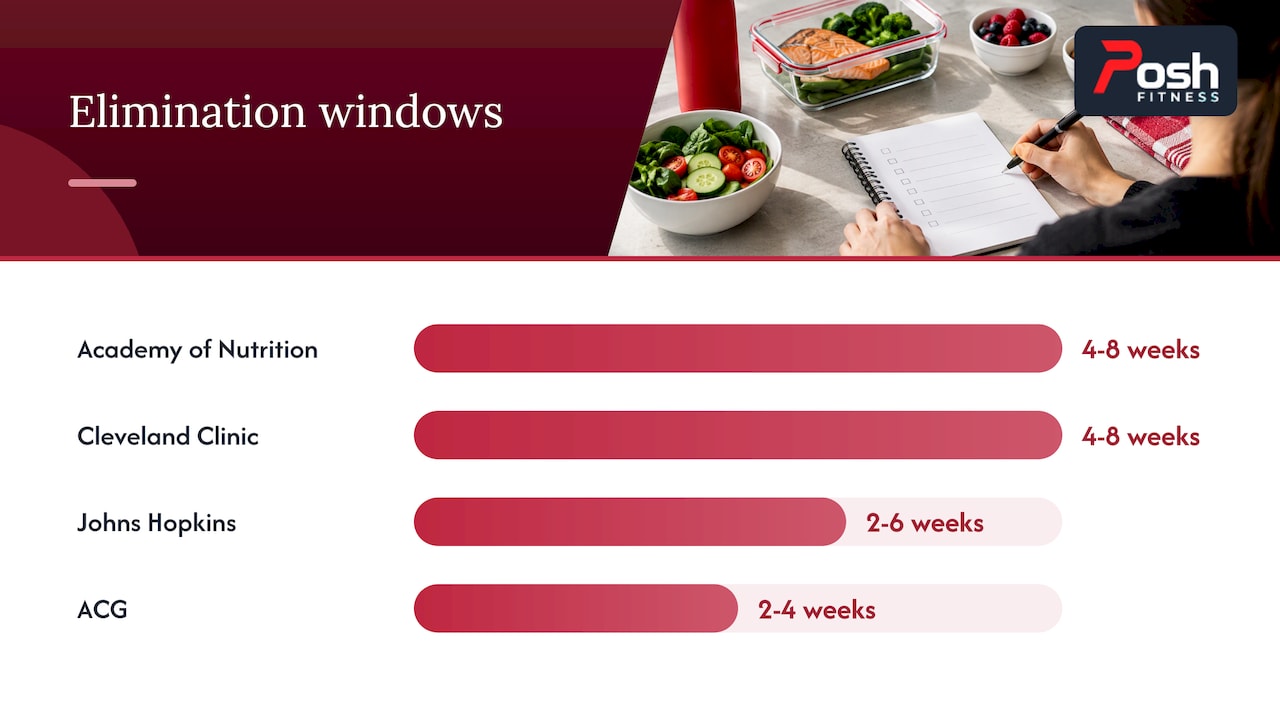
How long? The sources differ slightly, and the differences are worth knowing:
| Source | Elimination length |
|---|---|
| Academy of Nutrition and Dietetics | 4 to 8 weeks |
| Cleveland Clinic | 4 to 8 weeks |
| Ohio State Health & Discovery | Typically 1 to 3 months |
| Johns Hopkins Medicine (low FODMAP) | 2 to 6 weeks |
| American College of Gastroenterology (low FODMAP) | 2 to 4 weeks only |
For a low FODMAP plan, two to four weeks is the practical target. If your symptoms have clearly improved, move to reintroduction. If nothing has changed after the window your clinician sets, that is useful information too, and it is a reason to look elsewhere rather than restrict longer.
One detail from Ohio State: an inflammatory reaction to a food can continue for up to two weeks after you eat it. That is why a plan with one slip in week one can blur the results, and why consistency in the first few weeks pays off.
Step 4: Reintroduce one food at a time
This is the step that tells you something. A protocol described by the Ohio State registered dietitian goes like this: test one food for two to three days, increasing the portion gradually, then follow with a three-to-four-day wait-and-see phase while you keep the symptom diary. Johns Hopkins describes reintroducing high FODMAP foods one at a time, about every three days.
A simple version:
- Pick one food from one FODMAP group, such as a small portion of garlic or a half cup of milk.
- Eat a small amount on day one, a larger amount on day two and a full portion on day three.
- Return to your baseline diet for the wait-and-see days and record bloating, gas, bowel changes and energy.
- Move to the next food only when you are symptom-free again.
The Cleveland Clinic is blunt about it: rushing reintroduction makes it impossible to identify trigger foods. The Academy of Nutrition and Dietetics adds that you should start with a small amount and record how much you tolerate. The goal is a threshold, not a yes or no. Many people find they can eat a small portion of a food without trouble.
Step 5: Personalize and widen
The final phase keeps only the foods that bother you restricted and returns everything else to your plate. Johns Hopkins describes the long-term goal as avoiding only your trigger foods while enjoying the rest. The ACG guideline notes that long-term over-restriction may lead to micronutrient deficiencies, so the target is always the broadest diet you can tolerate.
What you can eat during a low FODMAP elimination phase
Johns Hopkins lists the following as foods to base meals on, and the NIDDK lists what contains FODMAPs and is usually removed:
| Category | Usually allowed | Usually removed |
|---|---|---|
| Protein | Eggs, meat | Lentils |
| Dairy and alternatives | Aged cheeses such as Parmesan, cheddar, Brie and Camembert; almond milk | Milk, soft cheeses, yogurt, ice cream |
| Grains | Rice, quinoa, oats | Wheat and rye products |
| Vegetables | Eggplant, potatoes, tomatoes, cucumbers, zucchini | Artichokes, asparagus, garlic, onions |
| Fruit | Oranges, pineapple, kiwi, papayas | Apples, pears, watermelon |
| Sweeteners | None needed | Honey, high-fructose corn syrup, sweeteners ending in -ol such as sorbitol, mannitol, xylitol and maltitol |
Lists vary by source and by the testing used, so treat this as a starting frame and follow the exact list your clinician or dietitian gives you. Check labels: garlic and onion powder hide in broths, sauces and seasoning blends, and sugar-free gum and protein bars often contain polyols.
Low FODMAP workouts: keep training without feeding the bloat
Stopping exercise while you are already tired and uncomfortable rarely helps. The better question is how to fuel training while your menu is narrower.
A 2025 sports nutrition position statement reports that a low FODMAP diet for six days, or a short 24 to 48 hour low FODMAP intervention before exercise, reduced the severity of exercise-associated gut symptoms. It advises pairing the approach with carbohydrate loading or carbohydrate feeding during exercise, within what you tolerate. That research concerns athletes and endurance events, so for a recreational lifter or walker the takeaway is simpler: your pre-workout meal is the one worth controlling.
Practical ways to apply this:
- Keep the meal before training familiar and low in fiber and fat. Rice cakes with peanut butter, or lactose-free yogurt with a low FODMAP fruit such as kiwi or orange segments, are examples of the type of snack that fits a low FODMAP phase.
- Do not cut carbohydrates to avoid bloating. Rice, oats, potatoes and quinoa are all on the allowed list and supply the fuel for training.
- Use fats and oils that contain no FODMAPs to meet calorie needs if you struggle to eat enough, since fats are the most calorie-dense food at 9 calories per gram.
- Match intensity to how you feel. Fatigue is common during the first weeks of any restricted diet. A shorter, steady session beats a skipped week.
- Log the workout in your diary. If bloating tracks with a hard session or a late meal rather than a food, you have learned something the elimination alone would not show.
For timing details, our guide on meal timing for workouts explains what to eat and when. If you notice you are wiped out after sessions, the post-workout fatigue checklist lists what to look at first.
Fiber, pace and other quick adjustments
People often ask what relieves bloating fast. An elimination diet is not a fast fix, and nothing in the research here supports a single overnight remedy. One well-sourced adjustment is the pace of your fiber. The NIDDK notes that the Dietary Guidelines for Americans, 2020 to 2025, recommend 22 to 34 grams of fiber a day for adults, and that adding fiber slowly, 2 to 3 grams a day, may help prevent gas and bloating in IBS. A sudden jump in fiber, even from healthy foods, can cause the very symptom you are trying to solve.
What the diet cannot tell you
You may finish all five steps and still wonder why a food bothers you, or find the bloating persists. Forum threads and recent articles on this topic make a similar point: removing foods manages a symptom, and the underlying reason can sit elsewhere. Sleep, stress, meal pace, hormones, gut bacteria balance and medical conditions all play a part. That is the stage where individual data becomes more useful than another round of restriction. Our microbiome meal plan shows what a week of gut-friendly eating can look like, and gut microbiome testing is one of the diagnostics we use to tailor nutrition.
Our perspective
Most of the clients who come to us with bloating have already tried to fix it on their own. They cut gluten, then dairy, then sugar, and finish with a shorter list of foods, less energy and no clear answer.
What changes the picture is making the plan about the person. Our programs are tailored using DNA analysis, bloodwork, gut microbiome testing and physical assessments, so nutrition and training are built around your biology rather than a template. Coaching then keeps the process organized: a diary you actually fill in, a reintroduction schedule you follow, and a training plan that fits the weeks when your menu is narrow.
We work alongside your physician or dietitian, not in place of them. If you need a medical workup or a GI dietitian for a diagnosis, that comes first. Our role is to help you carry the plan out, keep your energy and strength up, and move from a short list of avoided foods to a wide, sustainable way of eating.
Peter
How we can help in Fairfield County and Westchester
If you live in Fairfield County, CT, or Westchester County, NY, we offer personal training and health coaching at your home, at affiliated gyms or virtually. Our 4 Week DNA Coaching and Health Coaching use your own biology as the starting point. If you prefer to work remotely, our online personal fitness plans start at $40 per month for the Online Personal Fitness Plan Starter, and the Truly Personal Plan is $99 per month. A single Live Virtual Training Session is $80.

See all options on our pricing page, or visit our home page to arrange in-home training.
FAQ
How long should I stay on an elimination diet for bloating?
Most guidance puts food removal at four to eight weeks for a general elimination diet, and two to six weeks, often two to four, for low FODMAP. Your clinician sets the exact window. Once symptoms improve, move on to reintroduction instead of extending the restriction.
What is the difference between an elimination diet and a low FODMAP diet?
A general elimination diet removes suspected foods or groups, such as dairy or gluten, and tests them one by one. A low FODMAP diet is a specific version that removes fermentable carbohydrates known to cause gas in the colon. Both end with reintroduction and personalization.
Can I exercise during an elimination diet?
Yes, for most people. Keep carbohydrate intake adequate, choose allowed foods before sessions, and lower the intensity if you feel drained. A 2025 sports nutrition statement found that a short low FODMAP window before exercise reduced exercise-related gut symptoms. If you have a medical condition, check with your physician first.
Is an elimination diet safe to do on my own?
It is safest with a physician or registered dietitian, especially if you have a suspected allergy, an eating disorder history, unexplained weight loss or ongoing digestive changes. Medical guidance helps rule out conditions such as celiac disease and keeps nutrition adequate.
Sources
- Banner Health: Elimination Diet, How to Identify Trigger Foods
- American College of Gastroenterology: Low-FODMAP Diet
- Cleveland Clinic: Elimination Diet and How To Start
- Ohio State Health & Discovery: Elimination diets and food sensitivity
- Academy of Nutrition and Dietetics: What Is an Elimination Diet?
- Healthline: How to Do an Elimination Diet and Why
- Johns Hopkins Medicine: FODMAP Diet, What You Need to Know
- NIDDK: Eating, Diet, and Nutrition for Irritable Bowel Syndrome
- AGA GI Patient Center: Low-FODMAP diet
- ACG Clinical Guideline: Management of Irritable Bowel Syndrome
- Sports nutrition position statement on exercise-associated gut symptoms (PMC)
- Mayo Clinic: Gas and gas pains