
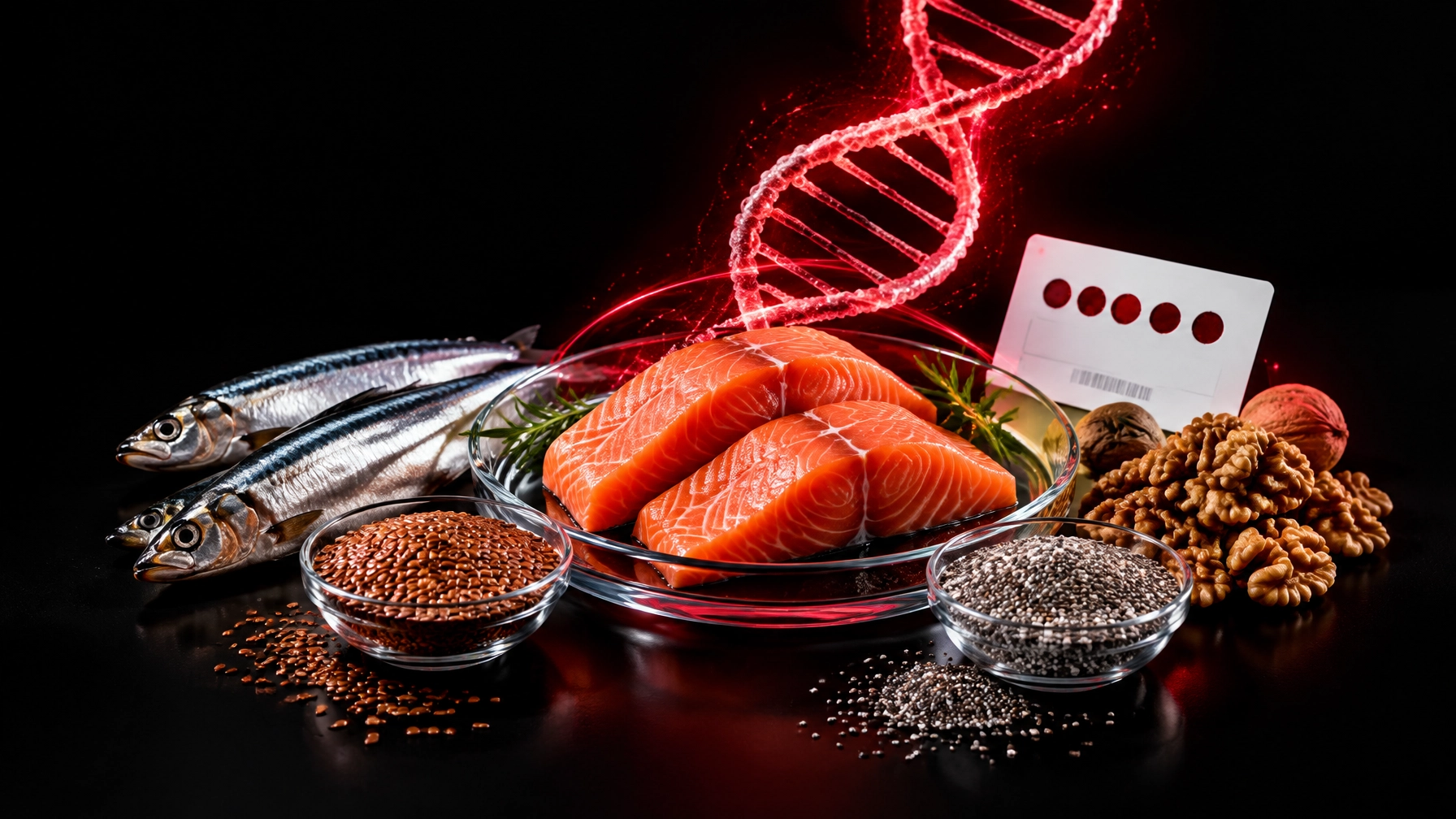

Part 2 of our five-part series on personalized health, nutrition, and genetics.
You may be eating flax, chia, and walnuts. You may even take fish oil every day. But your body may not be turning those omega-3 fats into useful EPA and DHA as efficiently as someone else’s body.
That is where FADS1 and FADS2 come into the conversation.
These genes help control the pathway that converts plant-based alpha-linolenic acid, or ALA, into the long-chain omega-3 fats EPA and DHA. Your genotype may influence how efficient that process is.
But genes are tendencies, not verdicts. The most useful approach is to combine DNA information with an objective blood test, nutrition history, and your health goals.
What Does FADS1 Actually Do?

FADS1 provides instructions for making the delta-5 desaturase enzyme. This enzyme works later in the pathway that converts shorter-chain fatty acids into longer-chain polyunsaturated fatty acids.
Here is the simplified process:
- You eat ALA from foods such as flax, chia, walnuts, and certain plant oils.
- FADS2 helps begin the conversion pathway.
- Other enzymes elongate the fatty-acid chain.
- FADS1 helps convert an intermediate into EPA.
- Additional steps are involved in the eventual production of DHA.
FADS2 is involved earlier in the pathway, while FADS1 plays a key role closer to the production of EPA. Together, the FADS1/FADS2 gene cluster can influence how much EPA and DHA your body makes from ALA (Koletzko et al., 2019; Minihane, 2016).
Some variants are associated with higher desaturase activity. Others are associated with lower activity. People with lower-activity variants may have more ALA and fewer long-chain products, including EPA and DHA, in their blood at similar dietary intakes.
That does not mean your DNA determines your outcome. It means your starting point and response to ALA may differ from someone else’s.
Plant-Based ALA Does Not Equal EPA and DHA
ALA is an important essential fatty acid. Your body needs it, and plant foods that contain ALA can absolutely be part of a healthy diet.
However, the conversion process is limited.
Research commonly estimates that:
- Approximately 5–10% of ALA may convert to EPA in many adults.
- Conversion to DHA is usually much lower.
- DHA conversion is often under 1–5%, with several studies reporting values near or below 1%.
- Conversion varies with age, sex, diet, overall health, and genetics.
In other words, eating a serving of chia seeds does not provide the same amount of preformed EPA and DHA as eating salmon.
This is not a reason to avoid flax, chia, or walnuts. These foods provide fiber, minerals, and other beneficial nutrients. It simply means that people who rely mostly on plant-based ALA may not achieve the same blood EPA and DHA levels as people who regularly consume fatty fish or preformed omega-3 supplements.
Your FADS1 and FADS2 variants may further shift that conversion efficiency.
Why Your Genotype Is Not Enough
A DNA report can suggest that you are likely to be a more efficient or less efficient converter. But it cannot tell you exactly where your omega-3 status is today.
That is why genotype should guide questions, not replace measurement.
Two people with the same FADS1 variant may have different omega-3 levels because of differences in:
- Fatty-fish intake
- Supplement use
- Body composition
- Age and sex
- Overall dietary pattern
- Absorption and digestion
- Health conditions
- Medication use
- Consistency over time
This is where a blood test becomes valuable.
The Omega-3 Index: A More Direct Answer

The Omega-3 Index measures EPA plus DHA in red blood cell membranes as a percentage of total fatty acids.
Because red blood cells live for several months, this test can provide a longer-term picture than a single meal or a short period of supplement use.
A commonly used framework is:
- Below 4%: Low range
- 4% to under 8%: Intermediate range
- 8% or higher: Desirable target range
These categories come from the work of William Harris and colleagues, who developed the Omega-3 Index as a practical marker of omega-3 status (Harris & von Schacky, 2004).
The test does not prove that omega-3s will prevent every health problem. It is not a diagnosis. But it gives you something useful: a measurable starting point.
Instead of asking, “Should I take more fish oil?” you can ask:
- What is my current Omega-3 Index?
- Does my diet support my target?
- Could my genetics be affecting conversion?
- Am I responding to my current routine?
- What should I discuss with my physician?
This is a much better process than guessing from a DNA report alone.
Practical Ways to Improve Your Omega-3 Intake

1. Eat fatty fish twice per week
Fatty fish provides preformed EPA and DHA, which means your body does not need to rely on the ALA conversion pathway.
Good options include:
- Salmon
- Sardines
- Trout
- Anchovies
- Herring
- Mackerel
Preparation matters. Grilled, baked, or broiled fish is generally a better choice than heavily fried fish.
2. Use plant-based ALA foods
Flax, chia, hemp seeds, and walnuts can still be valuable additions to your diet.
They support a high-fiber, nutrient-dense eating pattern. Just remember that they are not a guaranteed substitute for preformed EPA and DHA.
3. Consider algae-based DHA if you do not eat fish
Algae-based products can provide preformed DHA and may be a useful option for people who avoid seafood.
Some algae products also contain EPA. Check the label carefully, since amounts and ratios vary.
4. Choose supplements carefully
If a supplement is appropriate for you, look for a reputable company that provides:
- Independent third-party testing
- Clear EPA and DHA amounts
- Oxidation or freshness testing
- Heavy-metal testing
- Transparent sourcing
Do not choose a product based only on the total amount of “fish oil.” The important number is the actual amount of EPA and DHA.
Poshfitness does not prescribe supplements or medication. Supplement type and dose decisions should be discussed with your physician, especially if you take blood thinners, have a bleeding disorder, are preparing for surgery, or have a cardiovascular condition.
How a Health Coach Helps You Use This Information

This is exactly the kind of question a personal health coach can help you organize.
The goal is not to obsess over one gene. The goal is to connect the information:
- Test: Review your DNA and, when appropriate, your bloodwork.
- Interpret: Look at your FADS tendencies alongside your Omega-3 Index.
- Build the plan: Adjust food choices, training, recovery, and habits around your goals.
- Track: Repeat relevant testing when your physician recommends it.
- Refine: Use real results instead of continuing with trial and error.
A personalized plan may look different for someone focused on cardiovascular risk reduction, muscle gain, cognitive performance, body composition, or healthy aging.
For clients in Fairfield County CT and Greenwich CT, this data can be combined with in-home training and personalized lifestyle support. Nationally, our virtual coaching provides the same practical structure through digital fitness tracking, habit coaching, nutrition support, and community accountability.
Whether you are looking for elite personal training, ultra personal training, or a more flexible virtual health coaching plan, the principle is the same: your plan should reflect your body, your data, and your priorities.
The Bottom Line
Your omega-3 routine may be helping. But you may not know how well it is working until you measure your status.
FADS1 and FADS2 variants can influence how efficiently your body converts ALA from plant foods into EPA and DHA. Some people are more efficient converters. Others may benefit more from direct dietary sources of EPA and DHA.
Your genes provide context. Your Omega-3 Index provides a more objective measurement.
If you want help connecting DNA, bloodwork, nutrition, training, and long-term health habits, learn more about Posh Fitness DNA Fitness Coaching.
This article is for educational purposes only and is not medical advice. Poshfitness does not prescribe medication, supplements, GLP-1s, peptides, or HRT. All medical decisions regarding GLP-1s, peptides, or HRT remain with your physician or the GameDay Men's Health partnership for clinician-guided care.
References
Burdge, G. C., & Calder, P. C. (2005). Conversion of alpha-linolenic acid to longer-chain polyunsaturated fatty acids in human adults. Reproduction Nutrition Development, 45(5), 581–597. https://doi.org/10.1051/rnd:2005046
Harris, W. S., & von Schacky, C. (2004). The Omega-3 Index: A new risk factor for death from coronary heart disease? Current Atherosclerosis Reports, 6(6), 503–507. https://pubmed.ncbi.nlm.nih.gov/15208005/
Koletzko, B., Reischl, E., Tanjung, C., Gonzalez-Casanova, I., Ramakrishnan, U., Meldrum, S., et al. (2019). FADS1 and FADS2 polymorphisms modulate fatty acid metabolism and dietary impact on health. Annual Review of Nutrition, 39, 21–44. https://doi.org/10.1146/annurev-nutr-082018-124250
Minihane, A. M. (2016). Impact of genotype on EPA and DHA status and responsiveness to increased intakes. Nutrients, 8(3), 123. https://doi.org/10.3390/nu8030123
Yuan, S., Bäck, M., Bruzelius, M., Mason, A. M., Burgess, S., & Larsson, S. C. (2019). Plasma phospholipid fatty acids, FADS1 and risk of 15 cardiovascular diseases: A Mendelian randomisation study. Nutrients, 11(12), 3001. https://doi.org/10.3390/nu11123001
National Institutes of Health, Office of Dietary Supplements. (n.d.). Omega-3 fatty acids fact sheet for health professionals. https://ods.od.nih.gov/factsheets/Omega3FattyAcids-HealthProfessional/