
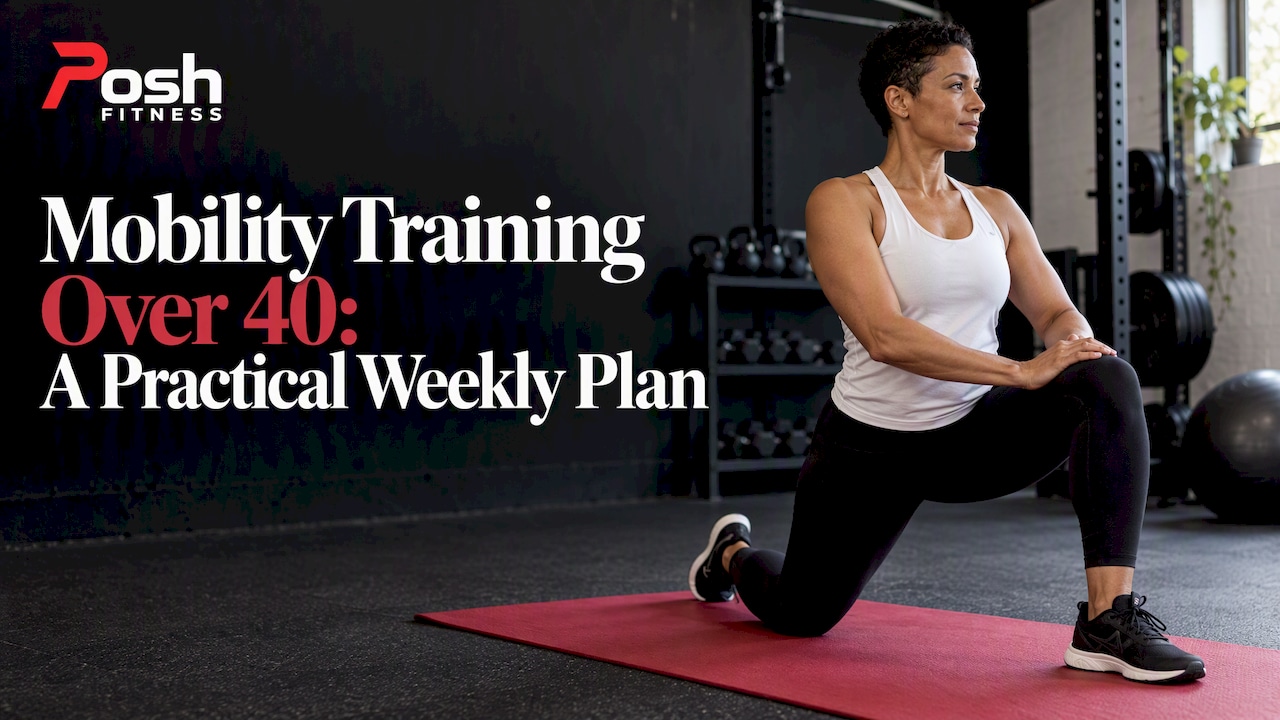

Mobility training after 40 means actively moving your joints through their full range with control, a few short sessions a week, alongside the strength and cardio work you already do. You do not need an hour on the floor. Ten focused minutes, a handful of well-chosen drills and a steady weekly rhythm will do more than an occasional long stretching session. Below you will find what mobility work is, a routine you can start this week, how to fit it around lifting, how often to do it, and how to keep it safe.
Key Takeaways
- Mobility is active control of movement through your available range. Flexibility is the passive ability of muscle and soft tissue to lengthen. After 40, you want both, but mobility is what you feel in daily life.
- A short dynamic warm-up before lifting does more for how you move than stretching cold muscles.
- Aim for mobility or range-of-motion work on at least 2 to 3 days a week, and 5 to 7 days if you can fit it in, on top of the national minimums for aerobic and strength training.
- Start at a low level, move warm joints, never push into pain, and check with your healthcare provider if you have pain or a medical condition.
- Track your progress with simple tests you repeat monthly, not with how sore you feel.
Table of Contents
- What Mobility Training Is, and How It Differs From Flexibility
- Why Movement Changes After 40
- A Dynamic Warm-Up Before You Lift
- A 10-Minute Mobility Routine to Start With
- How Often to Train: Mobility, Strength and Cardio Together
- Staying Safe While You Build Range
- How to Tell Whether Your Routine Is Working
- Our Perspective
- Get a Mobility Plan Built Around You
- FAQ
- Sources
What Mobility Training Is, and How It Differs From Flexibility
The two words get used as if they mean the same thing. They do not, and the difference shapes how you train.
Flexibility is the ability of a muscle and the surrounding soft tissue to lengthen. Mobility is the ability to move freely through a range of motion with coordination and stability. You can be flexible enough to pull your foot to your backside while lying on a mat, yet unable to squat comfortably because your hips and ankles cannot control that position under load.
ACE-certified professionals describe it the same way: mobility training emphasizes active control through a full range of motion, using dynamic drills, controlled articular rotations (CARs) and functional movement patterns. Flexibility reflects passive capacity. With age, mobility work helps you keep access to useful motion despite stiffness that builds from repetitive postures or inactivity.
In practice:
- Flexibility work is a static stretch, such as holding a hamstring stretch for 30 seconds.
- Mobility work is a slow, controlled hip circle, a loaded deep squat hold or a thoracic rotation where you own every degree of motion.
For most people over 40 who sit for work, drive, and lift a few times a week, mobility is the missing piece. It is also the reason a stretch-only routine often fails to change how a squat or overhead press feels.
Why Movement Changes After 40
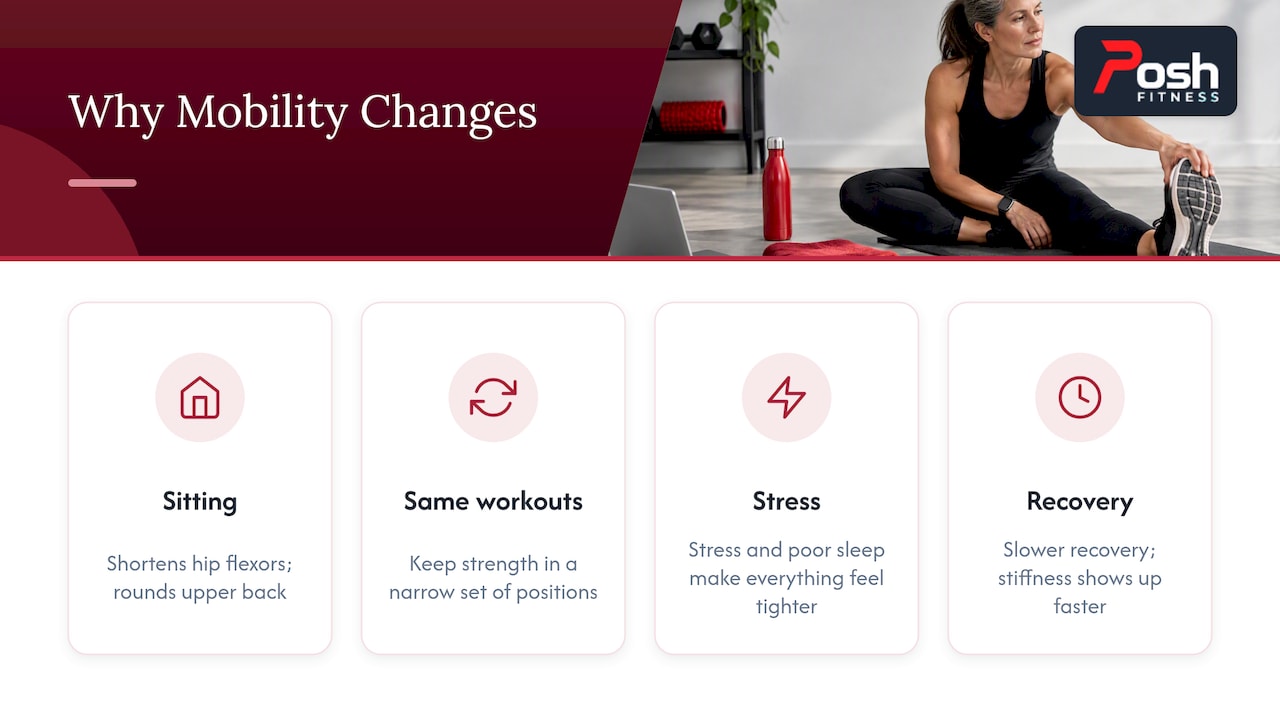
Nobody wakes up on their 40th birthday unable to move. What changes is the cumulative effect of decades of habits. Long hours in a chair shorten hip flexors and round the upper back. Years of repeating the same workout keep you strong in a narrow set of positions. Stress and poor sleep make everything feel tighter. Add the slower recovery many adults notice in their 40s, and a stiff morning or a cranky shoulder shows up faster than it used to.
There is good news in the research. Regular exercise and physical activity can reduce the negative physiological effects of a sedentary lifestyle and may increase healthspan, according to the American College of Sports Medicine. The same source notes that responses to exercise vary with age, sex and hormonal status, and that no single program is optimal for everyone. That is the reason we do not hand out one routine to every client. If you feel flat or tired as well as stiff, our guide to low energy at 40 covers the common causes and the checks worth asking about.
A Dynamic Warm-Up Before You Lift
If you do only one thing from this article, make it this. Before a strength session, use a short dynamic warm-up in place of a long static stretch. In our coaching, a good warm-up has four parts:
- Raise your heart rate. Two to three minutes of easy cycling, brisk walking, or rowing.
- Move every joint through its range. Ankles, hips, spine, shoulders and wrists, with slow controlled circles.
- Rehearse the movement patterns. Bodyweight squats, hip hinges, push-ups on an incline, or band pull-aparts, whatever the session needs.
- Ramp up to your first working set. Do two or three lighter sets of your first lift before the heavy one.
Static stretching has a place too, but timing matters. The American College of Sports Medicine notes that static stretching is best preceded by light-to-moderate aerobic activity that increases muscle blood flow and temperature. That is why we place long holds after the session, or on a separate day, rather than before heavy lifting.
Two moves are worth adding to almost any pre-lift routine for adults over 40:
- Hip hinge with a pause. Push your hips back with a long spine, feel the hamstrings load, then return. This prepares the pattern for deadlifts, swings and carrying groceries.
- Controlled hip or shoulder CARs. Slow, large circles at the edge of your range, as smooth as you can make them.
A 10-Minute Mobility Routine to Start With
The following routine uses movements that mobility-focused fitness guidance for adults in their 40s and beyond often features, such as side bends, hip hinges and kneeling stretches, plus CARs from the ACE description above. Move slowly. Each rep should feel like you are exploring your range, not forcing it.
| Move | What it targets | Dose |
|---|---|---|
| Cat-cow | Spine, upper and lower back | 8 slow reps |
| Hip CARs (standing or on all fours) | Hip joint | 5 circles each direction, each side |
| Hip hinge to a pause | Hamstrings, glutes, back control | 8 reps |
| Half-kneeling hip flexor stretch with a reach | Front of the hip, trunk | 30 seconds each side, 2 rounds |
| Thoracic rotation (open book) | Mid-back | 8 reps each side |
| Shoulder CARs | Shoulder joint | 5 circles each direction, each side |
| Deep squat hold with support | Hips, ankles, knees | 30 to 60 seconds total |
A few coaching notes:
- Work at the edge, not past it. You should feel a stretch or a gentle challenge, never sharp or pinching pain.
- Breathe. Holding your breath is a sign you are forcing the position.
- Use support. A doorframe, a bench or a light kettlebell as a counterweight in the squat hold makes the position safer and easier to learn.
- Repeat the same routine for a month. Familiarity lets you notice real changes in range.
If your lower back is the main problem, pair this routine with the short sessions in our guide to lower back pain workouts you can do in 5 to 12 minutes.
How Often to Train: Mobility, Strength and Cardio Together
Mobility is not a substitute for the basics. It sits beside them. The national guidelines are clear on the foundation. The Physical Activity Guidelines for Americans recommend that adults aim for at least 150 minutes of moderate-intensity aerobic activity per week, plus at least 2 days of muscle-strengthening activities. The National Institute on Aging likewise advises that muscle-strengthening activities for the major muscle groups be done at least 2 days per week to help preserve physical function and independence as you age.
For range of motion, the ACSM guidance suggests that static stretching is commonly recommended at 15 to 30 seconds for 2 to 4 repetitions, on at least 2 to 3 days weekly and optimally 5 to 7.
A realistic week for a busy adult in their 40s or 50s might look like this:
| Day | Session |
|---|---|
| Monday | Strength (full body), 5-minute dynamic warm-up |
| Tuesday | 10-minute mobility routine plus a brisk 30-minute walk |
| Wednesday | Cardio at a moderate pace, 30 to 40 minutes |
| Thursday | Strength (full body), 5-minute dynamic warm-up |
| Friday | 10-minute mobility routine |
| Saturday | Longer walk, hike or sport, plus 5 minutes of stretching afterward |
| Sunday | Rest or gentle movement |
That adds up to two strength days, around 150 minutes or more of aerobic activity including walking, and mobility work on four or more days. It is a template, not a prescription. If you are deciding how to split your time, our post on what to do each week for longevity goes deeper on strength, cardio and recovery.
Do not forget balance
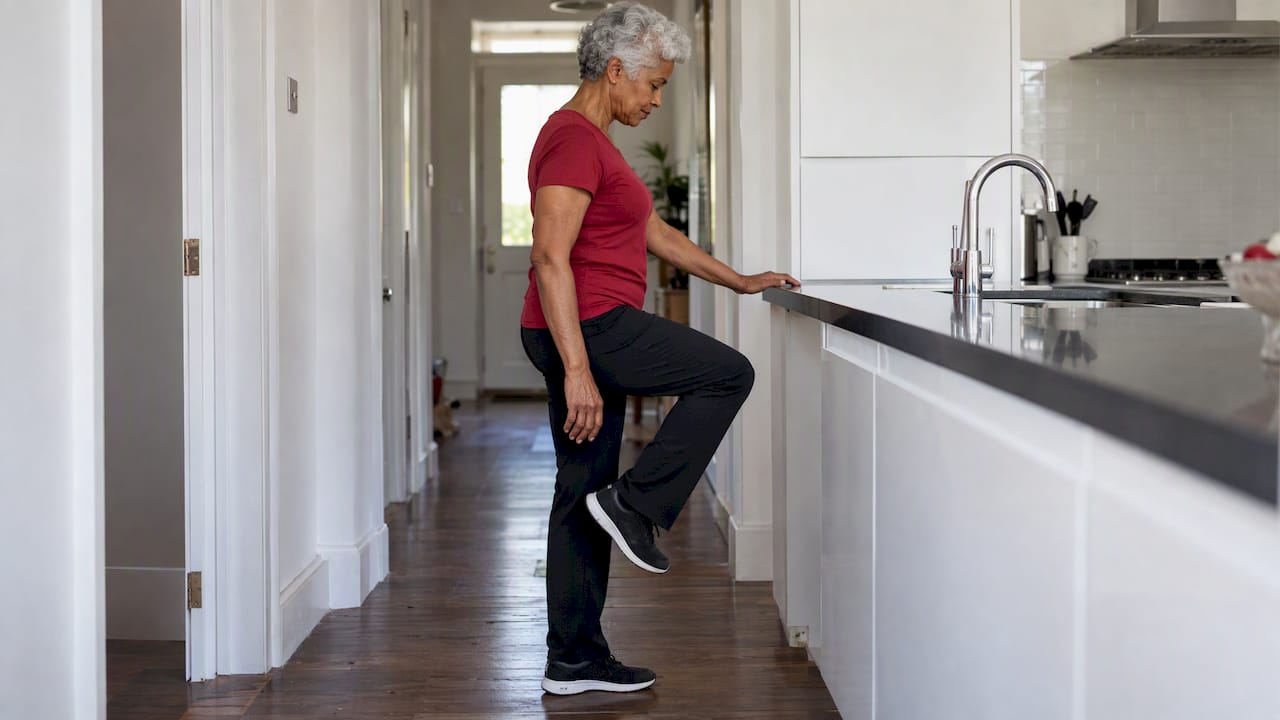
For older adults, the guidelines emphasize a multicomponent approach. According to the CDC’s summary of Community Preventive Services Task Force findings, balance training belongs alongside aerobic and muscle-strengthening exercise. You can start now with single-leg stands near a counter or heel-to-toe walking. If you want to see how people structure this work, this overview of balance training for older adults lays out safe exercise options.
Staying Safe While You Build Range
Mobility work is low-risk when you respect a few rules. These apply most if you have pain, a past injury or a long break from exercise.
- Start low and build gradually. Guidance from the University of Michigan’s pain program says that people with pain should begin at a low level, stretch warm muscles without bouncing or stretching into pain, and consult a healthcare provider before starting or changing an exercise program.
- Warm up and cool down easily. The ACSM’s guidance for people with mobility limitations advises light-to-medium effort, gradual increases, and cutting back if pain worsens.
- Skip bouncing. Ballistic stretching on cold tissue is a common way to tweak a hamstring or lower back.
- See the right professional for specific situations. Pain that radiates down a leg, numbness, joint swelling, dizziness, or a recent surgery all call for a conversation with your physician or a physical therapist before you add new movements.
It is also worth knowing that the National Institute on Aging points out that the benefits of exercise for older adults often outweigh the minor associated risks, and that routine medical stress testing may not always be necessary before beginning a program. That is reassuring, but it does not replace advice from your own doctor if you have heart disease, diabetes, or another condition.
How to Tell Whether Your Routine Is Working
Soreness is a poor scoreboard. Use measures you can repeat.
- Deep squat hold. Time how long you can sit in a supported deep squat with heels down. Retest every four weeks.
- Hip hinge reach. Stand tall, hinge, and note how far down your legs your hands travel with a flat back.
- Overhead reach. Stand with your back to a wall and raise your arms. Can your ribs stay down and your arms touch the wall?
- Morning feel. Rate your stiffness out of 10 for the first 30 minutes of the day, and track the weekly average.
- Lift quality. Do your squats and presses feel smoother at the same weight?
If two or three of these improve over 6 to 8 weeks, the routine is helping. If nothing changes, the fix is rarely more stretching. It is usually a different drill, more strength through the new range, or a look at sleep, stress, and recovery.
Our Perspective
Most of the clients who come to us over 40 have already tried stretching. They hold a hamstring stretch for years and still cannot hinge without their back taking over. Our view is that mobility is a skill you build with strength, not a flexibility score you chase.
That is why we start with an assessment of how you actually move, and, where it helps, with data on how your body is built: DNA analysis, bloodwork and physical testing. Two people with the same stiff hips can need very different plans. One is under-recovered and under-slept, with energy markers that explain why every session feels heavy. Another simply has not trained their hips through a full range in fifteen years. A generic routine treats them the same. A personalized one does not.
We build mobility into every program, in your home, at an affiliated gym or virtually, so the work fits your week and your goals. We work alongside your doctor, and we ask you to check in with your provider before you start if you have pain or a medical condition. Calm, consistent, measured work wins. Ten minutes four times a week, repeated for a year, will change how you move.
Peter
Get a Mobility Plan Built Around You
If you would rather have someone watch you move, correct your form and build the routine into your strength training, our trainers can do that. In Fairfield County, we train clients at home, at affiliated gyms or virtually, and we also serve Westchester County, NY.

Online options start with the Online Personal Fitness Plan Starter at $40 per month, and the Truly Personal Plan at $99 per month, both on our online personal training page. If you want a trainer to review your movement live, a Live Virtual Training Session is $80. For a deeper, data-led approach, see our health coaching and DNA coaching programs.
FAQ
Is it too late to improve flexibility after 40?
No. Muscle and soft tissue still respond to regular, gradual stretching and active range-of-motion work at any age. The key is consistency and warm tissue, with ACSM guidance suggesting range-of-motion work on at least 2 to 3 days a week. Start gently and build up, and check with your provider if you have pain or a joint condition.
How often should I work out over 40?
The national guidelines call for at least 150 minutes of moderate aerobic activity each week and muscle-strengthening on at least 2 days. Most of our clients do two or three strength sessions, a few walks or cardio sessions, and short mobility work on top. Your own schedule should reflect your health, recovery and goals.
Should I stretch before or after lifting?
Before lifting, use a dynamic warm-up: raise your heart rate, move your joints through their range and rehearse your main lifts with lighter sets. Save longer static holds for after your session or a separate day, when your muscles are warm.
Is mobility work safe if I have back or joint pain?
Often yes, when it is gentle and gradual, but it depends on the cause of your pain. Stay in a comfortable range, never stretch into pain, and talk with your doctor or a physical therapist first, especially for numbness, radiating pain, swelling, or after surgery.
Sources
- Mobility vs. flexibility: Why the difference matters for movement and performance (ACE)
- Flexibility vs. mobility: What is the difference? (Medical News Today)
- 5 Mobility Moves to Do in Your 40s and Beyond (Healthline)
- Exercise and Physical Activity for Older Adults (ACSM)
- Fitness Focus Copy-and-Share: Flexibility (ACSM Health & Fitness Journal)
- Physical Activity Guidelines for Americans, 2nd edition (CDC)
- Exercise and Older Adults (National Institute on Aging)
- Physical Activity: Home-based Exercise One Pager (CDC)
- Exercise (University of Michigan PainGuide)
- Being Active With Mobility Limitations (ACSM)
- Reducing Chronic Disease and Disability (National Institute on Aging)
- Balance Training for Seniors: Safe Exercises to Prevent Falls