

An MTHFR variant changes how efficiently your body converts folate into its active form, but it does not mean you cannot use folate. The CDC states that people with an MTHFR variant can process all types of folate, including folic acid. The practical questions are how much folate you get, whether your B12 is adequate, and what your bloodwork shows. This guide covers each one, with a short section at the end on vitamin D, because the same fatigue and performance questions tend to come up together.
Key Takeaways
- MTHFR variants are common and affect how folate is converted. Folic acid still raises blood folate levels in people with them.
- If you could become pregnant, the CDC recommends 400 mcg of folic acid daily, even with an MTHFR variant.
- Methylfolate is a legitimate supplement option for some people. Large folate doses can hide a B12 deficiency, so B12 status matters.
- Homocysteine, B12 and folate bloodwork tell you more about how you are functioning than a genotype alone.
- Vitamin D is worth checking when symptoms or risk factors point to it, but it is not a proven fix for fatigue, low testosterone or weight loss.
Table of Contents
- What MTHFR Does in Your Body
- Folic Acid vs. Methylfolate
- Do You Need to Test for MTHFR?
- MTHFR and B12
- Methylfolate Dosage and Side Effects
- Eating for Folate: What to Put on Your Plate
- Vitamin D: The Other Question Behind Fatigue
- Our Perspective
- Turning Your Results Into a Plan
- Work With Us on a Plan That Fits Your Biology
- FAQ
- Sources
What MTHFR Does in Your Body
MTHFR is a gene that codes for an enzyme involved in folate metabolism. The enzyme helps convert folate into 5-methyltetrahydrofolate (5-MTHF, also called methylfolate), the form your body uses to recycle homocysteine into methionine. That step also depends on vitamin B12, which is why folate and B12 are discussed together.
The variant most people ask about is C677T. A 2017 review reports roughly a 30% drop in enzyme activity in people with one copy and about 60% in people with two. That can mean higher homocysteine and lower folate levels. The same review notes that giving folic acid has been shown to eliminate these differences.
The CDC gives a concrete figure: with similar folate intake, people with the 677 TT genotype have a blood folate level about 16% lower on average than people with the CC genotype. That is a measurable difference, not a barrier. The same CDC page says 400 mcg of folic acid daily can raise blood folate regardless of genotype.
How common is it?
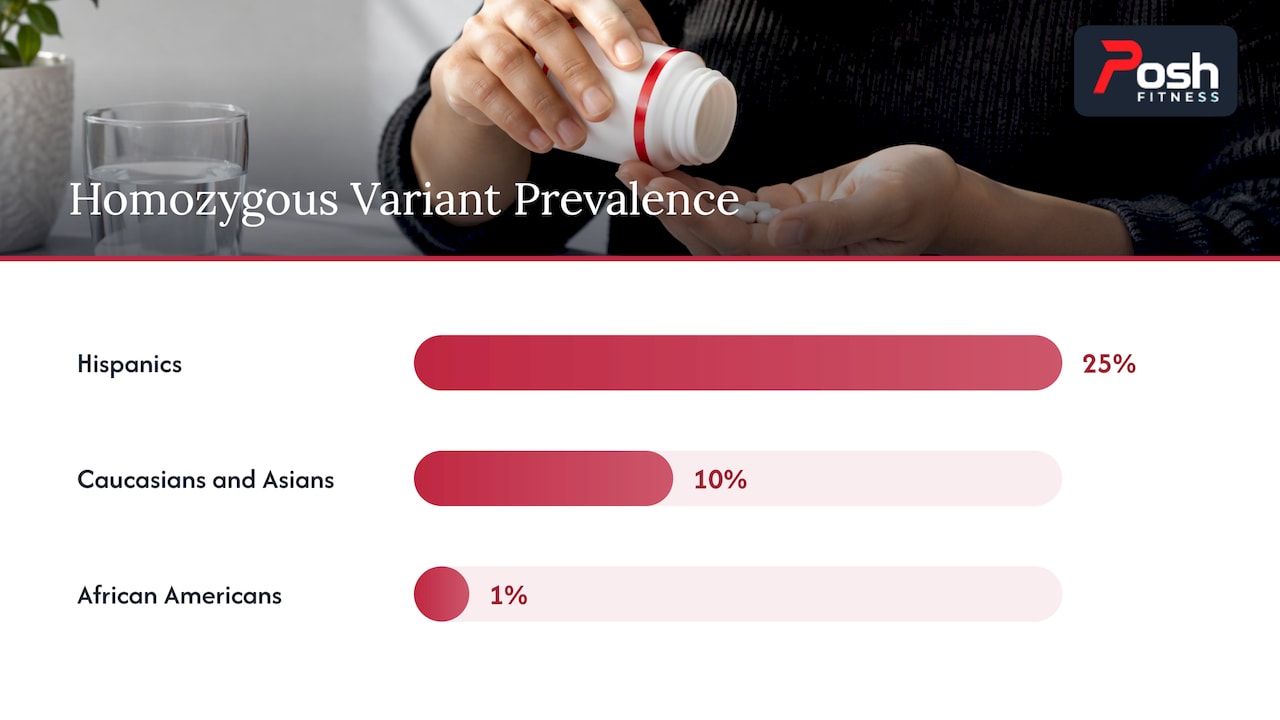
Very. According to the NIH Office of Dietary Supplements, about 25% of Hispanics, 10% of Caucasians and Asians, and 1% of African Americans are homozygous for the 677C>T polymorphism. If you have a result back from a consumer DNA kit, you are in large company.
Folic Acid vs. Methylfolate
These are different forms of the same family of vitamins.
| Form | What it is | Where you find it |
|---|---|---|
| Folate | The natural food form | Leafy greens, beans, liver, citrus |
| Folic acid | The fully oxidized synthetic form | Fortified grains, most standard supplements |
| Methylfolate (5-MTHF, L-methylfolate) | The active form, already converted | Some supplements |
The NIH explains that folic acid is the form used in fortified foods and most supplements, while some supplements contain 5-MTHF. The NIH consumer fact sheet adds that 5-MTHF supplements might be better than folic acid for some people with the C677T variant, because their bodies can use that form more easily.
So is methylfolate better? The honest answer is that it depends on who you are. For most adults, a food-first pattern plus a quality supplement chosen with your clinician is reasonable. For anyone who could become pregnant, the answer is more specific, covered next.
If you could become pregnant
The CDC and NIH are consistent here. All women and teen girls who could become pregnant should get 400 mcg of folic acid daily from supplements, fortified foods or both, in addition to the folate in a healthy diet, even with an MTHFR C677T variant. The CDC also notes that folic acid is the only type of folate shown to help prevent neural tube defects.
The UK Teratology Information Service points out that no studies have yet looked at birth defect rates in babies born to women who took methylfolate in pregnancy, and that it cannot currently recommend routine prenatal methylfolate in preference to folic acid. If you are planning a pregnancy or are pregnant, speak with your obstetrician or midwife before changing the form of folate you take.
Why this matters for the variant itself: a case-control study found the CT and TT genotypes were associated with higher odds of neural tube defects (odds ratios of 1.52 and 2.56). That is a reason to take the standard recommendation seriously, not a reason to look for a substitute.
Do You Need to Test for MTHFR?
Most people do not need an MTHFR genotype for medical decisions. The CDC’s clinician guidance states there are no clinical recommendations to test for MTHFR status or to change folate or folic acid intake based on genotype. MedlinePlus says a provider may order the test in specific cases: higher-than-normal homocysteine with a close relative diagnosed with an MTHFR change, early heart or blood vessel disease in you or close family, or when methotrexate is prescribed.
What tells you more about how you are functioning is a blood marker. Cleveland Clinic Laboratories suggests that when there is concern about high homocysteine, measuring plasma homocysteine is more informative than genotyping. If it is high, B6, B12 and folate are options your clinician can discuss. If it is normal, no treatment is indicated even with a variant.
This is how we think about it with clients. A genetic result is one data point. Bloodwork shows what is happening now. Our related guides cover what DNA testing can and cannot tell you and which lab markers matter when you are working on body composition.
MTHFR and B12
Folate and B12 work as a pair in the remethylation of homocysteine. A review in PMC on cobalamin response is part of the research picture, but the safety point is simpler and well established.
The NIH consumer fact sheet says large amounts of folate supplements might hide a vitamin B12 deficiency, because they can correct the anemia that B12 deficiency causes, and large doses might worsen its symptoms. The health professional sheet explains that experts’ concern has shifted to large folate amounts precipitating or worsening the anemia and cognitive symptoms of B12 deficiency.
In practice, if you plan to take folate or methylfolate beyond a standard multivitamin, ask your physician to check B12 first. This is especially relevant if you are over 50, vegetarian or vegan, or take medications that affect B12 absorption, and your physician can advise on your situation.
Methylfolate Dosage and Side Effects
There is no official dose of methylfolate set by MTHFR genotype. The FDA Daily Value for folate is 400 mcg DFE for most adults, 600 mcg DFE in pregnancy and 500 mcg DFE while breastfeeding. ConsumerLab reports that the Tolerable Upper Intake Level for supplemental folic acid and methylfolate is 1,000 mcg per day for adults 19 and older, and that too much over a long period can cause harm, including kidney damage.
Prescription L-methylfolate products carry more detailed labeling. Medscape’s reference lists possible effects such as altered sleep, irritability, nausea and bloating, and notes that doses above 0.1 mg per day may obscure pernicious anemia, with use under a healthcare provider’s supervision. If you notice sleep changes, anxiety or irritability after starting methylfolate, stop and talk with your prescriber.
A reasonable approach, to take to your clinician:
- Get B12, folate and homocysteine measured.
- Choose a supplement dose that stays well within 1,000 mcg unless a clinician directs otherwise.
- Retest in a few months to see whether your markers moved.
Eating for Folate: What to Put on Your Plate
There is no special MTHFR diet backed by guidelines, but folate-rich foods are the foundation. The NIH lists these per serving:
- Beef liver, braised, 3 ounces: 215 mcg DFE (54% DV)
- Spinach, boiled, ½ cup: 131 mcg DFE (33% DV)
- Black-eyed peas, boiled, ½ cup: 105 mcg DFE (26% DV)
- Asparagus, boiled, 4 spears: 89 mcg DFE (22% DV)
All of those figures come from the NIH fact sheet. The FDA adds that folate is also in brussels sprouts, mustard greens, oranges, walnuts and beans, and that folic acid is added to enriched breads, pastas, rice, cornmeal and certain cereals. Since the FDA began requiring fortification in January 1998, mean folic acid intake in the US rose by about 190 mcg per day.
A simple weekly pattern: a leafy green at most meals, legumes three or four times a week, and citrus or berries as a daily snack. That fits a protein-forward, whole-food pattern that supports body recomposition as well.

Vitamin D: The Other Question Behind Fatigue
Middle-aged adults who ask us about MTHFR are often really asking why they feel tired and flat. Vitamin D comes up in the same conversation, so here is where the evidence stands.
Fatigue
Cleveland Clinic lists fatigue, bone pain, muscle weakness and mood changes among possible signs of vitamin D deficiency. Providers usually do not run routine checks but may test when you have risk factors or symptoms. A 2018 American Family Physician review found that trials of vitamin D for fatigue showed no benefit, even in people with low baseline levels. The takeaway: fatigue deserves a broad workup (sleep, thyroid, iron, B12, glucose, stress) instead of a single-nutrient guess.
Testosterone
A 2026 meta-analysis of randomized trials found no statistically clear or reproducible effect of vitamin D supplements on total testosterone in adult men. A 2015 analysis of three small trials found raised vitamin D levels but no change in testosterone in men with normal baselines. If you are concerned about low testosterone, that is a conversation for your physician and a proper lab panel.
Weight loss
The NIH Office of Dietary Supplements says the research does not support vitamin D supplements for weight loss. A meta-analysis of 12 trials found no effect on body weight or fat mass without calorie restriction. Body weight and vitamin D status are associated, but that is not the same as cause.
How much is safe?
The upper intake level for adults is 4,000 IU (100 mcg) per day, and the recommended allowance is 600 IU for adults 19 to 70. Use a blood level and your clinician’s advice to decide whether you need more than that.
Our Perspective
Most of the people who come to us are not asking about one gene. They are asking why they feel worn down when they are doing the things they were told to do. MTHFR is often the first thing they have read about, and we understand why: it offers a single, tidy explanation.
What we have found is that the explanation is rarely one variable. A variant, a borderline B12, a low vitamin D, poor sleep and a training program that does not fit your recovery can all be part of the picture. Our approach combines DNA analysis, bloodwork, gut microbiome testing and physical assessments so that the program fits your biology instead of an average.
We work alongside your physician, never in place of one. Supplement decisions, especially around folate form, pregnancy and B12, belong with your clinician. Our role is to translate the data into daily training, nutrition and recovery habits you can actually keep, then retest to see what moved.
Our aim is for you to regain the energy and performance you remember, with a plan built on your numbers.
Peter
Turning Your Results Into a Plan
If you already have a genetic report, treat the MTHFR line as a prompt to look at the rest of your data. Our 4 Week DNA Coaching program is built for that: it uses your results to shape training and nutrition. If you also want to see how your gut handles nutrients, our Viome microbiome testing adds another layer.
For clients in Greenwich, Stamford, Darien, Westport and Norwalk, we bring in-home personal training to your door. We also coach virtually and at affiliated gyms.
Work With Us on a Plan That Fits Your Biology
We design personal training, nutrition and longevity coaching around your DNA, bloodwork and assessments. If you prefer to start online, our Online Personal Fitness Plan Starter is $40 per month and the Truly Personal Plan is $99 per month, both on the online training page. A single Live Virtual Training Session is $80.
For in-person and longevity options, see our pricing page, or get started with a trainer in Fairfield County.
FAQ
Should I take folate if I have an MTHFR variant?
Yes, folate still matters. The CDC says people with MTHFR variants can process all forms of folate, including folic acid. If you could become pregnant, it recommends 400 mcg of folic acid daily regardless of variant. For any other supplement plan, ask your clinician and check B12 first.
Is methylfolate better than folic acid?
It may suit some people with the C677T variant, since it is already in the active form. For pregnancy, the CDC and NIH still point to folic acid, which is the form with proven neural tube defect prevention. Discuss the choice with your physician.
Does an MTHFR mutation need a special diet?
No guideline sets an MTHFR-specific diet. Emphasize folate-rich foods such as leafy greens, legumes, asparagus, brussels sprouts and citrus, along with adequate B12 from animal foods or a clinician-approved supplement.
Can too much methylfolate cause problems?
Possibly. The upper limit for supplemental folic acid and methylfolate is 1,000 mcg per day for adults, and high doses can obscure a B12 deficiency. Reported effects of prescription L-methylfolate include sleep changes and irritability, so use it under a provider’s supervision.
Does vitamin D deficiency cause fatigue?
It can be one of several possible signs, but trials of vitamin D for fatigue have not shown benefit. If you are persistently tired, ask your physician about a full workup that may include a vitamin D level.
Sources
- CDC: MTHFR Gene Variant and Folic Acid Facts
- CDC: Folic Acid Facts for Clinicians
- NIH ODS: Folate Health Professional Fact Sheet
- NIH ODS: Folate Consumer Fact Sheet
- Genetic polymorphisms and folate status (PMC, 2017)
- MTHFR C677T and neural tube defect risk (PMC, 2004)
- UKTIS: Use of methylfolate in pregnancy
- MedlinePlus: MTHFR Gene Test
- Cleveland Clinic Laboratories: MTHFR Polymorphism Genotyping
- Medscape: Deplin (L-methylfolate)
- FDA: Folate and Folic Acid on Nutrition and Supplement Facts Labels
- Cleveland Clinic: Vitamin D Deficiency
- American Family Physician: Vitamin D Screening and Supplementation
- Vitamin D, total testosterone and androgens meta-analysis (PMC, 2026)
- Vitamin D supplementation and testosterone concentrations (PubMed, 2015)
- NIH ODS: Vitamin D Health Professional Fact Sheet
- Good Housekeeping: How much vitamin D per day