

Testosterone is one of the main hormonal signals that tells muscle to build and repair itself. When levels are adequate, resistance training and protein turn into muscle more efficiently. When levels fall well below normal, that process gets harder, and fat tends to creep in. You can support healthy testosterone with training, sleep, body composition and nutrition. If you suspect your levels are truly low, the answer is a morning blood test and a conversation with your physician, not a supplement.
Key Takeaways
- Testosterone stimulates muscle protein synthesis and blocks muscle-breakdown pathways, which is why it matters for strength and lean mass.
- Levels drift down gradually with age, and the lifestyle factors you control (resistance training, sleep, body fat, diet) are the first lever to pull.
- Most over-the-counter “testosterone boosters” fail to raise total testosterone in a systematic review, so training and body composition do more.
- Low testosterone is diagnosed only when symptoms and repeated low blood values appear together, so bloodwork comes before any decision.
Table of Contents
- How testosterone builds and maintains muscle
- What happens to testosterone and muscle with age
- Testosterone and fat loss
- What testosterone therapy does for muscle
- Natural ways to support healthy testosterone
- When to get bloodwork
- Our perspective
- Train around your own biology
- FAQ
- Sources
How testosterone builds and maintains muscle
Testosterone binds to androgen receptors in muscle cells. From there it does several things at once. According to a 2026 review in Endocrine Reviews and PubMed, it increases the proliferation of muscle precursor cells, stimulates growth hormone and IGF-1 signaling, raises muscle protein synthesis and switches off genes that drive muscle atrophy.
In plain terms, training creates the stimulus and testosterone helps the body respond to it. A specialist at the Hospital for Special Surgery explains that testosterone helps generate the proteins that build muscle, which in turn supports strength.
Two details are worth knowing:
- Fiber types. Testosterone treatment increases the size of both type 1 and type 2 muscle fibers and raises muscle progenitor cell numbers, so the effect is not limited to one kind of training.
- Building and breakdown. In healthy people, a 200 mg intramuscular dose of testosterone enanthate produced a twofold increase in net protein synthesis while protein breakdown stayed unchanged. The gain came from building more, not from breaking down less.
This is also why testosterone is not a stand-in for training. The hormone amplifies the signal. Lifting, protein intake and recovery still supply it. If you want the training side in detail, hypertrophy training with weekly sets is a good place to see how volume drives muscle growth.
What happens to testosterone and muscle with age
Muscle loss begins quietly. According to the same HSS specialist, people lose about 3 to 5% of their muscle mass per decade after 30. Nutrition and exercise can lessen that, but it gets harder as men age and testosterone declines faster.
The decline rate is reported a little differently depending on the study:
| Source | What it reports |
|---|---|
| 2018 review on testosterone and sarcopenia | About 1% per year after age 30; roughly 40% to 70% of men older than 70 likely have low levels |
| 2022 narrative review in older men | Serum testosterone falls 2 to 3% annually, linked to late-onset hypogonadism symptoms |
The link to muscle is measurable. A 2025 review reports that a 50% decrease in free testosterone is associated with a 1.4-fold higher probability of frailty and a 1.55-fold higher risk of sarcopenia in men. Age is not a diagnosis, though. Plenty of men in their 40s and 50s sit comfortably in the normal range, and fatigue at that age often has other causes. Our guide to low energy at 40 walks through those causes and the checks worth running.
Testosterone and fat loss
The relationship between testosterone and body fat runs in both directions. A review of male obesity describes how rising body fat suppresses the hormonal axis that drives testosterone through inflammatory signals and insulin resistance, while low testosterone in turn promotes more total and visceral fat. That loop explains why some men feel stuck: the harder fat loss gets, the lower testosterone can fall, and the reverse.
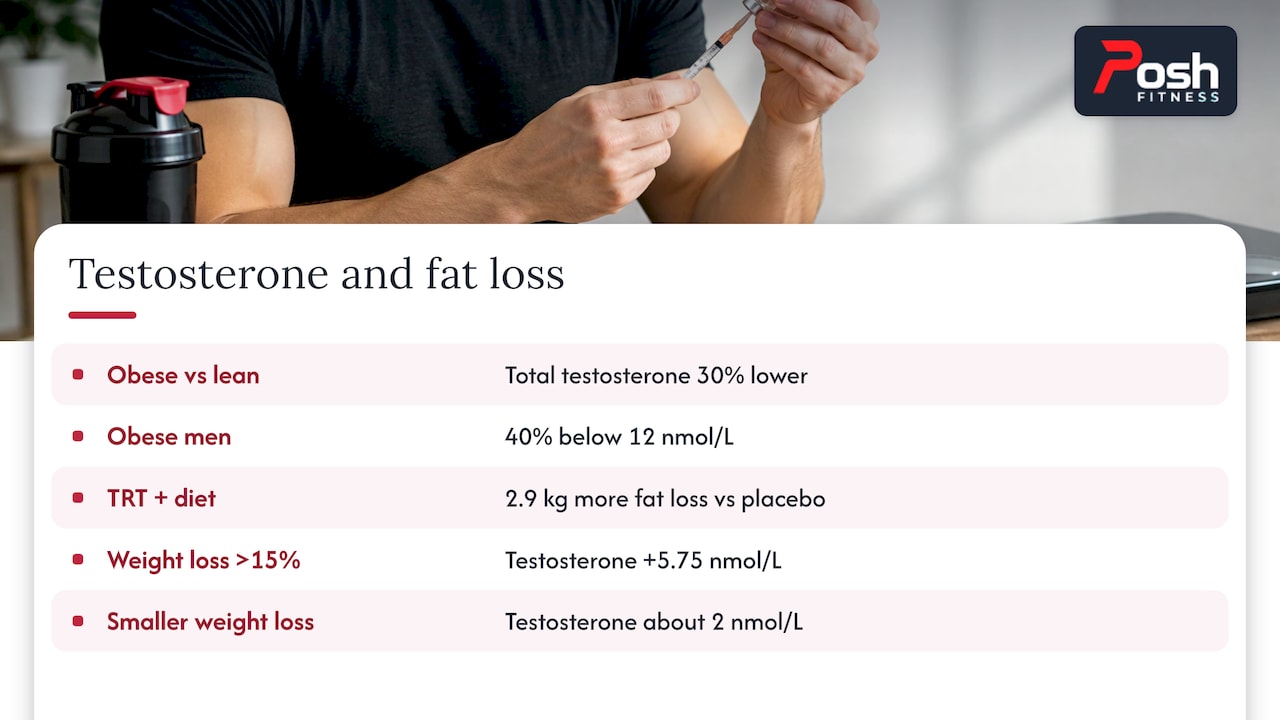
The numbers are striking. In a 2016 review, obese men had 30% lower total testosterone than lean men, and 40% had levels below 12 nmol/L. In obese men on a calorie-reduced diet, testosterone treatment added 2.9 kg of fat loss compared with placebo and protected lean mass.
The encouraging part for anyone not on therapy is that weight loss itself helps. The Grossmann review found that losing more than 15% of body weight raised total testosterone by about 5.75 nmol/L, while smaller losses produced only modest gains of about 2 nmol/L.
The practical lesson: lose fat in a way that protects muscle. Aggressive crash dieting works against you. Our article on body recomposition versus weight loss explains how to aim for 1 to 2 pounds a week while keeping lean mass.
What testosterone therapy does for muscle
Research on testosterone replacement therapy (TRT) gives a sense of how much muscle the hormone can influence. Results depend heavily on the formulation and the person.
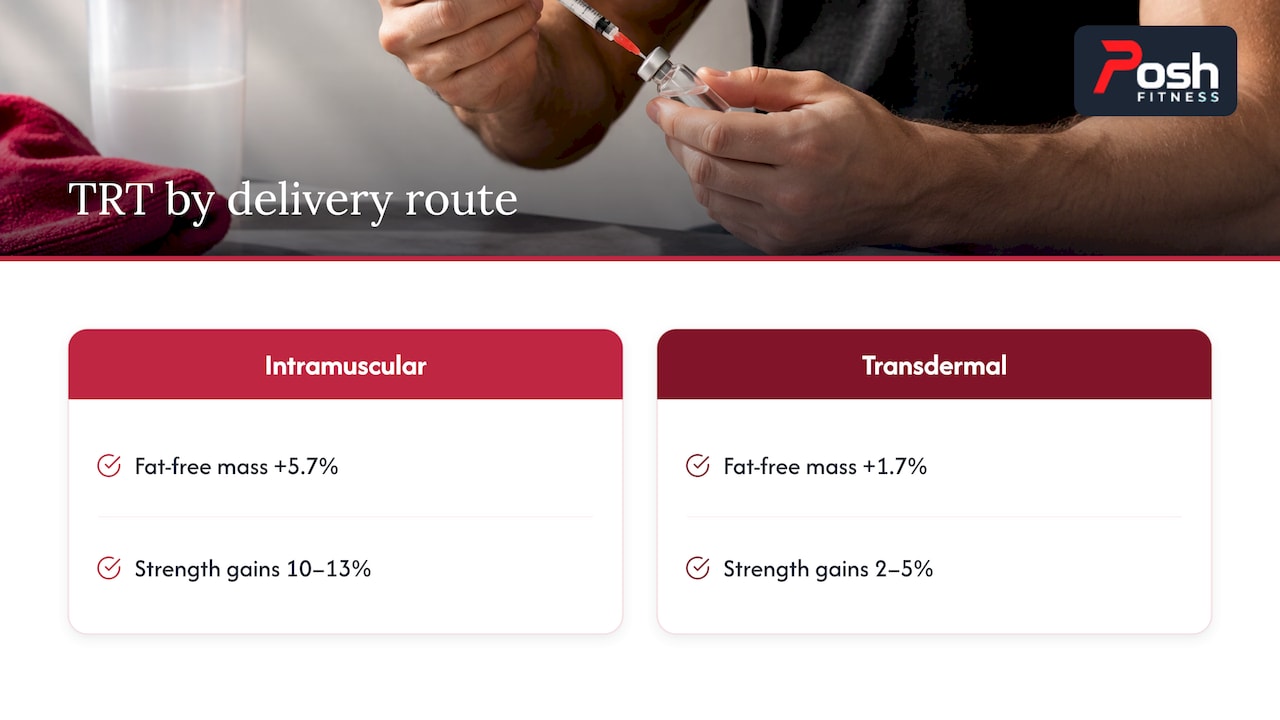
A 2018 meta-analysis by Skinner and colleagues found that intramuscular TRT was associated with a 5.7% increase in fat-free mass and 10 to 13% strength gains, while transdermal TRT was associated with a 1.7% increase in fat-free mass and 2 to 5% strength gains. Intramuscular delivery produced three to five times greater percent improvement.
In older men, a 2015 meta-analysis found androgen therapy increased lean body mass by 3.59 kg and reduced fat mass by 1.78 kg. A more recent 2024 review reports a more modest figure, about 1.6 kg of added lean mass in older men, with no consistent, meaningful change in strength, fatigue or cognition. Early work using supraphysiologic doses reported much larger muscle gains, for example a 20% increase in muscle mass at 3 mg/kg per week in healthy men, but those are pharmacological doses, not what clinical care aims for.
The takeaway: therapy can add lean mass in men who truly need it, and it works alongside training rather than replacing it. Whether it fits you is a medical decision.
Who qualifies for therapy
The American Urological Association defines testosterone deficiency as both low levels and symptoms or signs associated with low serum total testosterone. A number alone is not enough. A symptom alone is not enough either.
A 2024 review in American Family Physician adds practical detail: a fasting morning level below 300 ng/dL (10.41 nmol/L) should be repeated to confirm, and baseline hematocrit and PSA should be checked before therapy is considered. The Endocrine Society likewise recommends diagnosing hypogonadism only with symptoms plus consistently low levels and advises against routine screening of the general male population.
Safety and monitoring
If you and your physician consider therapy, these points matter:
- In February 2025, the FDA removed the boxed warning language about increased cardiovascular risk from testosterone products and added blood-pressure labeling.
- A 2023 randomized trial found TRT noninferior to placebo for major adverse cardiac events in men aged 45 to 80 with hypogonadism and elevated cardiovascular risk.
- The Endocrine Society recommends against therapy in men planning fertility soon, men with breast or prostate cancer, PSA above 4 ng/mL, elevated hematocrit, untreated severe sleep apnea, uncontrolled heart failure, or a heart attack or stroke in the last 6 months.
- Testosterone, hematocrit and PSA should be measured at baseline and at least annually in men 40 and older on therapy.
- For men with age-related low testosterone, the American College of Physicians suggests reevaluating symptoms within 12 months and stopping if sexual function has not improved.
These decisions belong with a urologist, endocrinologist or primary care physician. We work alongside your medical team and never replace it.
Natural ways to support healthy testosterone
This is the part you control today. Be realistic about the goal: you are supporting your body’s own production, not chasing a number.
1. Lift heavy, using big movements
Harvard Health notes that regular activity, particularly moderate- or high-intensity resistance exercise involving large muscle groups such as squats and bench presses, can increase testosterone. Build the week around compound lifts, progressive loading and enough weekly volume. Our guide to exercise for longevity shows how to set that up week by week.
2. Manage body fat
The same Harvard source says that losing weight through a balanced diet and regular exercise can raise testosterone production by up to 30%. Given the fat-and-testosterone loop above, this is often the most effective single change for men carrying extra weight around the middle.
3. Protect sleep and recovery
If you are exhausted after every session, training harder will not help. Sleep, stress and under-eating all blunt recovery. Our checklist for feeling tired after workouts lists what to adjust and four red flags that deserve a medical visit. Timing can matter for adherence too, and our piece on morning versus evening workouts helps you choose the slot you will keep.
4. Eat enough protein and total food
Muscle building needs raw material. A protein-forward diet that does not undercut your calories supports both training adaptation and body composition. Extreme deficits tend to stall progress.
5. Be skeptical of boosters
A 2023 systematic review in the International Journal of Impotence Research found that most testosterone boosters failed to raise total testosterone. The exceptions were β-hydroxy β-methylbutyrate and betaine, which may be effective for male athletes. Spend your money on food, coaching and lab work before any capsule.
When to get bloodwork
Consider testing if you have persistent low energy, reduced libido, loss of strength despite consistent training, or fat loss that has stalled for months. Those are also symptoms of thyroid issues, sleep apnea, anemia, high stress and under-recovery, which is why one hormone should not be the only question. Our lab markers for weight loss guide covers what a useful panel includes.
For a clear read on testosterone, ask your physician for a fasting morning draw, and expect a repeat if the first value is low. Bring the results to us and we can build training and nutrition around them. If a thyroid problem is involved, our hypothyroid workout guide shows a safe way to start.
Our perspective
Most men who come to us are not asking about hormones first. They say they train, they eat reasonably well, and nothing moves. Testosterone is one piece of that picture, alongside sleep, metabolic health, inflammation and recovery.
That is why we start with biology rather than a template. DNA analysis, bloodwork, gut microbiome testing and physical assessments show us where a person actually stands, and the training and nutrition plan follows from the data. Two men of the same age can need very different programs.
We see resistance training and protein-forward nutrition as the foundation for muscle and healthy hormone signaling at any age. Where bloodwork suggests a medical question, we encourage you to take it to your physician, and we are glad to work alongside your doctor on the coaching side.
Our goal is simple: help you regain the energy and strength you remember, and protect your healthspan along the way.
Peter
Train around your own biology
If you live in Fairfield County, Connecticut or Westchester County, New York, we bring personal training to your home, to affiliated gyms or to you virtually. Each plan starts from your own diagnostics, including DNA, bloodwork and gut microbiome testing, so the plan reflects your biology and not a generic template.
Options depend on how much support you want:
- A 4-week DNA coaching program or 16-week premium coaching plan for a structured, data-led reset.
- An online personal fitness plan, starting at $40 per month for the Starter plan, with the Truly Personal Plan at $99 per month.
- A live virtual training session at $80 for a one-off start.
- The Ultra Membership 5 a Week at $2,000 per month, listed on our pricing page.
Ready to talk? Get started with an in-home personal trainer in Fairfield County, or explore our aging programs for men. You can also look at DNA testing for SystemAge to see how biological age data shapes a plan.
FAQ
Does testosterone directly build muscle?
Yes, it promotes muscle protein synthesis and the growth of muscle fibers by acting on androgen receptors. It works with training and nutrition, not instead of them. Without a lifting stimulus and enough protein, a normal testosterone level does not build much on its own.
Can I raise testosterone naturally?
You can support it. Resistance training with large movements, losing excess body fat, sleeping well and eating enough all help. Research shows most commercial boosters do not raise total testosterone, so focus on those habits first.
Does low testosterone make fat loss harder?
It can. Low testosterone promotes fat accumulation, especially visceral fat, and extra body fat can in turn suppress testosterone. Losing weight in a way that preserves muscle helps break that loop, and bloodwork can show whether your levels are actually low.
How is low testosterone diagnosed?
Guidelines call for both symptoms and consistently low blood levels. A fasting morning total testosterone below 300 ng/dL is typically repeated to confirm the diagnosis. Your physician makes the diagnosis and decides on any treatment.
Is testosterone therapy safe?
It depends on your health history. The FDA removed the boxed cardiovascular warning in 2025, but guidelines still list conditions where therapy is not recommended and call for regular monitoring. Discuss your own risks with your doctor.
Sources
- Mechanisms of Testosterone’s Anabolic Effects on Muscle (PubMed, 2026)
- Mechanisms of Testosterone’s Anabolic Effects on Muscle (Endocrine Reviews)
- How Aging Affects Testosterone and Muscle Mass in Men (HSS)
- Cellular and molecular mechanisms responsible for the anabolic actions of testosterone (PMC)
- Testosterone and Sarcopenia (PMC, 2018)
- Relationship between Testosterone and Sarcopenia in Older-Adult Men (PMC, 2022)
- Androgens as the “old age stick” in skeletal muscle (PMC, 2025)
- Lowered testosterone in male obesity (PMC, 2014)
- Effects of testosterone treatment on body fat and lean mass (PMC, 2016)
- Muscular responses to testosterone replacement vary by administration route (PMC, 2018)
- Effects of testosterone on lean mass gain in elderly men (PMC, 2015)
- Testosterone supplementation for men (PMC, 2024)
- Effect of testosterone on muscle mass and muscle protein synthesis (PubMed, 1989)
- Testosterone Deficiency Guideline (American Urological Association)
- Testosterone Replacement Therapy for Male Hypogonadism (American Family Physician, 2024)
- Testosterone Therapy for Hypogonadism Guideline (Endocrine Society)
- Testosterone Treatment in Adult Men With Age-Related Low Testosterone (American College of Physicians, 2020)
- FDA class-wide labeling changes for testosterone products (2025)
- Lifestyle strategies to help prevent natural age-related decline in testosterone (Harvard Health)
- Do “testosterone boosters” really increase serum total testosterone? (International Journal of Impotence Research)