

The best personalized fitness app coaching pairs an app that adapts to you with a credentialed human who reviews your data, adjusts your plan and keeps you accountable. An app alone can get you started. In our experience, the coaching around it decides whether you are still training six months later. This guide explains how to judge an app, what the research supports, what to check before you share health data, and how our own remote plans work.
Key takeaways
- Digital tools can improve exercise adherence in the short term, but evidence for long-term adherence past 48 weeks is thin and less consistent.
- Personalization means more than a name on a workout. Look for goal setting, structured feedback and a real person who responds.
- Strength training at least 2 days a week is a federal guideline, and many app programs lean too heavily on cardio.
- Health data inside an app is often not covered by HIPAA, so read the data-sharing policy before you upload bloodwork or DNA results.
- Our remote plans start at $40 per month, with live virtual sessions at $80 each and in-home training in Fairfield County, CT.
Table of Contents
- What “personalized” should mean in a coaching app
- What the research says about apps and adherence
- Why strength work should not be an afterthought
- Progression and safety when no one is in the room
- Privacy: read the data policy before you upload anything
- App-only, hybrid or coach-led: how the options compare
- Our perspective: biology first, then the app
- How our remote coaching works
- A simple checklist before you commit
- FAQ
- Sources
What “personalized” should mean in a coaching app
Most apps call themselves personalized. Many mean that you chose a goal and an equipment list on day one, and the app filtered a library of workouts. That is customization, and it is useful, but it is not coaching.
A scoping review of personalization in real-time physical activity coaching found that most successful interventions rely on mechanisms such as goal setting and structured feedback. The same review found that these tools still struggle to use behavior change theory fully or to adapt automatically in real time. In practical terms, an app that never adjusts to a missed week, a sore knee or a stressful quarter at work is not personalizing much.
When you evaluate an app or a coaching program, ask five questions:
- What does it adapt to? Your schedule and equipment, or also your recovery, injuries, labs and age?
- Who reviews the data? A trained coach, or only an algorithm?
- How fast does the plan change? Weekly, monthly or never?
- Is progression built in? Load, volume and intensity should rise gradually and deliberately.
- What happens when you stall? A good program has an answer that is not “try harder.”
What the research says about apps and adherence
The encouraging part first. A systematic review of digital interventions for home exercise found that roughly 70% of the randomized trials showed a statistically significant short-term benefit for adherence. A separate meta-analysis of apps that deliver personalized exercise videos reported small-to-moderate gains in physical function (SMD 0.35) and in confidence performing exercise (SMD 0.67).
Now the caveats, which matter if you are deciding where to put your money:
- Those trials mostly involve people doing home exercise for rehabilitation, so the results do not transfer cleanly to everyone.
- Data on adherence beyond 48 weeks is limited and less consistent.
- The novelty of an app wears off. Programs that last tend to combine goal setting, real-time feedback and accountability to another human, rather than relying on an algorithm alone.
That last point shapes how we build our programs. Technology handles the logistics: scheduling, delivering workouts, tracking. A coach handles the part that is hard to automate, which is noticing that you have missed three sessions and finding out why.
Why strength work should not be an afterthought
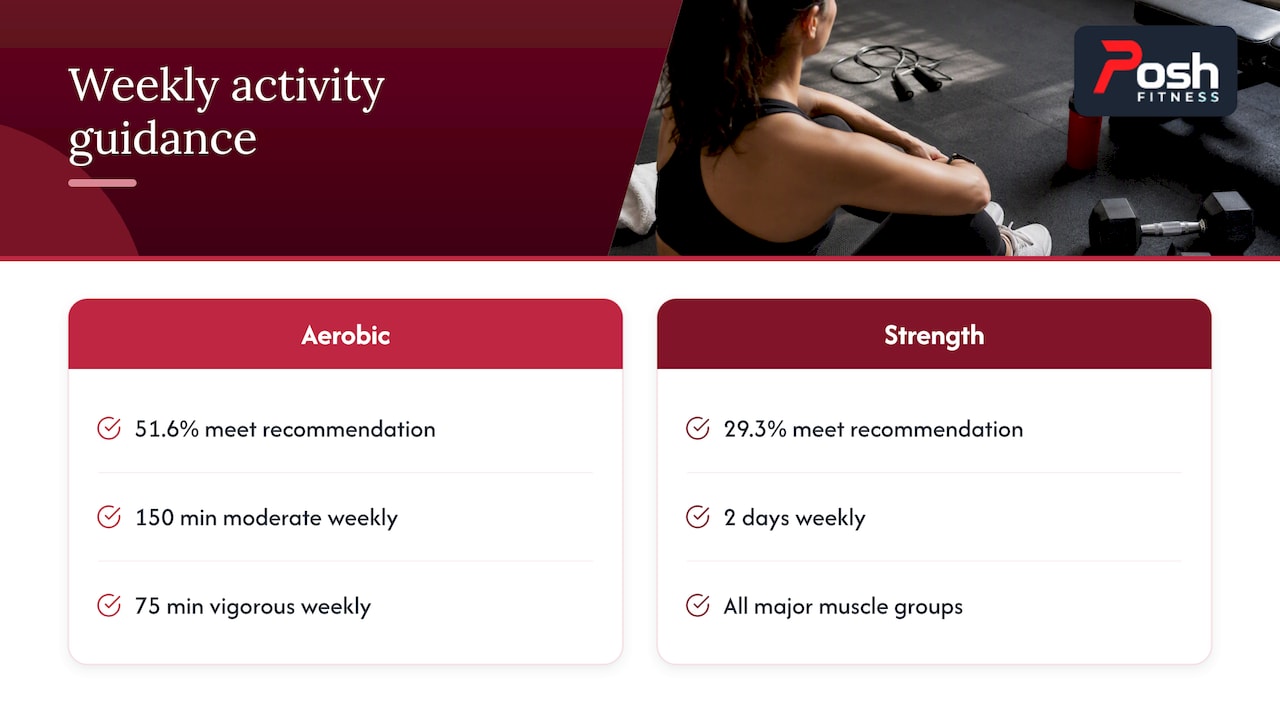
If you are in your 40s, 50s or 60s, the most common gap we see in app-based programs is strength. The CDC’s physical activity guidance recommends at least 150 minutes of moderate-intensity aerobic activity per week (or 75 minutes of vigorous activity), plus muscle-strengthening activities on at least 2 days per week that work all major muscle groups: legs, hips, back, abdomen, chest, shoulders and arms.
The strength half is the one people miss. A CDC analysis of 2011 survey data found that among middle-aged and older adults, 51.6% met the aerobic recommendation but only 29.3% met the muscle-strengthening one.
An app that serves you mostly running plans, step goals and HIIT videos may leave this gap open. When you review a program, look at a typical week. Can you see two real resistance sessions covering the whole body, with a clear plan for adding load over time?
Progression and safety when no one is in the room
Remote training removes the person who watches your form and says “that is enough for today.” Public health guidance on home-based programs points the same way: results come with consistent professional instruction that challenges you progressively, and many people struggle because they lack incremental guidance on scaling intensity and volume safely. CDC materials on home-based exercise make this point.
Three habits help:
- Start below your ceiling. Our approach to conditions like an underactive thyroid is to start with 20 minutes and build. The same logic applies to anyone returning after years away.
- Treat pain as information. If back pain is a limiter, work with a short, evidence-based routine such as these lower back pain workouts, and talk to your physician if pain is new, severe or travels down a leg.
- Train balance along with strength. Falls prevention is part of longevity, and balance training for older adults shows how safe exercise selection can look.
If you have a heart condition, diabetes, osteoporosis, joint replacements or take medications that affect blood pressure or heart rate, see your physician before starting a new program and share the plan with them.
Privacy: read the data policy before you upload anything
The more personal the app, the more sensitive the data. Heart rate, sleep, body measurements, bloodwork and DNA results are all health information, and many fitness apps are not covered by HIPAA, the federal health privacy law that governs doctors and insurers.
The Federal Trade Commission regulates this space through consumer protection law. In 2021 it settled with the developer of a popular fertility-tracking app over allegations that the company shared users’ health information with outside analytics providers despite privacy promises. The FTC also publishes a guide on which federal rules can apply to mobile health apps, including those that track fitness, diet and sleep.
Before you sign up, check:
- Whether the policy says health data is shared with advertisers or analytics partners
- Whether you can delete your data and your account
- Which third-party labs or services receive your results
- Whether the company explains this in plain language, not only in marketing copy
App-only, hybrid or coach-led: how the options compare
| Option | Best for | Strengths | Limits |
|---|---|---|---|
| Self-guided app | Self-motivated people with training experience | Low cost, flexible | Little accountability, limited adjustment, form unchecked |
| AI-adaptive app | People who want automatic workout changes | Fast adjustments to logged performance | Adapts to what you log, not to what you do not mention; weak on motivation over time |
| Coach plus app (hybrid) | Adults who want structure and a person who responds | Human review, progression, accountability | Costs more than an app alone |
| In-person or in-home training | People who need hands-on form coaching or have injuries | Direct feedback, equipment and space tailored to you | Highest cost, scheduling |
There is no single right answer. If you have trained for years and just need a template, an app may be enough. If you have been through three programs and quit each one, the research on accountability suggests that a person in the loop is the variable worth paying for.
Our perspective: biology first, then the app
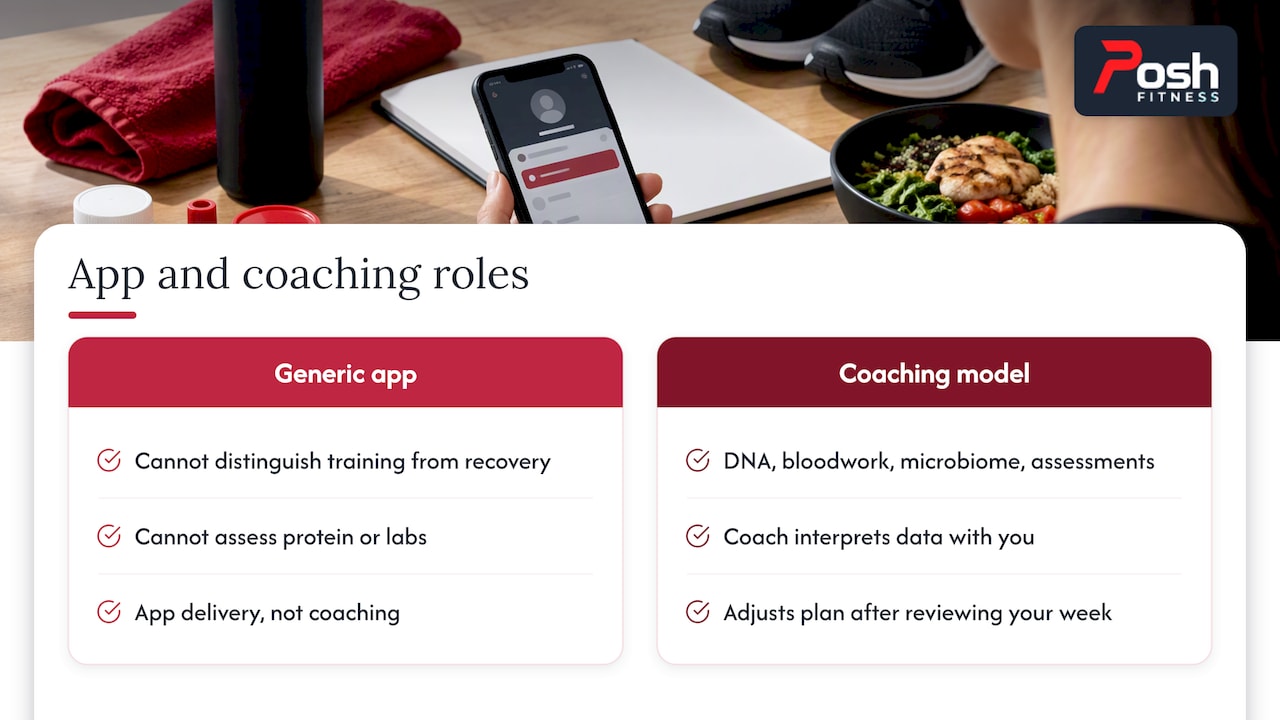
We built Posh Fitness around a simple observation. Many of the people who come to us are not lazy and not unmotivated. They are tired, their fat loss has stalled, and the workouts that worked at 30 no longer deliver. A generic plan, however nicely delivered through an app, cannot tell the difference between someone who needs more training and someone who needs recovery, better protein intake or a closer look at their labs.
That is why we combine coaching with diagnostics where it makes sense: DNA analysis, bloodwork, gut microbiome testing and physical assessments. The data informs the plan, and the coach interprets it with you. The app is the delivery channel. It is not the coach.
Our view on remote training is plain. Technology should remove friction: no commute, no rescheduling stress, workouts waiting on your phone. It should not remove the human who looks at your week and says, “Let us change this.” The research on long-term adherence points in the same direction, and so does what we see with clients.
We also think strength deserves the same attention as cardio. For adults in midlife, resistance training with sensible progression and protein-forward nutrition is the foundation of body recomposition and metabolic health. Everything else sits on top of it.
— Peter
How our remote coaching works
We serve clients virtually and in person. Our remote options are outlined on our online personal training page, with these published prices:
| Plan | Price |
|---|---|
| Online Personal Fitness Plan Starter | $40 per month |
| Truly Personal Plan | $99 per month |
| Truly Personal Fitness Plan | $1,000 per year |
| Live Virtual Training Session | $80 one-off |
The Live Virtual Training Session is a good first step if you want to see how a trainer coaches you on camera before committing to a monthly plan. For a deeper, higher-touch option, our pricing page lists the Ultra Membership 5 a Week at $2,000 per month, along with Longevity Coaching and the SystemAge + Coaching Session.
If you want the biology behind your plan, our 4 Week DNA Coaching and our 16 Week Premium Coaching Plan pair testing with coaching. For nutrition-led goals, see our health coaching program. Pricing for those programs is not published, so contact us for details.
Living in Greenwich, Stamford, Darien, Westport, Norwalk or elsewhere in Fairfield County? We also train clients at home. You can get started with an in-home trainer, and we serve Westchester, NY as well.
A simple checklist before you commit
Use this whether you choose us or anyone else:
- Define the result. “Lose 15 pounds” is a goal. “Train twice a week with resistance and hit a protein target on five days” is a behavior you can track.
- Ask who the coach is. Look for scientific credentials and a named person, not just “our team.”
- Find out how often your plan changes. Monthly reviews are a minimum for most adults.
- Check the strength component. Two full-body resistance sessions per week is the federal floor.
- Test the human response. Send a question in week one and see how quickly and thoughtfully you get an answer.
- Read the privacy policy. Especially if you will upload lab results or DNA data.
- Plan for month seven. Ask what support looks like once the novelty has faded.
FAQ
Is personalized fitness app coaching worth it compared with a free app?
It can be, if the coaching includes a real person who adjusts your plan. Research shows digital tools can lift short-term adherence, but long-term results usually depend on accountability and feedback. If you already train consistently on your own, a free app may be enough.
Can remote personal training work for beginners or people over 50?
Yes, provided the program starts at a manageable level and increases load gradually. Beginners benefit from a live session early on so a trainer can check form and movement quality. If you have a medical condition or pain, talk to your physician first.
How much does remote personal training cost?
Our published remote options are $40 per month for the Starter plan, $99 per month for the Truly Personal Plan, $1,000 per year for the Truly Personal Fitness Plan, and $80 for a single live virtual session. Higher-touch programs, such as the Ultra Membership 5 a Week, are $2,000 per month. Other programs do not have published prices, so ask us.
Are my health data and test results safe in a fitness app?
Not automatically. Many fitness apps fall outside HIPAA, and the FTC has taken action against health apps that shared user data contrary to their promises. Read the data-sharing policy, ask which labs and partners receive your information, and confirm that you can delete your data.
Sources
- Personalization in Real-Time Physical Activity Coaching Using Mobile Applications: A Scoping Review
- Do digital interventions increase adherence to home exercise rehabilitation? A systematic review
- The Effectiveness of Digital Apps Providing Personalized Exercise Videos: Systematic Review With Meta-Analysis
- CDC: Older Adult Activity Overview
- CDC: Sociodemographic Correlates of Meeting Muscle Strengthening Recommendations
- CDC: home-based exercise materials
- FTC: Fertility-tracking app settlement
- FTC: Mobile Health App Interactive Tool