

Sleep does not burn fat on its own, but it changes how hungry you are, how well you recover from training and how much of the weight you lose comes from fat rather than muscle. If your diet and workouts look right on paper and results are still stuck, short or broken sleep is one of the first things we check. Below is what the research shows, how much sleep adults need, and what to do about it this week.
Key takeaways
- Short sleep mostly hurts fat loss by raising food intake, not by slowing your metabolism. In one review, sleep restriction raised intake by more than 250 kcal a day.
- Adults 18 to 60 should aim for at least 7 hours a night, according to the NIH.
- In a secondary analysis of three calorie-restriction studies, each extra hour of sleep went with about 0.72 kg more fat loss.
- Sleep supports muscle repair, so poor sleep can blunt the benefit of the training you are already doing.
- Sleep is not a standalone fat-loss treatment. Nutrition, resistance training and daily movement still do the main work.
Table of Contents
- What the research says about sleep and fat loss
- Why a short night makes you eat more
- How much sleep you need for fat loss
- Sleep, muscle and recovery
- Why better sleep alone will not melt fat
- Habits that improve sleep and support fat loss
- When sleep problems are a sign of something else
- Our perspective: treat sleep as part of the program
- Get a plan built around your biology
- FAQ
- Sources
What the research says about sleep and fat loss
The link between short sleep and body weight is consistent across large datasets, though the trials are smaller and less tidy.
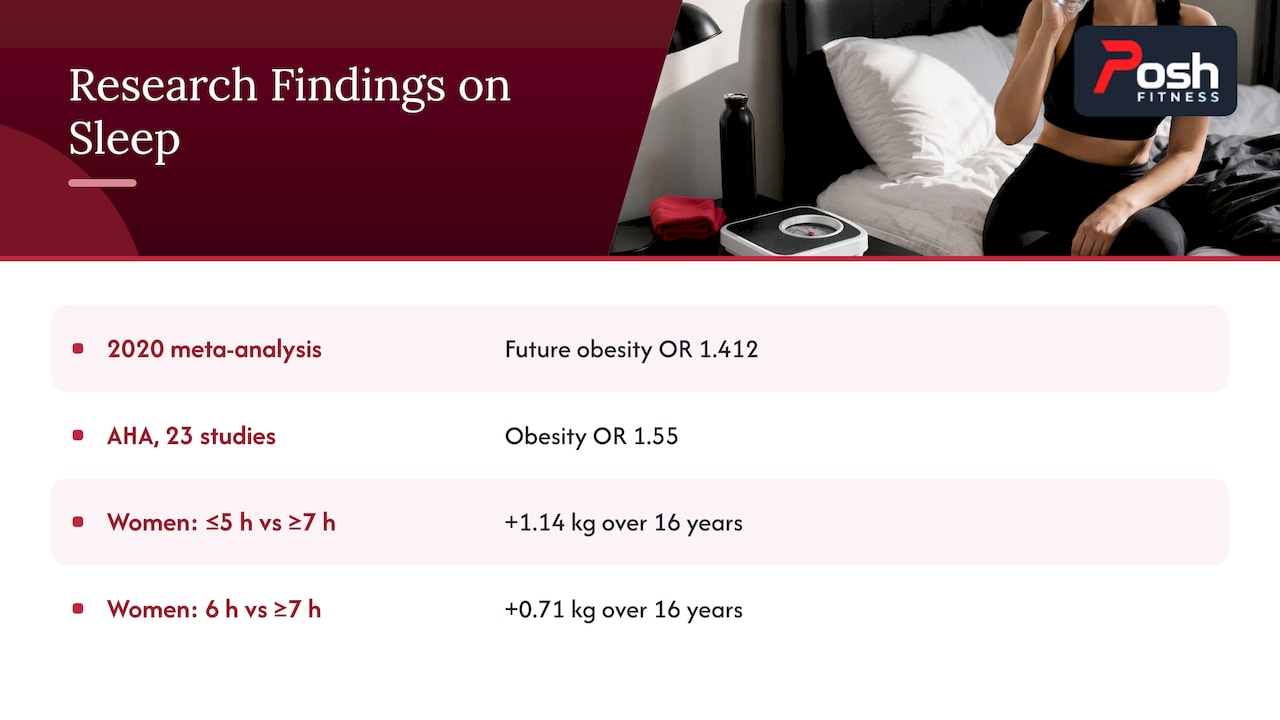
On the population side, a 2020 meta-analysis found that short sleep was significantly associated with future adult obesity, with an odds ratio of 1.412. The American Heart Association scientific statement reports that, across 23 adult studies, short habitual sleep was linked to obesity with a pooled odds ratio of 1.55. In the Nurses’ Health Study data it summarizes, women who slept 5 hours or less gained 1.14 kg more over 16 years than women who slept at least 7 hours. Women sleeping 6 hours gained 0.71 kg more.
Those numbers describe risk across many people, not what will happen to you. The controlled trials are where the mechanism shows up. A 2022 review in Nature Reviews Endocrinology concluded that sleep restriction raises energy expenditure by about 100 kcal per day but raises energy intake by more than 250 kcal per day. That leaves you in a net surplus, and the review also describes a stronger drive to eat through reward and cognitive-control pathways.
The honest caveat: a 2015 systematic review of randomized trials found only 18 qualifying studies. It concluded that sleep restriction generally increased food intake and energy expenditure, while the effect on overall weight change was inconsistent. A 2024 scoping review of 35 adult studies found that baseline sleep may predict later weight loss, but weight-loss programs did not reliably improve sleep, and it called the evidence limited.
So the fair reading is this: poor sleep makes it harder to eat less, and it probably makes a diet harder to sustain. It is a strong supporting factor, not a magic lever.
Why a short night makes you eat more
The appetite effect is the part most people feel before they see it on a scale. After a bad night, you are hungrier, the food that appeals to you changes, and you have less patience to say no.
The NIH explains that poor-quality sleep can raise hunger-related hormones, reduce insulin responsiveness, increase eating (especially fatty, sweet and salty foods) and reduce physical activity. Each of those pushes in the same direction.
In practice, here is what we see with clients who sleep five or six hours:
- Afternoon cravings. The 3 p.m. snack drawer becomes a daily event, and it is rarely protein.
- Larger evening portions. Fatigue lowers the effort you are willing to put into cooking, so takeout wins.
- Skipped sessions. Lower energy means a shorter walk, a lighter workout or a canceled one.
- Less consistent tracking. Willpower is a limited resource when you are tired, and food logs are the first thing to slip.
The Nature Reviews Endocrinology authors frame insufficient sleep and circadian misalignment as metabolic stressors that promote weight gain through food intake, food choice, appetite regulation and energy expenditure. Notice that food intake and food choice come first. That matches what clients report.
The review titled Sleep-obesity relation reaches a similar view: weight management is hindered when attempted during sleep restriction, and short sleep affects weight mainly by raising energy intake. In other words, the fix for a sleep-driven plateau is rarely a stricter diet. It is usually more sleep.
How much sleep you need for fat loss
The NIH recommends that adults aged 18 to 60 sleep 7 or more hours nightly. For ages 61 to 64 it lists 7 to 9 hours, and for 65 and older, 7 to 8 hours.
There is no separate official “fat-loss number.” The best data point we have comes from a secondary analysis of three calorie-restriction studies, summarized in the Sleep-obesity relation review: each additional hour of sleep was associated with 0.77% greater fat loss, or 0.72 kg, after adjustment. That is an association, not a promise, but it shows the direction.
If you train hard, you may need to lean toward the upper end. A review of sleep in athletes notes that most adults need 7 to 9 hours and athletes may need more because of exercise demands, though the exact extra amount is not established.
A practical way to find your number:
- Pick a fixed wake time you can hold seven days a week.
- Count back 8 hours and set that as your target bedtime for two weeks.
- Note how you feel at 10 a.m. and 3 p.m., and whether cravings change.
- Adjust by 15 to 30 minutes in either direction.
If you spend 8 hours in bed but wake often, the quality of your sleep is the problem, not the duration. That is a different conversation, covered below.
Sleep, muscle and recovery
Fat loss that costs you muscle is a poor trade, especially after 40, when muscle is already harder to hold. This is where sleep earns its place in a training plan.
According to the athlete-recovery review, sleep deprivation can impair glucose sensitivity, glycogen repletion and protein synthesis, alter growth hormone and cortisol, and raise inflammatory cytokines. Those changes can slow muscle repair and recovery after exercise. The authors describe sleep as supporting recovery through hormonal, inflammatory, immune, metabolic and protein-synthesis pathways, so inadequate sleep can undermine both adaptation to training and performance.
What that means for you:
- You may feel unusually sore or flat for days after sessions that used to feel fine.
- Your lifts stall even though your program has not changed.
- Your body holds on to the muscle you are trying to build less efficiently while you are in a calorie deficit.
If this sounds familiar, read our checklist on recovering faster when you are tired after workouts, which also covers the warning signs that mean you should see a physician rather than just rest. And if you are deciding whether to chase the scale or body composition, our guide to body recomposition versus weight loss explains why protecting muscle matters.
Why better sleep alone will not melt fat
It is tempting to hear “sleep more, lose weight” and expect results from a mattress upgrade. The research does not support that. The 2015 systematic review noted that controlled trials are relatively few, weight outcomes are inconsistent and larger randomized studies are needed. For a plain-language overview of the same question, how sleep affects weight loss is worth a look.
The relationship also runs both ways. Poor sleep can promote weight gain, and excess weight can worsen sleep, for example through sleep apnea. If you snore heavily, stop breathing during the night or wake unrefreshed no matter how long you sleep, talk to your physician about a sleep evaluation before changing anything else.
If you have already fixed your sleep and your weight still will not move, the cause is likely elsewhere: calorie intake, protein, training load, stress, thyroid function or other metabolic factors. Our plateau audit walks through that order of checks, and our post on lab markers for weight loss explains which tests are worth asking your doctor about.
Habits that improve sleep and support fat loss
The NIH guidance is simple and, for most people, enough to start. It advises a consistent bedtime and wake time every day, including weekends, regular exercise (but not within a few hours of bedtime), daytime sunlight, and a cool, quiet, dark bedroom. It also suggests limiting late caffeine, nicotine, alcohol, large meals, excess fluids and screens before bed, and seeing a doctor for persistent sleep problems.
Here is how we turn that into a weekly plan.
Anchor your wake time
A fixed wake time sets your body clock more reliably than a fixed bedtime. Hold it within 30 minutes, weekends included.
Move your training earlier when you can
If you wake up wired after evening workouts, shift hard sessions to morning or midday. Evening walks and gentle mobility are fine.
Get morning light
Ten to twenty minutes outside after waking helps set your rhythm. It also gives you an easy walking habit.
Close the kitchen earlier
A large late meal can disrupt sleep, and late snacking is where short sleepers tend to overeat. Aim to finish dinner a few hours before bed, with protein at that meal. If prep is what derails you, our weekly meal prep plan for weight loss makes the evening decision for you.
Set limits on caffeine and alcohol
Pick a caffeine cutoff, often early afternoon, and see whether your sleep deepens. Alcohol may feel like it helps you fall asleep, but the NIH lists it among the things to limit near bedtime.
Build a wind-down
Dim lights, put your phone out of reach, keep the room cool. Thirty minutes is enough.
Give any change two to three weeks before judging it. If you want a broader look at building routines like these, our four-week metabolism habit plan lays one out.
When sleep problems are a sign of something else
Not every bad night is a habit problem. Persistent insomnia, loud snoring with pauses in breathing, night sweats, and unexplained daytime exhaustion all deserve a conversation with your physician. Women in perimenopause often see sleep and body composition change together, which we cover in our guide to perimenopause weight loss and protecting muscle.
As coaches, we do not diagnose. We work alongside your medical team, and we will tell you when what you describe sounds like a question for your doctor.
Our perspective: treat sleep as part of the program
Most clients arrive asking about workouts and food. When we dig into their weeks, the pattern is often the same: five to six hours of sleep, a busy job, a caffeine-heavy day and a plan that depends entirely on willpower in the evening.
We do not think the answer is to tell people to “just sleep more.” Sleep is shaped by stress, schedule, training timing, meal timing and sometimes biology. That is why our approach starts with assessment. We look at your habits, your training history and, where it makes sense, data from DNA analysis and bloodwork, so the plan fits you rather than an average person. We use that information to decide what to change first, and we leave medical decisions to your doctor.
For most people, the order that works is this: stabilize sleep, protect muscle with resistance training, set protein and calories sensibly, then fine-tune. When sleep is the missing piece, fat loss often starts moving without any additional restriction. We would rather give you an extra hour of sleep than take another 200 calories off your plate.
— Peter
Get a plan built around your biology
If you live in Fairfield County, CT or Westchester County, NY and have been doing the work without the results, we can build a plan that accounts for sleep, training and nutrition together. Our trainers work in your home, at affiliated gyms or virtually, and our 4 Week DNA Coaching shows how we use diagnostics to set priorities.
Prefer to start remotely? Our online plans include a Starter plan at $40 per month and the Truly Personal Plan at $99 per month, both listed on our online personal training page. A Live Virtual Training Session is $80 one-off. Details on in-home and longevity coaching are on our pricing page. Not sure you are ready? Take the weight loss readiness quiz first.
FAQ
How much sleep do I need to lose fat?
The NIH recommends at least 7 hours a night for adults 18 to 60. There is no separate fat-loss target, but most people who train hard do better toward the 8-hour end. Track how you feel and how your cravings behave, then adjust.
Can sleep deprivation cause weight gain?
It can contribute. The NIH says poor sleep can raise hunger-related hormones, reduce insulin responsiveness and increase food intake, particularly fatty, sweet and salty foods, while lowering physical activity. In controlled studies, the increase in eating outweighed the small rise in energy burned.
Does sleep really help muscle recovery?
Yes. Reviews of athlete recovery link sleep loss to impaired protein synthesis and glycogen repletion, altered growth hormone and cortisol, and more inflammation. That can slow repair after workouts, which matters most when you are cutting calories and trying to keep muscle.
Will I lose weight if I just sleep more?
Not reliably. Research shows short sleep is linked to higher intake and weight gain, but trials on weight change are inconsistent. Better sleep makes a nutrition and training plan easier to follow. It does not replace one.
Sources
- The role of insufficient sleep and circadian misalignment in obesity (Nature Reviews Endocrinology, 2022)
- Sleep duration and obesity in adulthood: an updated systematic review and meta-analysis (2020)
- Systematic review and meta-analysis of randomized trials of sleep restriction (2015)
- The Relationship Between Sleep Quantity, Sleep Quality, and Weight Loss (2024)
- Sleep-obesity relation: underlying mechanisms and consequences for treatment
- Sleep Duration and Quality: Impact on Lifestyle Behaviors and Cardiometabolic Health (American Heart Association, 2016)
- Healthy Sleep (NIH)
- Sleep Hygiene for Optimizing Recovery in Athletes