

Health coaching for fatigue is a structured, one-on-one process. A coach helps you find what is draining your energy, then builds small, trackable changes in sleep, stress, nutrition and movement, with regular check-ins so the changes hold. It works best alongside a medical evaluation, not instead of one. If you are over 40, tired, and tired of workouts that leave you flatter than before, this guide explains what coaching involves, what to expect, and how to begin without overdoing it.
Key Takeaways
- A health coach does not diagnose fatigue. A coach helps you act on what your clinician finds and on the lifestyle drains that are within your control.
- See a doctor first if fatigue lasts more than a couple of weeks despite rest, or comes with chest pain, shortness of breath or thoughts of self-harm.
- Energy usually improves through small steps in sleep, stress, food and gradual strength work, tracked against specific goals.
- Testing such as bloodwork and DNA analysis can make coaching more specific, because it replaces guesses with data about your own biology.
- Expect to work with a coach for at least three months, with regular check-ins.
Table of Contents
- Start by Ruling Out a Medical Cause
- What Health Coaching for Fatigue Actually Involves
- The Habits a Coach Will Look at First
- How to Build Activity When You Are Already Tired
- Setting Goals and Tracking Whether Energy Is Improving
- Why We Add Testing to Coaching
- How Coaching with Posh Fitness Works
- Ready to Start? Your Next Step
- A Realistic First Month
- FAQ
- Sources
Start by Ruling Out a Medical Cause
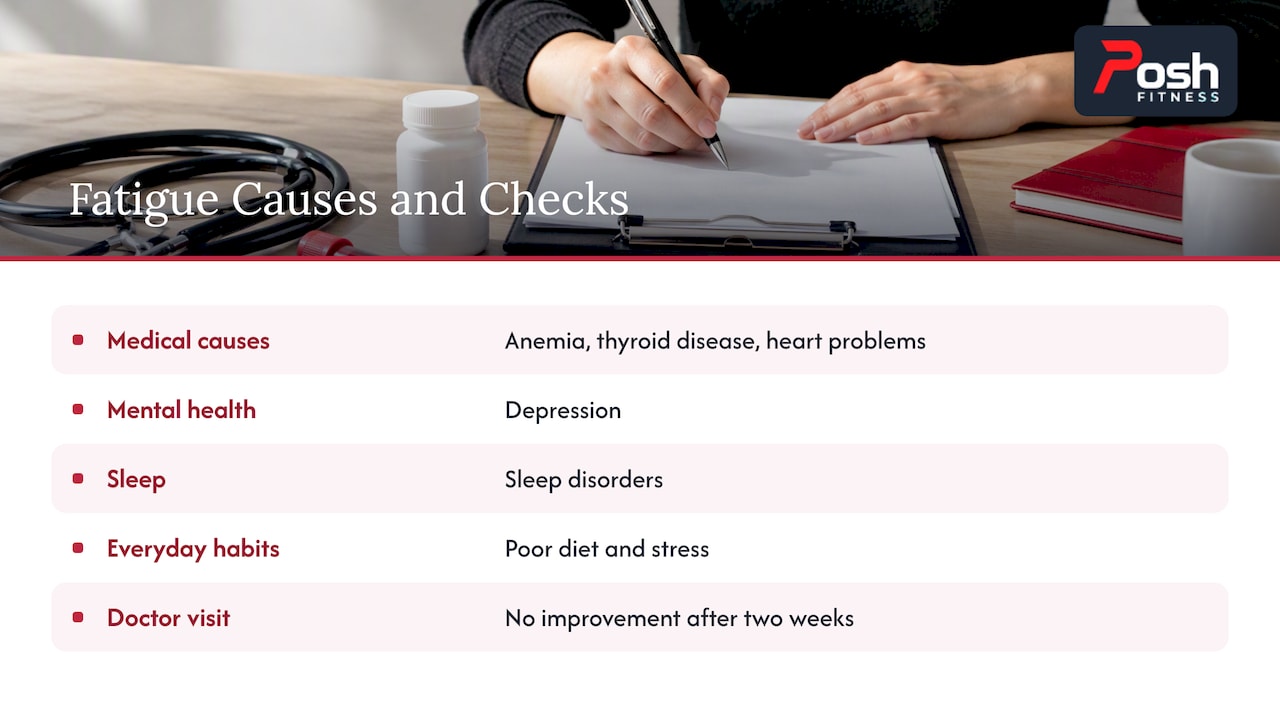
Before any coaching plan, fatigue deserves a proper look. Cleveland Clinic lists medical conditions such as anemia, thyroid disease and heart problems, mental health factors such as depression, sleep disorders, and everyday habits such as poor diet and stress as possible causes. It advises talking with a healthcare professional if fatigue lasts more than a few days, interferes with daily life, has no clear cause, or comes with serious symptoms like chest pain, shortness of breath or thoughts of self-harm.
The Mayo Clinic gives a practical threshold: schedule a doctor’s visit if fatigue has not improved after two or more weeks of prioritizing rest, stress reduction, a healthy diet and proper hydration. Cancer treatment and recovery from major surgery can also cause fatigue, according to MedlinePlus, which is a case for coordinating with your care team before changing your routine.
The American Academy of Family Physicians adds a useful distinction: physiologic fatigue is a normal response when the activities that spend energy outweigh the ones that restore it. That is the kind of imbalance a coach can help you fix, and it is common in busy adults in their 40s and 50s.
If you want a closer look at the usual suspects at this age, our guide to low energy at 40 walks through causes and checks.
What Health Coaching for Fatigue Actually Involves
Cleveland Clinic describes a health coach as a mentor and guide who helps you make sustainable lifestyle changes in areas such as physical activity, nutrition, stress management and sleep. The same source notes that coaching usually involves regular check-ins over at least three months, with goal setting, barrier spotting and accountability.
For fatigue specifically, the process tends to look like this:
- An energy assessment. You review your sleep, food, stress, movement, mindset and daily schedule to find the drains. A coaching organization’s overview describes this as a personalized look at lifestyle, mindset, sleep, diet and stress triggers.
- Goals you can measure. Vague aims like “get more energy” become specific targets, such as a bedtime window or three short walks a week.
- Habit tracking. You log what you did and how you felt, so you can see which changes are actually helping.
- Regular adjustments. Goals are reviewed and revised as you progress.
Research published through the National Library of Medicine describes coaching as a potential unifying element in integrative care, helping patients build self-efficacy, prioritize goals and manage symptom burden in chronic fatigue. The point is not a magic protocol. It is steady, supported behavior change that fits your life.
The Habits a Coach Will Look at First
Sleep
The AAFP reports that nearly 30% of U.S. adults sleep fewer than seven hours a night, and names this as a widespread contributor to fatigue. Its sleep hygiene advice is simple: keep a consistent schedule, limit screen time, and avoid caffeine or alcohol near bedtime. Harvard Health points to seven to nine hours of sleep as part of a lifestyle that supports energy.
A calm wind-down matters too. Some people find that a dim, low-stimulation evening routine, such as dim red light before bed, helps them settle. If you are curious about how sleep connects to body composition, see what seven hours of sleep can change.
Stress
Chronic stress drains energy quietly. A coach helps you identify your triggers and choose a practice you will really use. Options range from short breathing breaks to mindfulness practices for stress. Social connection counts as well: the National Institute on Aging notes that time with friends and family or volunteering can help older adults feel more engaged and productive through the day.
Nutrition and hydration
Harvard Health notes that a diet low in added sugars and processed foods can help give you more energy. In coaching, that usually means regular protein-forward meals, fewer blood sugar swings, and enough fluids. Two of our own guides go deeper: hydration and energy and three evidence-backed moves for steady energy.
Movement
It sounds backwards, but moving more can raise energy. Harvard Health reports that regular aerobic exercise improves sleep depth, and that deep sleep is particularly restorative. The standard targets are at least 150 minutes of aerobic activity a week and at least two muscle-strengthening sessions, per Harvard Health. Those are destinations, though, not starting lines.
How to Build Activity When You Are Already Tired
If standard workouts leave you wiped out, the answer is rarely “push harder.” The National Institute on Aging recommends increasing activity over weeks to months: start with lower-intensity activity suited to your current fitness, then raise frequency, intensity and duration gradually. It adds that this approach can build confidence, motivation and routine.
Here is what a gradual start can look like, drawn from public guidance:
- Very short bouts. NIDDK says inactive adults can begin with 5 minutes of activity several times a day, 5 to 6 days a week, and work up to 10-minute sessions three times daily.
- Staged strength work. The CDC and Tufts guide Growing Stronger uses body-weight exercises in weeks 1 and 2, dumbbells or ankle weights in weeks 3 to 6, and added variety from week 7. It recommends completing each phase two to three times a week before moving on.
- Your best time of day. The NIA suggests scheduling activity when your energy is highest, since many older adults feel less fatigue during and after activity.
- Variety and enjoyment. MedlinePlus advises building slowly, showing up even for short sessions, varying workouts to avoid boredom and choosing activities you like.
Stop exercising and get medical help if you have chest pain, tightness or pressure, extreme shortness of breath, dizziness or pain, as both MedlinePlus and NIDDK advise. If you have a thyroid condition, our piece on hypothyroid workouts covers a careful start, and if sessions leave you drained, the tired-after-workouts checklist lists four red flags to know. For a weekly structure once you are ready, see exercise for longevity.
Setting Goals and Tracking Whether Energy Is Improving
Goals work when they are specific and realistic. The NIA recommends goals that are specific, realistic and measurable, such as a 10-minute walk three times a week, reviewed regularly as you progress.
The New York State Department of Health’s SMART goals guide says to define what you will do, when and how often, and how you will measure progress, using a paper log, a wearable or a pedometer. It also suggests that if your confidence in a goal rates below 7 out of 10, you should revise the goal until it feels achievable.
A simple two-week energy log is enough to start:
| What to track | How | Why it helps |
|---|---|---|
| Bedtime and wake time | Note them each day | Shows whether sleep is consistent |
| Energy at morning, midday, evening | Rate 1 to 10 | Reveals when your best window is |
| Movement | Minutes and type | Links activity to energy the next day |
| Meals and fluids | Brief notes | Flags crashes after certain foods |
| Stress level | Rate 1 to 10 | Connects hard days with low energy |
A two-week morning routine test is a good first experiment to run against that log.
Why We Add Testing to Coaching
Most people who come to us have already tried the standard advice. They sleep more, cut back on sugar, join a gym, and still feel flat. The usual reason is not a lack of effort. It is a plan that was written for an average person instead of for them.
That is why we start with your biology. We use DNA analysis, bloodwork, gut microbiome testing and physical assessments, delivered through partnered labs, to see how you respond to training, food and recovery. Our trainers are scientifically credentialed, and we design each program around those results rather than a template. Our aim is to help you reset your biology and extend your healthspan, so that you can recover the energy and performance you had earlier in life.
We also work alongside your doctor, not in place of one. If your symptoms point to something medical, that comes first. Once that is addressed, coaching turns your results into daily habits: how you sleep, how you eat, how you train, and how you track it. We believe fatigue is rarely fixed by one big change. It is fixed by a sequence of small, personal ones that you can actually keep.
Peter
How Coaching with Posh Fitness Works
We offer health coaching in person, at home, at affiliated gyms or virtually, depending on what fits your schedule. Our clients are mostly middle-aged, health-conscious adults in Fairfield County, Connecticut and Westchester County, New York who are frustrated with stagnant results and low energy.
If you want testing built in, our 4 Week DNA Coaching and 16 Week Premium Coaching Plan use diagnostics to shape your training and nutrition. Our page on DNA testing for SystemAge explains one of the tests we use. Longevity coaching and SystemAge sessions are listed on our pricing page.
If you prefer to start online, our online personal fitness plans are listed at $40 per month for the Starter plan, $99 per month for the Truly Personal Plan, and $1,000 per year for the Truly Personal Fitness Plan. A live virtual training session is $80 one-off.
Ready to Start? Your Next Step
If you live in Fairfield County, we come to you: see our in-home training for Greenwich, Stamford, Westport, Norwalk and Darien. In Westchester, our health coaching page has the details. Everyone starts with a conversation about your symptoms, history and goals, so we can build a plan that respects where you are today.

To get started, book through our Personal Training page and tell us what your energy looks like across a typical week.
A Realistic First Month
What should you do in the first four weeks, whether or not you work with a coach? Here is a sensible sequence.
- Week 1: Book the medical check. Share your fatigue pattern with your doctor, especially if it has lasted two weeks or more despite better rest.
- Week 1: Start the log. Track sleep, energy, movement and stress using the table above.
- Week 2: Fix one sleep habit. Pick a consistent bedtime or a screen cutoff, not both.
- Week 2 and 3: Add short walks. Begin with 5 to 10 minutes at your best time of day, as NIA and NIDDK suggest.
- Week 3 and 4: Add body-weight strength work. Two sessions a week, moving up only once the earlier phase feels manageable.
- Week 4: Review. Look at your log, keep what helped, and revise any goal you rate below 7 out of 10 for confidence.
Progress in energy is usually gradual, and that is fine. Consistency across a few months is what turns a better week into a better year.
FAQ
Can a health coach treat chronic fatigue?
No. A coach does not diagnose or treat medical conditions. A coach supports the lifestyle side: sleep, stress, nutrition and movement, plus accountability. Fatigue that persists should be evaluated by a physician, and a good coach works with that guidance.
How long does health coaching for fatigue take?
Cleveland Clinic notes that coaching usually involves regular check-ins over at least three months. Many people notice small changes in sleep or daytime energy sooner, but lasting habits take time to build. Our 4 and 16 week programs are structured around that reality.
Is exercise safe when I feel exhausted?
Gentle activity is generally encouraged, starting with short bouts and building slowly, according to NIA and NIDDK. Stop and seek medical help for chest pain, extreme shortness of breath, dizziness or pain. If you have a heart, thyroid or other condition, check with your doctor before starting.
Do I need DNA or bloodwork to get started?
No. You can begin with an assessment and habit tracking. Testing is an option that makes a plan more specific to your biology, and we arrange it through partnered labs when it fits your goals.
Sources
- Fatigue: Causes & Treatment, Cleveland Clinic
- Fatigue when to see a doctor, Mayo Clinic
- Fatigue: MedlinePlus
- Fatigue in Adults: Evaluation and Management, AAFP
- What Is a Health and Wellness Coach? Cleveland Clinic
- Manage Fatigue With Health Coaching Strategies, ANHCO
- Coaching to strengthen critical success factors, National Library of Medicine
- Ways to maximize your energy, Harvard Health
- Boosting Your Energy, Harvard Health
- Fatigue in Older Adults, National Institute on Aging
- Tips for Getting and Staying Active as You Age, National Institute on Aging
- Staying Active at Any Size, NIDDK
- Growing Stronger, CDC and Tufts University
- Exercise and Physical Fitness: MedlinePlus
- SMART goals guide, New York State Department of Health
- Types of Mindfulness Practices for Women
- Dim Red Light for Sleep