


A personalized meal plan in the United States typically costs somewhere between about $100 for a short, one-week plan and several hundred dollars for a multi-week plan built around your labs, restrictions, and goals. Ongoing nutrition coaching is billed monthly instead, and the price depends on how much testing, adjustment, and human support sits behind it. Below, we break down the ranges, the factors that move them, what a fair price should include, and how to match the format to your budget.
Key Takeaways
- Practitioner pricing reported in US dollars runs from roughly $115 on average for a one-week custom plan to about $340 on average for a five-to-eight-week plan, with high-end prices well above that.
- Price rises with complexity: food restrictions, medical conditions, performance goals, and testing such as bloodwork or DNA analysis all add assessment time.
- Always ask what is included: number of days, recipes, grocery lists, revisions, and follow-up support differ widely between plans at the same price.
- HSA and FSA funds generally cover nutrition counseling only when it treats a specific disease diagnosed by a physician.
- At Posh Fitness, published pricing runs from $40 per month for an online plan to $2,000 per month for our Ultra Membership, with other services quoted individually.
Table of Contents
- What a Personalized Meal Plan Typically Costs
- Why Two Plans at the Same Length Can Cost Very Different Amounts
- What Your Money Should Buy
- One-Time Plan or Ongoing Coaching
- Automated Apps Versus Professional Planning
- Can HSA or FSA Funds Pay for It?
- Our Perspective
- What Personalized Nutrition Costs at Posh Fitness
- How to Set Your Budget
- FAQ
- Sources
What a Personalized Meal Plan Typically Costs
Prices vary because “personalized” covers a wide range of work. At one end, a plan is a template adjusted for your calorie target. At the other, a practitioner reviews your health history, labs, medications, schedule, and food preferences, then builds and revises a plan over several weeks.
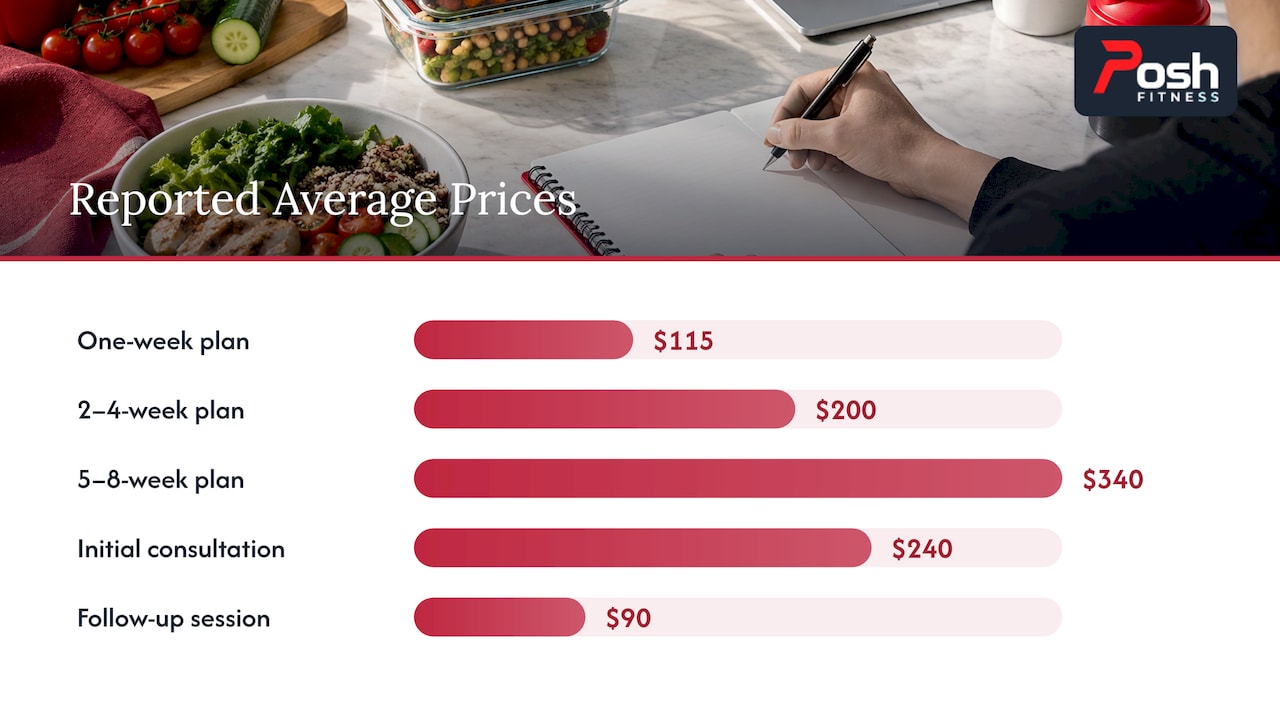
One pricing handbook for nutrition practitioners reports worldwide prices converted to US dollars. In it, a one-week custom meal plan averages $115, with high-end prices reaching $395. A two-to-four-week plan averages $200 and reaches $450, and a five-to-eight-week plan averages $340 and reaches $780. Initial nutrition consultations average $240, and follow-ups average $90 (That Clean Life Pricing Handbook). These are averages from practitioners around the world, so treat them as a reference range rather than a quote for any one city.
Here is how those figures line up:
| Format | Reported average | Reported high end |
|---|---|---|
| One-week custom meal plan | $115 | $395 |
| Two-to-four-week custom plan | $200 | $450 |
| Five-to-eight-week custom plan | $340 | $780 |
| Initial nutrition consultation | $240 | $540 |
| Follow-up session | $90 | $200 |
In Fairfield County and Westchester, where we work, expect pricing to follow the higher half of national ranges for in-person or in-home work, since the service includes a credentialed professional’s time and local overhead. That is our observation of the market, not a published statistic.
Why Two Plans at the Same Length Can Cost Very Different Amounts
The number of weeks is only one variable. These factors usually matter more.
Complexity of your needs
A plan for a generally healthy adult who wants more structure is the simplest to build. Add a restrictive diet, a medical condition, food sensitivities, or several competing goals, and the practitioner has to spend considerably more time on assessment and planning. That extra time is what you are paying for.
How much data the plan is built on
A plan based on a questionnaire is one thing. A plan based on bloodwork, gut microbiome testing, DNA analysis, and a physical assessment is another. The second approach lets the plan respond to how your body handles carbohydrates, fats, caffeine, inflammation, or recovery, instead of relying on population averages. Testing has its own cost, and so does the interpretation.
How much support follows the plan
A PDF delivered once is the least expensive format. A plan that is revised after week two, adjusted when your labs come back, and supported by check-ins costs more because someone is actively working on your case.
Delivery and format
In-home, in-person, and virtual services have different cost structures. Virtual coaching tends to be more affordable per session. In-home work brings the practitioner to your kitchen, where we can look at what you actually stock, which is a different level of personalization.
What Your Money Should Buy
Before you pay, ask for a written list of inclusions. A personalized plan may include a client assessment, calorie or macro targets, meals and recipes, grocery lists, revisions, and follow-up support, depending on the service. Two quotes that look similar can differ sharply in what they cover.
Use this checklist:
- Assessment. Is there an intake conversation, a health history review, or testing? Who reviews it, and what are their credentials?
- Plan scope. How many days of meals are covered? Is it a weekly template you repeat or a full multi-week rotation?
- Recipes and groceries. Are recipes and a shopping list included, or only targets?
- Revisions. How many adjustments are included, and for how long?
- Follow-up. Are check-ins built in, and how do you reach your coach between sessions?
- Fit with training. Does the nutrition plan align with your workouts? Our guide to meal timing for workouts shows why this matters for energy and recovery.
A plan that answers all six is easy to compare against any other quote.
One-Time Plan or Ongoing Coaching
The choice depends on what is keeping you from results.
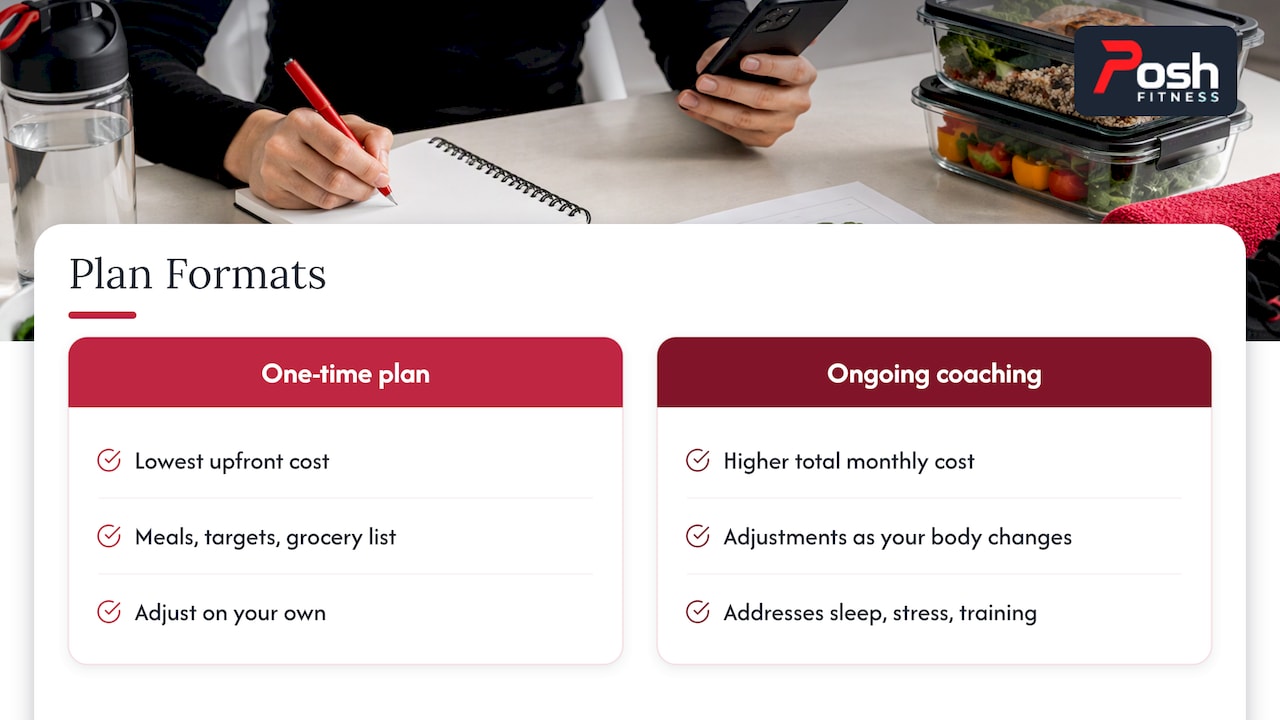
A one-time or short-term plan suits you if you know what to do but need structure. You want a clear set of meals, targets, and a grocery list, and you are comfortable adjusting on your own. It has the lowest upfront cost.
Ongoing coaching suits you if you have tried structured plans before and stalled, if your energy is inconsistent, or if your results have not matched your effort. In that situation the plan is rarely the only problem. Sleep, stress, training load, and your own biology all interact with what you eat, and a coach can adjust as new information arrives. The monthly cost is higher in total, but the work continues as your body changes.
If you want a plan alongside a training approach, our post on meal prep for weight loss shows what a weekly structure looks like in practice. For readers whose goal is to lose fat while holding on to muscle, our explanation of body recomposition versus weight loss helps you set the right target before you buy any plan.
Automated Apps Versus Professional Planning
Software-based meal planners cost a small fraction of professional services, often in the range of a few dollars to a few tens of dollars per month. They generate menus from your calorie targets and preferences. They are useful for simple needs, though a program cannot interpret your lab results or adjust for a medical history. For a closer look at how automated apps versus professional planning compare on price and service, that page lays out the trade-offs.
The practical difference is judgment. When your results stall, a person asks why: protein too low, sleep short, training volume mismatched, thyroid or glucose markers off. That is the work our clients come to us for.
Can HSA or FSA Funds Pay for It?
Sometimes, but not for general wellness. The IRS states that nutritional counseling may be paid or reimbursed through an HSA, FSA, Archer MSA, or HRA only when it treats a specific disease diagnosed by a physician, such as obesity or diabetes. Otherwise it is not a medical expense (IRS FAQ on nutrition, wellness, and general health expenses, updated 23 September 2026).
The purpose of the counseling decides eligibility, not the fact that it is personalized. If you have a physician-diagnosed condition, ask your doctor whether a letter of medical necessity is appropriate, and confirm with your plan administrator before you pay. If your goal is general fitness, energy, or longevity, plan to pay out of pocket.
Our Perspective
We built Posh Fitness around a simple observation: two people can follow the same meal plan and get opposite results. The difference is biology. Metabolism, hormone levels, inflammation, gut health, and genetics all shape how your body responds to food and training.
That is why we use DNA analysis, bloodwork, gut microbiome testing, and physical assessments to guide nutrition and training, instead of starting from a generic template. Our aim is to help you reset your biology and extend your healthspan, so you can regain the energy and performance you had earlier in life.
When you compare prices, we encourage you to compare what is behind the number. A lower-priced plan solves a simpler problem. If you are fatigued, stuck on fat loss, or frustrated with workouts that stopped working, a plan built on your own data, supported by a credentialed coach, addresses the cause rather than the symptom. We work alongside your physician, not in place of one.
Peter
What Personalized Nutrition Costs at Posh Fitness
We publish prices where they are fixed and quote individually where the work depends on your testing and goals. Here is what is listed today:
| Option | Price |
|---|---|
| Online Personal Fitness Plan Starter | $40 per month |
| Truly Personal Plan | $99 per month |
| Truly Personal Fitness Plan | $1,000 per year |
| Live Virtual Training Session | $80 one-off |
| Ultra Membership, 5 a Week | $2,000 per month |
You can see the monthly and annual online options on our online personal training programs page and single sessions under online personal trainer packages. The Ultra Membership, Longevity Coaching, and SystemAge + Coaching Session are on our pricing page.
For nutrition work built on your biology, our 4 Week DNA Coaching, Health Coaching, and 16 Week Premium Coaching Plan are quoted based on your goals and the diagnostics you choose. Services are delivered at home, at affiliated gyms, or virtually.

If you live in Fairfield County or Westchester and want a plan matched to your biology, you can get started with an in-home personal trainer and tell us what you want to change. We will recommend the format that fits.
How to Set Your Budget
Start with the problem, then pick the format.
- Define the outcome. Fat loss, steadier energy, better lab markers, or more strength each call for different support.
- Decide how much data you want. If previous plans failed, testing may save you months of guesswork.
- Choose your support level. Self-directed app plan, virtual coaching, or in-home sessions.
- Price per month, not per document. A $100 plan you abandon costs more than a $99 monthly plan you follow.
- Check reimbursement. If a physician has diagnosed a condition, ask about HSA or FSA eligibility first.
A complex or specialist plan for someone with multiple requirements, restrictions, or performance goals can run $300 to $600 or more, so keep room in your budget if your situation is layered. If you are unsure which category you fall into, our FAQ on in-home training, health coaching, and virtual fitness answers common questions about how our services work.
FAQ
How much does a personalized meal plan usually cost?
Reported practitioner averages are about $115 for one week, $200 for two to four weeks, and $340 for five to eight weeks, with high-end prices much higher. Plans built around medical conditions, restrictions, or test results sit toward the top of those ranges.
Is nutrition coaching billed monthly or per plan?
Both models exist. Plans are often a single fee for a set number of weeks, while ongoing coaching is billed monthly. At Posh Fitness, our online plans are billed monthly or annually, and our Ultra Membership is billed monthly.
Does a personalized plan include recipes and grocery lists?
It depends on the service. Some plans give only calorie or macro targets, while others include meals, recipes, grocery lists, and revisions. Ask for the inclusions in writing so you can compare quotes fairly.
Can I use my HSA or FSA for a meal plan?
Only in specific cases. According to the IRS, nutritional counseling qualifies when it treats a physician-diagnosed disease such as obesity or diabetes, not for general wellness. Confirm with your plan administrator before you pay.
Sources
- That Clean Life Pricing Handbook
- IRS: Frequently asked questions about medical expenses related to nutrition, wellness, and general health