

Biological age tests are accurate at the population level and much less precise for any one person. Many epigenetic clocks carry about three years of error, so your result is best read as a rough signal to combine with bloodwork and fitness data, not as a verdict. Below we explain what the tests measure, why results move, and how to use yours well.
Key Takeaways
- Epigenetic clocks track calendar age very closely, but their ability to say something about mortality and disease for an individual is only moderate.
- Stanford Medicine estimates roughly three years of error in many clocks, so a result a few years off your chronological age may be noise.
- Different providers use different algorithms, so two tests on the same person can disagree. Compare results only within the same test.
- The most useful approach pairs a biological age estimate with blood pressure, glucose, lipids, strength and fitness measures.
- Treat the number as a starting point for coaching decisions, not a diagnosis.
Table of Contents
- Biological age vs. chronological age
- What these tests actually measure
- How accurate are biological age tests?
- Why your result can change or disagree with another test
- What a result can and cannot tell you
- How to interpret your result alongside established health measures
- Our perspective
- From a test result to a plan
- Work with a coach who reads the whole picture
- FAQ
- Sources
Biological age vs. chronological age
Chronological age is the number of years since you were born. Biological age is an estimate of how far aging-related changes have progressed in your cells, tissues, organs or functional systems. That is why two 52-year-olds can receive different biological-age estimates.
There is no single, universally accepted biological age. Mayo Clinic Press explains that it is inferred from multiple biomarkers, such as laboratory measurements, blood pressure, heart rate, imaging, genes, proteins, mobility, gait and frailty. Each test picks a different subset and combines it with its own math. When people ask about accuracy, the first question is always: accurate at measuring what?
What these tests actually measure
There are two broad families of biological age estimates.
- Epigenetic tests. These use DNA methylation. According to Cleveland Clinic, methylation does not change the DNA sequence, but it can disrupt cell functions, and the amount of methylation is used to calculate biological age. This is what most people mean by an epigenetic age test.
- Blood and physical-measure algorithms. Cleveland Clinic notes that other estimates combine blood tests and physical characteristics such as blood pressure, blood sugar, cholesterol, heart rate, height and weight.
Researchers also study telomere length, inflammatory and metabolic blood markers, proteins, physiological function and cognitive performance. The Max Planck Institute for Biology of Ageing states that no single test accurately captures all biological aging.
Not all clocks are built the same way
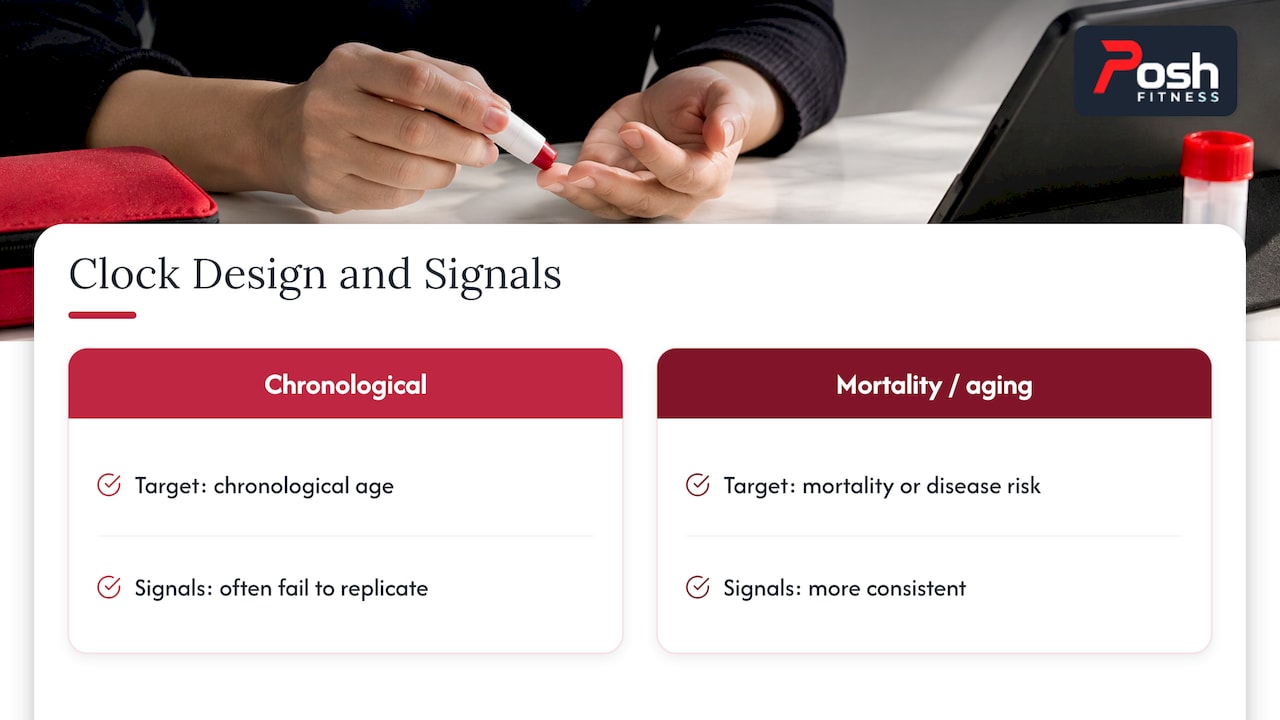
The type of clock matters. Stanford Medicine distinguishes first-generation clocks such as Horvath and Hannum, initially designed to estimate chronological age, from later clocks such as GrimAge, designed to relate methylation patterns more directly to mortality or future disease risk.
That design choice affects what the clock can tell you. An analysis of when to trust epigenetic clocks found that clocks trained on chronological age often show intervention signals that do not replicate, while mortality-based or rate-of-aging clocks were more consistent. The authors argue that a clock can be excellent at guessing calendar age yet poor at detecting biological change, because its training goal does not necessarily capture modifiable aging biology.
How accurate are biological age tests?
It depends on which kind of accuracy you mean.
Accuracy at predicting calendar age
A systematic review of phenotypic and epigenetic clocks reports that epigenetic clocks can predict chronological age with a correlation of 0.96 or higher. That is impressive, and it is also somewhat beside the point. You already know your birthday. The value of a biological age test would be in telling you something your birthday cannot.
Accuracy at predicting health outcomes
Here the picture is more modest. The same review finds that the ability of epigenetic clocks to provide information about mortality and disease is moderate. A 2021 analysis of U.S. adults aged 56 and older in the Health and Retirement Study found that different biological-age summaries explained different health outcomes, and that chronological age explained cognitive dysfunction and mortality at least as well as the summary measures.
A 2025 review on individual-level use argues that epigenetic clocks are useful at the population level but do not currently meet ordinary clinical standards for accuracy, and should not be used alone for individual medical or economic decisions. Population-level success does not automatically establish clinical usefulness for one person. Technical processing, tissue specificity and social or environmental context all matter.
What this means for you
A clock can be a legitimate research tool and still be a blunt instrument for an individual. That is not a reason to ignore it. It is a reason to know how much weight a single number can carry.
Why your result can change or disagree with another test
If you have seen two different numbers for yourself, the research explains why.
| Source of variation | What the research says |
|---|---|
| Built-in error | Stanford Medicine estimates roughly three years of error in many epigenetic clocks, and changing blood-cell levels can add noise. |
| Time of day and temporary states | Epigenetic age may fluctuate by as much as two years during one day, and can be affected by fasting, acute stress, menstrual cycle, season and other transient conditions. |
| Repeat analysis of a sample | A 2022 study summarized by The Conversation found repeated analysis of samples could deviate by as much as nine years in some earlier clocks. |
| Different providers | The same report notes that commercial providers use different methods and algorithms with no full standardization, so two providers may produce materially different estimates. |
| Tissue composition | A 2024 cell-type study found that about 39% of a blood clock’s predictive accuracy and 12% of a brain clock’s accuracy were driven by age-related shifts in cell-type composition. |
Biological age is also not one body-wide quantity. The Max Planck Institute explains that brain, heart and kidney aging can differ, so a sample from one tissue cannot necessarily represent every organ.
A practical reading of the three-year rule
If a clock has roughly three years of error and your result is three years older than your calendar age, Stanford notes that this could reflect noise rather than a true three-year difference. A result that is ten years off in either direction deserves more attention than one that is two years off, but even then it is a prompt for further assessment, not a diagnosis.
What a result can and cannot tell you
A result may show how your biology compares with age-related averages. Stanford cautions that a single number should not be overinterpreted and that its links to healthspan and lifespan remain uncertain. Its guidance is to avoid overreacting to an older result and to treat a younger result with caution.
That cuts both ways, and both halves are useful:
- An older-than-expected result is not a sentence. It is a reason to look at the measurable things behind it: blood pressure, fasting glucose, lipids, inflammation markers, sleep, strength and cardiorespiratory fitness.
- A younger-than-expected result is encouraging, but it is not permission to skip routine checkups or screening.
The Max Planck Institute says commercial tests can provide interesting information but should not be the sole basis for medical or health-related decisions. In an NPR report, University of Washington researcher Matt Kaeberlein considered these tests not yet clearly actionable for individuals, and noted that clinicians cannot prescribe anti-aging drugs based on an individual score. If you have a health condition or take medication, talk with your physician before changing your care because of any test result.
How to interpret your result alongside established health measures
The strongest evidence supports combining measures. The 2021 U.S. study found that combining clinical indicators with newer aging-related biomarkers performed better overall than relying on a single summary biological-age number, though combining indicators can reduce explanatory detail.
A review of geriatric assessment versus biological age measures reports that clinically derived frailty indices can outperform biological-age measures in predicting proximity to death. Established functional assessment still matters. The same review describes sophisticated biomarker-based age measures as potential supplements that are costly.
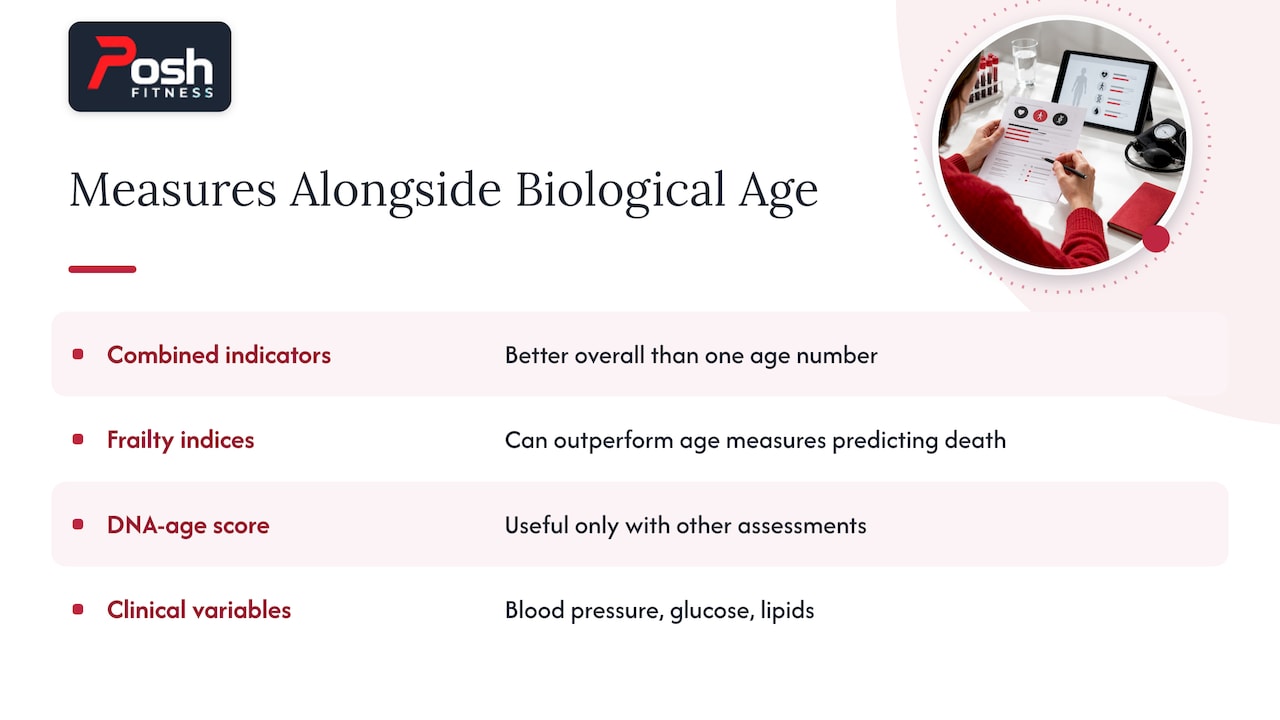
In the NPR report, Northwestern’s Doug Vaughan describes a DNA-age score as useful only as one measure combined with other assessments. The report also quotes Steve Horvath recommending clinical variables such as blood pressure, glucose metabolism and lipid levels for a more accurate estimate of health or lifespan.
A simple framework for reading your number
- Check the gap. Is it within about three years of your calendar age? If so, treat it as roughly on par.
- Look at your labs. Do blood pressure, glucose, lipids and inflammation markers agree with the story? Our guide to lab markers worth tracking explains what each one tells you.
- Add function. Strength, walking speed, grip, balance and aerobic capacity are measurable and trainable.
- Retest the same way. Use the same provider, the same time of day, and similar conditions such as fasting status, so changes mean something.
- Decide on behavior, not on the number. Training, protein intake, sleep and stress habits are worth improving whatever the clock says.
For a deeper look at costs and what the common tests measure, see our guide to biological age testing.
Our perspective
We use biological age testing the way we use any data point: as one input to a plan, never as the plan itself.
Clients often arrive after a result that frightened them or confused them. Our first step is to put the number in context. We look at the research limits, such as the roughly three years of error many clocks carry, and then we look at the things that can be measured and improved: bloodwork, DNA-based insight, physical assessments, strength, and recovery.
That is why our approach combines several kinds of diagnostics rather than leaning on one score. A clock may be noisy, but fasting glucose, lipids, blood pressure and how you move under load are not. When those inputs are read together, we can design training and nutrition around your biology and track whether the changes are real.
We also work alongside your physician. We believe the most empowering use of testing is a clear next step: what to train, what to eat, what to retest, and when. A number that leads to consistent action is worth far more than a perfect number that sits in an inbox.
Peter
From a test result to a plan
The research gives a clear direction. If a single estimate is imprecise, the answer is more and better data, interpreted by someone who can turn it into training and nutrition. Our DNA testing for SystemAge page describes how we offer a biological age estimate as part of a broader assessment, and our article on what DNA testing can and cannot tell you sets realistic expectations.
If you want to see what changes in habits are linked to lower biological age in human trials, our 3 to 6 month plan summarizes it, and our weekly exercise guide for longevity shows what that looks like in practice.
Work with a coach who reads the whole picture
Posh Fitness builds personal training, nutrition and longevity coaching around diagnostics such as DNA analysis, bloodwork, gut microbiome testing and physical assessments. We train clients at home in Fairfield County, CT and Westchester County, NY, at affiliated gyms, or virtually.
If you already have a biological age result, we can help you interpret it next to your labs and build a plan. Our Longevity Coaching and SystemAge + Coaching Session are listed on our pricing page, and the Ultra Membership 5 a Week is $2,000 per month. If you prefer to start online, the online personal fitness plans run $40 per month for the Starter plan and $99 per month for the Truly Personal Plan. To talk through your situation, get started with an in-home trainer.
FAQ
Are biological age tests accurate?
They are very accurate at estimating calendar age and moderately informative about mortality and disease risk at the group level. For one person, many epigenetic clocks carry roughly three years of error, according to Stanford Medicine. Use the result as one input alongside labs and fitness measures.
What is an epigenetic age test?
It measures DNA methylation, chemical marks on DNA that change with age and do not alter the DNA sequence. An algorithm converts the pattern into an age estimate. Different clocks are trained on different targets, such as calendar age or mortality risk, so results differ between providers.
Can I compare results from two different tests?
Not reliably. Commercial providers use different methods and algorithms with no full standardization, so the same person can get materially different numbers. If you want to track change over time, retest with the same provider under similar conditions, such as the same time of day and fasting status.
Should I be worried if my biological age is higher than my real age?
Not on the number alone. Stanford advises against overreacting to an older result, since it may partly reflect noise. Use it as a prompt to review blood pressure, glucose, lipids, sleep, strength and fitness, and discuss any concerns with your physician.
Sources
- Biological age versus chronological age: What the science says (Stanford Medicine, 2026)
- Understanding the difference between biological age and chronological age (Mayo Clinic Press)
- What Is Biological Age? (Cleveland Clinic)
- What is biological age and how can you measure it? (Max Planck Institute for Biology of Ageing)
- When to Trust Epigenetic Clocks: Avoiding False Positives
- A systematic review of phenotypic and epigenetic clocks
- Quest for a summary measure of biological age: the Health and Retirement Study
- From Population Science to the Clinic? Limits of Epigenetic Clocks
- How old are you really? (The Conversation)
- Cell-type specific epigenetic clocks to quantify biological age
- Determination of Biological Age: Geriatric Assessment vs Biological Clock
- How do biological age tests work and are they accurate? (NPR)