


Neither time wins outright. Large reviews of the evidence find no reliable health advantage for morning or evening training, so the best workout time is the one you can keep up week after week. Mornings tend to help with routine and consistency. Evenings can suit strength and high-intensity work, and they often fit a busy schedule better. Below we cover what each option does for energy, sleep, fat loss and performance, and how to pick yours.
Key takeaways
- Two large reviews found no dependable health or performance edge for one time of day, so consistency matters more than the clock.
- Morning training often makes a habit easier to protect. Evening training can feel stronger because your body is warmer and more limber.
- An evening workout around 7 p.m. is fine for most people. Finish vigorous sessions at least an hour before bed and watch how you sleep.
- Test mornings for a week and evenings for a week, then note your energy, sleep and mood.
- Home or gym matters less than whether you will actually show up.
Table of Contents
- What the research says about the best time to exercise
- The case for a morning workout
- The case for an evening workout
- Morning vs evening at a glance
- Fat loss and cortisol: does timing matter?
- How to choose: a two-week test
- Home or gym: where should you train?
- Our perspective: biology beats the clock
- Get a schedule built around you
- FAQ
- Sources
What the research says about the best time to exercise
If you hoped for a clean winner, the science is more modest. A 2023 systematic review and meta-analysis screened 14,125 articles and included 26 studies. It found little evidence that one time of day improves performance or health outcomes more than another. One nuance: training at the same time of day you plan to perform or compete may help performance-related results.
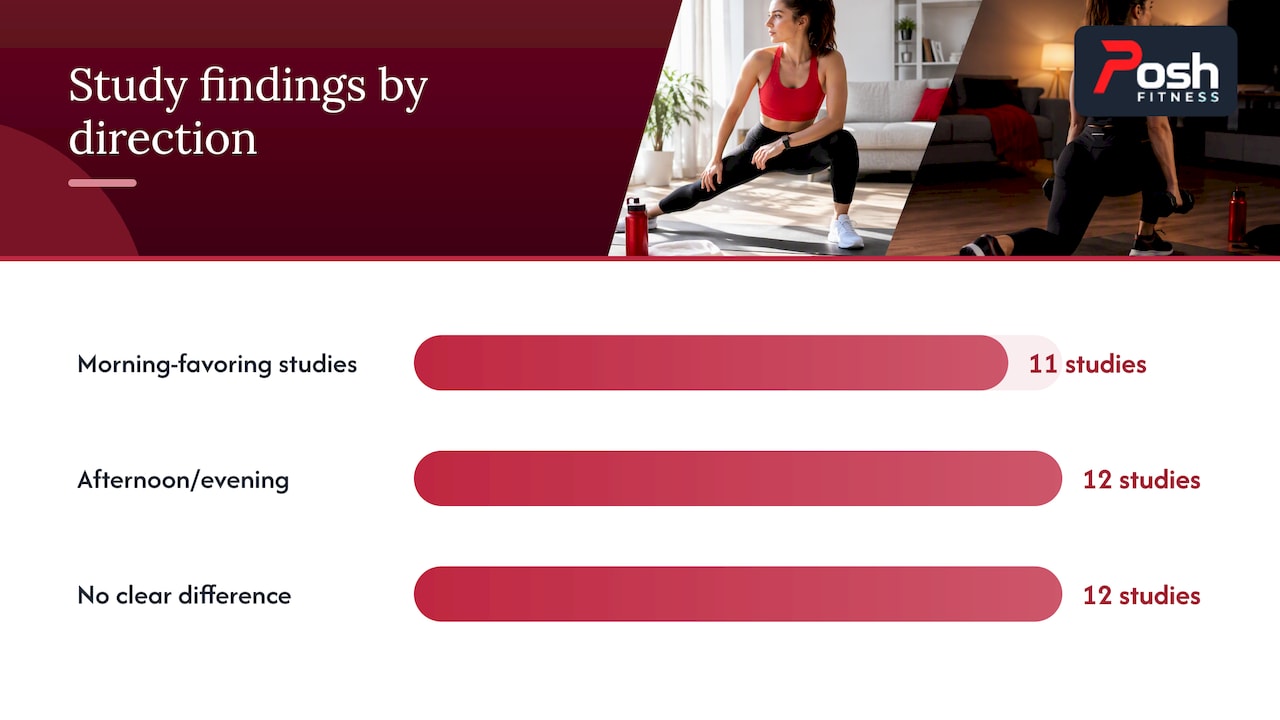
A 2022 review of 35 studies with 17,259 participants points the same way. Eleven studies favored morning activity, 12 favored afternoon or evening, and 12 found no clear difference, and the authors rated the evidence quality as very low. Findings were inconsistent across all nine health-outcome categories they examined, which is why no reliable ranking exists.
This is useful, not disappointing. If timing were a major lever, we would see it clearly in the data. Instead, the variable that keeps showing up is adherence. Cleveland Clinic’s exercise physiologist guidance is to choose the time when you have the most energy and motivation, and that consistency is the most important variable.
The case for a morning workout
Morning sessions have real practical advantages, and some research associations to go with them.
Consistency. Fewer things interrupt a 6:30 a.m. workout than a 6 p.m. one. Work runs late, kids need rides, dinner plans shift. Northwestern Medicine notes that research suggests morning exercisers tend to be more consistent and more likely to stay active through the day.
Alertness and sleep. Cleveland Clinic says morning exercise may support alertness and may help sleep. It also reports associations with better sleep, lower blood pressure and greater weight loss, but presents these as associations rather than proof that mornings are universally better. The sleep evidence is mixed: in the 2022 review, some studies favored morning exercise or exercise at least four hours before bed, one favored evening, and others found no link at all.
Sleep timing. In a 2021 randomized study of overweight and obese adults, morning training advanced bedtime and mid-sleep, while early-evening training delayed them. If you are a night owl who wants to shift earlier, that is worth knowing. If your bedtime already suits you, it is not a reason to change.
The drawbacks. Mornings can mean cold muscles, stiffness, lower energy, digestive discomfort if you eat close to training, and fewer workout partners. Time is tight too, especially if you commute. If you are already tired when the alarm rings, a hard 5 a.m. session is a poor trade for sleep. Our post on a simple morning routine for energy lays out a low-friction way to test mornings before committing.
The case for an evening workout
Evening training has a physiological argument and a lifestyle one.
Performance. Northwestern Medicine reports that later in the day, body temperature, flexibility, power, coordination, reaction time and oxygen-uptake kinetics can support strength, high-intensity exercise and endurance performance. If you lift heavy or do intervals, you may feel stronger at 5 or 6 p.m. than at 6 a.m.
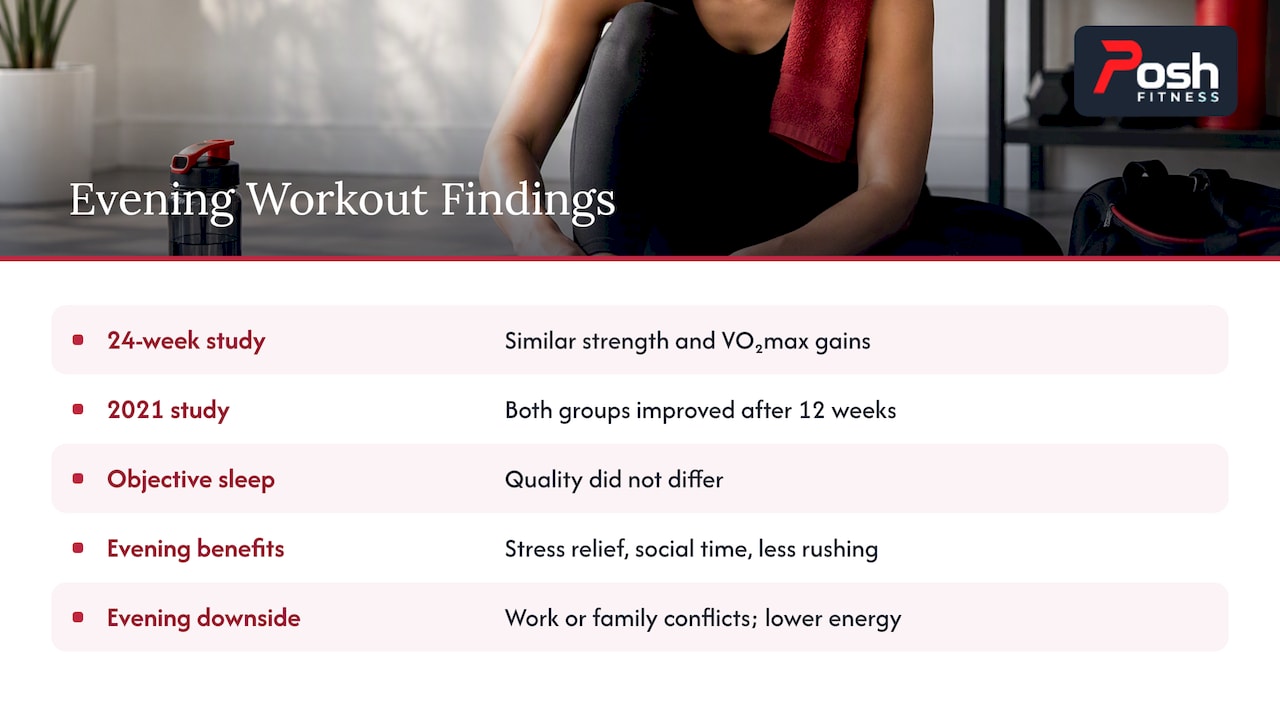
Results are similar over time. In a 24-week study of combined strength and endurance training, morning and evening groups improved strength and VO2max to a similar degree. Participants slept 7 to 8 hours, and neither schedule disrupted their sleep. In the 2021 study above, both morning and early-evening groups improved body composition, endurance, subjective sleep, sleepiness, fatigue and quality of life after 12 weeks of training three times a week. Objective sleep quality did not differ. The authors considered evening training an effective alternative when mornings are not feasible.
Lifestyle fit. Cleveland Clinic lists stress relief, social opportunities and less morning rushing as evening benefits. The downsides are conflicts with work or family commitments and lower energy after a long day.
Is it okay to work out at 7 p.m.?
For most people, yes. Cleveland Clinic advises avoiding vigorous exercise immediately before bed if it interferes with your sleep, and suggests finishing at least one hour before bedtime. Gentle yoga or an easy walk may be fine closer to bed. If you go to bed at 10:30, a 7 p.m. session leaves plenty of margin. If you notice a racing heart or trouble falling asleep, move the session earlier or lower the intensity.
One more evening trap is food. After a late workout, hunger and a tired brain can push you toward grazing at night. If that sounds familiar, this guide to stopping late-night snacking is worth a read, and planning a protein-forward dinner right after training helps too.
Morning vs evening at a glance
| Factor | Morning | Evening |
|---|---|---|
| Consistency | Fewer interruptions, easier to protect | More schedule conflicts, but suits many routines |
| Energy | Can be low, especially when stiff or cold | Can be lower after work, though some people peak |
| Strength and power | Fine with a good warm-up | Body temperature and flexibility are often higher |
| Sleep | Associated with earlier bedtime | Fine if vigorous work ends an hour or more before bed |
| Social | Fewer partners | More classes and workout partners |
| Stress | Starts the day with a win | Helps unwind from the workday |
Fat loss and cortisol: does timing matter?
Two of the most common questions are whether mornings are better for fat loss and whether they lower cortisol. The honest answer to both is that the evidence does not support a firm yes.
A 2015 crossover study of 10 obese male college students found that fasted morning exercise changed fat-substrate and hormone responses, but it also increased cortisol. That small, acute study cannot show that morning exercise produces superior long-term fat loss. Another 2015 crossover study of 14 healthy young men found that cortisol was higher before exercise in the morning than in the evening, and evening exercise produced higher immediate post-exercise adrenaline. Cortisol follows a daily rhythm, and it rises with hard exercise. So morning exercise does not lower cortisol simply because of the hour.
For fat loss, what you do matters more than when. Resistance training protects muscle, protein-forward nutrition supports appetite control, and a steady weekly pattern drives body recomposition. If this is your goal, our posts on cardio versus weights for fat loss and body recomposition versus weight loss are better places to spend your attention than the clock.
How to choose: a two-week test
Here is the approach we use with clients, and it matches what Cleveland Clinic recommends.
- Set your baseline. The U.S. Physical Activity Guidelines say adults should generally aim for at least 150 minutes of moderate or 75 minutes of vigorous aerobic activity weekly, plus muscle-strengthening work on at least two days. This is the 2008 edition. Pick a plan that fits inside that range.
- Train in the morning for one week. Keep the sessions the same length and intensity.
- Train in the evening the next week. Do the same workouts.
- Track three things daily: energy during the day, how quickly you fall asleep and how rested you feel, and your mood.
- Choose the time you will protect. Not the time that sounds ideal, but the one that won’t get crowded out.
Harvard Health’s guidance is to exercise when you feel motivated and energized enough, and it notes that an exercise partner can improve enjoyment and accountability. If you feel flat after sessions rather than better, look at the basics first. Our checklist for feeling tired after workouts covers when it is recovery and when it deserves a conversation with your doctor, and the same goes for hydration and energy.
If you already know your energy is unreliable, start with shorter sessions. Twenty focused minutes at a time you can protect beats a 60-minute plan you skip. The American College of Sports Medicine’s 2026 guidance says programs should be individualized to goals, enjoyment and safety, and that a plan you cannot maintain loses its effectiveness.
Home or gym: where should you train?
Time of day often decides location. A 6 a.m. workout at home removes the commute, and an evening class at a gym adds social energy.
ACSM’s home-gym guide lists lower membership costs, privacy and no commuting as reasons people train at home, and it also notes that home setups may lack external motivation. Resistance bands, kettlebells, stability balls, mats and foam rollers go a long way in small spaces. ACSM’s 2026 materials add that bodyweight, elastic-band and home-based training can be effective and that traditional gym settings are not required for general fitness.
A gym makes sense when you want heavier loads, more equipment variety or the structure of leaving the house. ACSM’s facility handout recommends choosing based on goals, access, equipment, programs, cleanliness, staffing and total value, touring several facilities, and checking for trial memberships and extra class fees. If you lean toward home, see our guide to setting up a home gym for what to buy and what to skip.
A few cases where timing and place interact:
- Early riser, short on time: home, 20 to 30 minutes, bands and dumbbells.
- Lifts heavy, evening person: gym after work, with a snack beforehand.
- Back pain or stiffness in the morning: later session, or a gentle warm-up first. Our lower back workouts take 5 to 12 minutes.
- Managing a thyroid condition: check with your clinician, then build gradually with a 20-minute start.
Our perspective: biology beats the clock
People come to us tired, frustrated with workouts that stopped working, and sure they are doing the timing wrong. Rarely is the clock the problem. More often it is a plan built for someone else: the wrong volume, not enough protein, poor sleep, or a schedule that makes the workout the first thing to go.
That is why we start with data on you. We use DNA analysis, bloodwork, gut microbiome testing and physical assessments to understand your recovery, your energy patterns and your constraints. Then we build the schedule around your real week. For one client a 6:30 a.m. in-home session is the anchor. For another, a 6 p.m. strength session with a lighter morning walk is what holds. Neither is wrong.
Our advice is to test, observe and adjust, and to bring your doctor in whenever fatigue is persistent or unexplained. A workout time is a tool, and the best one is the one you will use.
— Peter
Get a schedule built around you
If you live in Fairfield County, CT or Westchester County, NY, we can train you at home, at an affiliated gym or virtually, and we will help you find the time of day that works for your biology and your calendar. Start with in-home personal training in Fairfield County. If you prefer to begin online, our online personal training programs include a Starter plan at $40 per month, the Truly Personal Plan at $99 per month and live virtual sessions at $80 each.
FAQ
What is the best time to exercise for fat loss?
There is no proven best time. The evidence on timing and fat loss is limited, and the small studies that exist are short-term. Weekly consistency, strength training and nutrition drive results, so choose the slot you will keep.
Does morning exercise lower cortisol?
Not as a general rule. Cortisol is naturally higher in the morning, and one small study found fasted morning exercise raised it further. Hard exercise at any hour raises cortisol temporarily, and that is a normal response.
Will a workout at 7 p.m. hurt my sleep?
Usually not. Reviews and individual studies found no consistent sleep disruption from evening training, though results vary. Finish vigorous exercise at least an hour before bed, and if you sleep poorly, try an earlier session or an easier effort.
Is it better to train at home or at a gym?
Both work. Home training saves time and money and can be effective with bands, kettlebells and bodyweight. A gym offers more equipment and built-in structure. Pick the option that you will use consistently.
Sources
- Bruggisser et al., 2023: Best time of day for strength and endurance training
- Janssen et al., 2022: Timing of physical activity within the 24-hour day
- Cleveland Clinic: Best Time of Day to Workout
- Northwestern Medicine: Best Time of Day To Exercise
- Küüsmaa-Schildt et al., 2019: Morning vs. evening combined strength and endurance training
- 2021 randomized study: Morning versus evening exercise training
- 2015 study: Acute exercise after overnight fast
- 2015 study: Acute endurance exercise in the morning and evening
- Physical Activity Guidelines for Americans (2008)
- Harvard Health: Optimize your exercise routine
- ACSM: 3 Essentials for Building a Home Gym
- ACSM: Updated Resistance Training Guidelines
- Stummy: How to Stop Late Night Snacking