
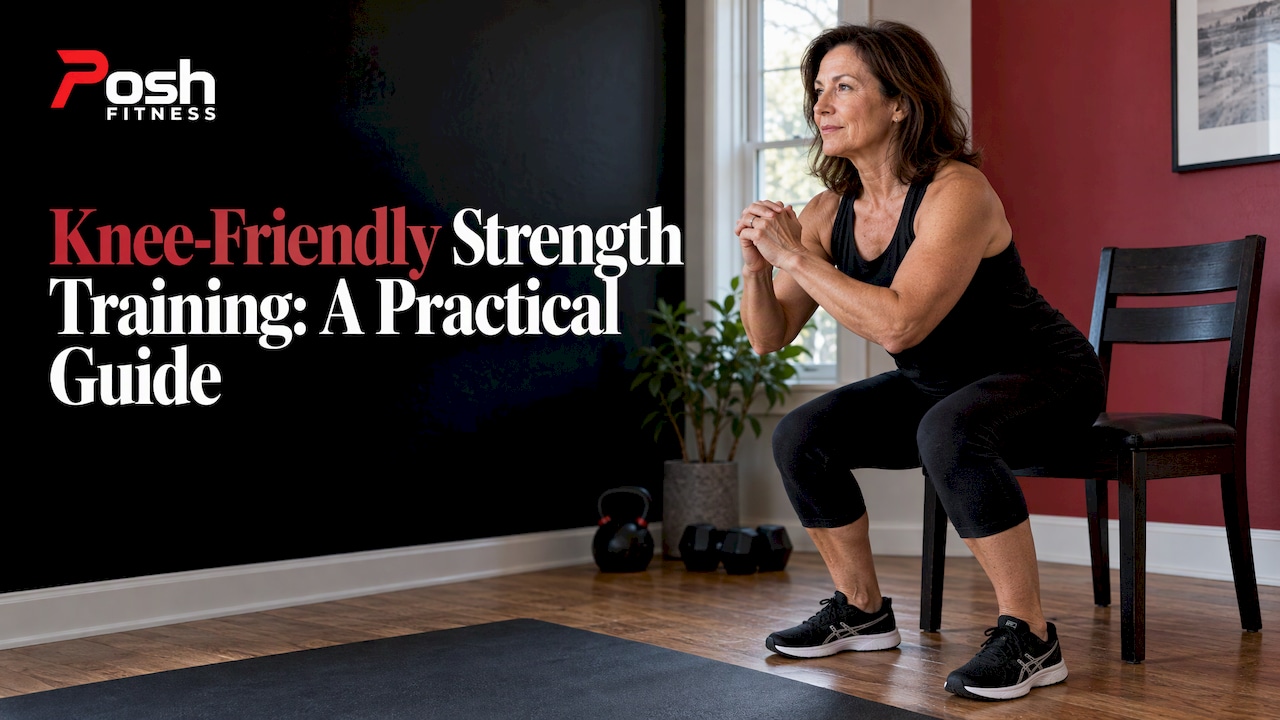

Knee-friendly strength training means building the muscles around the joint (quadriceps, hamstrings, glutes and hip stabilizers) with controlled, low-impact movements, moderate ranges of motion and gradual progression. Done this way, it is one of the most useful things you can do for sore knees. The details matter: which exercises, how deep, how heavy and how fast you add load. At Posh Fitness, we build programs from a physical assessment and, where clients choose it, DNA and bloodwork, so the plan fits your body instead of a generic template. Below is the full routine, the reasoning behind it and the signs that tell you to stop.
Key Takeaways
- Strong muscles around the knee are protective. A 2025 meta-analysis found resistance training improves physical function and reduces stiffness in knee osteoarthritis.
- Train the hips, hamstrings and quadriceps, favor controlled low-impact moves, and keep deep knee bending and jumping out of the picture while the knee is sensitive.
- Start with 3 sets of 10 to 15 repetitions, then raise resistance by 5% to 10% every 10 to 14 days.
- Stop an exercise that hurts. Pain that wakes you at night, swelling, or a knee that will not bear weight needs a doctor first.
- Individual factors such as age, baseline function and joint condition change what is right for you, which is where a personalized plan pays off.
Table of Contents
- Is strength training good for your knees?
- What makes a strength exercise knee-friendly
- The muscles to train
- A knee-friendly full-body routine
- Sets, reps and how to progress
- Low-impact does not mean low-effort
- If you have osteoporosis or low bone density
- Should you skip leg day if your knee hurts?
- Warning signs: when to stop and when to see a doctor
- Why a personalized plan fits knees best
- Work with a trainer who comes to you
- FAQ
- Sources
Is strength training good for your knees?
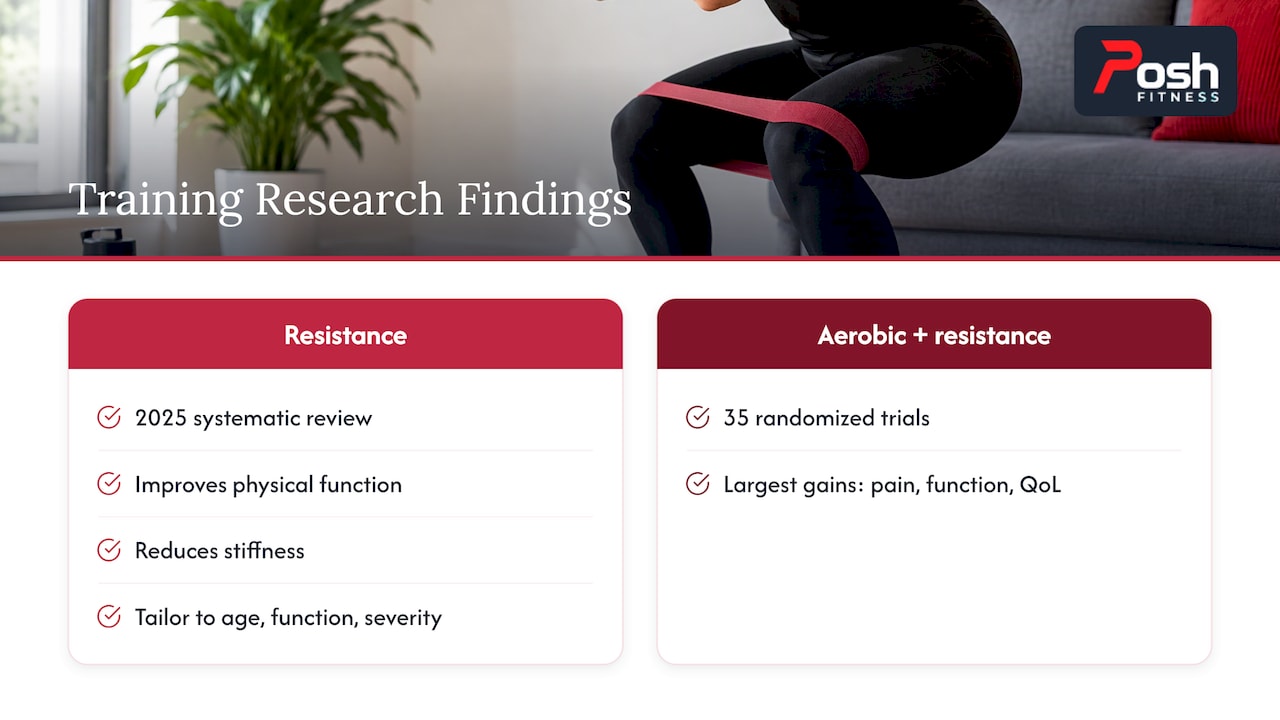
For most adults with achy knees, yes. The common fear is that lifting wears the joint out. The research points the other way. A 2025 systematic review and meta-analysis found that resistance training improves physical function and reduces stiffness in people with knee osteoarthritis, and it recommends tailoring the program to age, baseline function and disease severity. Separately, a network meta-analysis of 35 randomized trials found that combining aerobic and resistance training produced the largest short-term gains in pain, function and quality of life.
The practical lesson is not “lift more.” It is “lift smarter, and keep the whole body in the plan.” A knee rarely hurts in isolation. Weak hips, tight calves and a quadriceps that fatigues early all change how load lands on the joint.
What makes a strength exercise knee-friendly
Four variables decide whether a movement is kind to your knees: range of motion, load, stability and speed.
Range of motion
The National Strength and Conditioning Association advises caution with deep squats and other weight-bearing moves that bend the knee past 90 degrees, because they increase compression behind the kneecap. It also notes that knee extensions (the seated leg-extension machine) in the last 30 degrees before the leg straightens raise kneecap joint load and are often avoided when the front of the knee hurts. In plain terms: work in the middle of the range, where most people feel best.
Load
Heavy is not the enemy. Sudden jumps in load are. Progress in small, planned steps (more on that below).
Stability
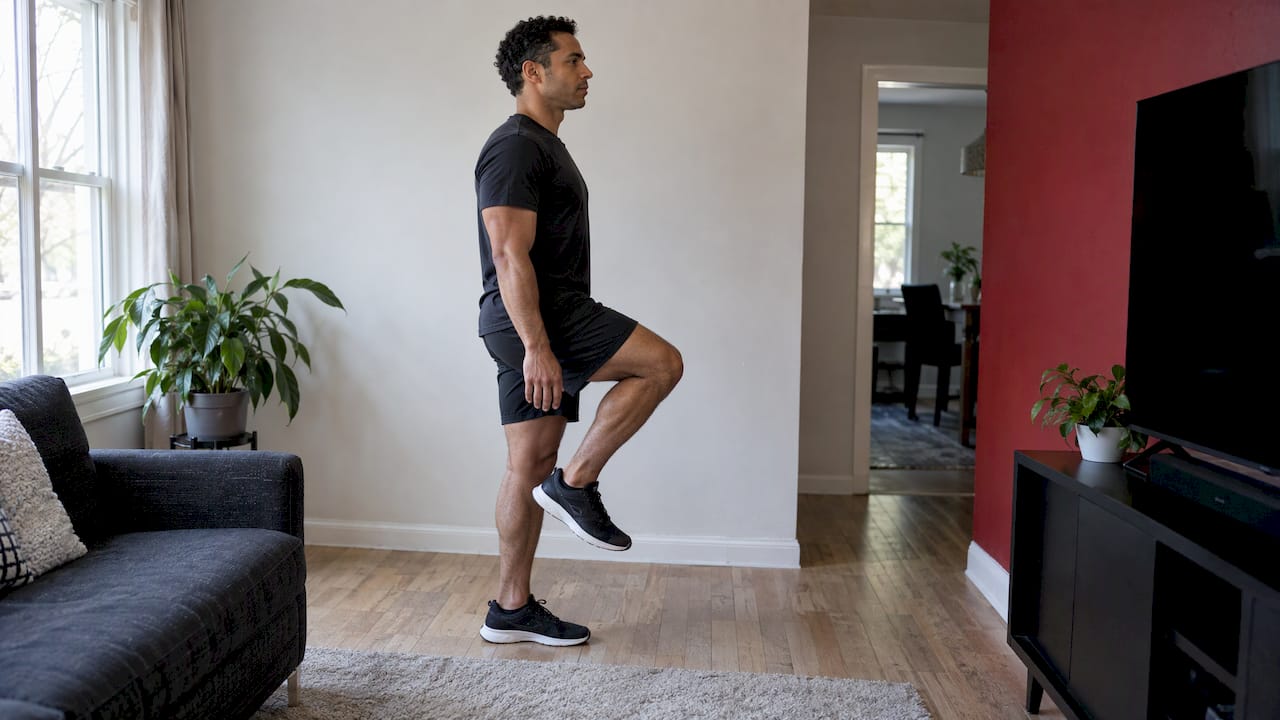
The NSCA also reports that hip strengthening and single-leg balance work are essential for stabilizing the leg and treating front-of-knee pain. Quadriceps strengthening improves kneecap function and reduces that pain too. So the plan needs both: quads and hips.
Speed
Slow, controlled repetitions (about two to three seconds lowering, one second lifting) keep the joint from being jerked and make it obvious when form slips.
The muscles to train
Harvard Health describes effective knee-friendly routines as focusing on the hip abductors (outer hips), hamstrings and quadriceps. A simple way to think about it:
| Muscle group | What it does for your knee | Example exercise |
|---|---|---|
| Quadriceps (front thigh) | Controls the kneecap and absorbs load on stairs | Box squat to a high chair, partial range |
| Hamstrings (back thigh) | Balances the quads and protects the joint from behind | Dumbbell Romanian deadlift, hamstring curl |
| Glutes and hip abductors | Keep the knee tracking over the toes | Banded lateral walk, glute bridge |
| Calves and core | Absorb ground forces and keep the trunk steady | Calf raise, dead bug, side plank |
A knee-friendly full-body routine
This routine suits most adults who are cleared to exercise and have mild to moderate knee discomfort. Do it two or three nonconsecutive days a week. Warm up first: Mass General Brigham suggests stationary cycling or an elliptical until you begin to sweat.
- Glute bridge. Lie on your back, knees bent, and lift your hips until your body forms a line from shoulders to knees. Pause for a second at the top. Where it goes wrong: arching the lower back instead of squeezing the glutes.
- Box squat to a high chair or bench. Sit back toward a seat that keeps your thighs above parallel, then stand. The seat limits depth so the knee stays in a comfortable range. Where it goes wrong: knees caving inward. Push them gently out over your middle toes.
- Banded lateral walk. Place a light band above the knees, soften the knees slightly and step sideways. This trains the outer hip that keeps the knee stable. Where it goes wrong: leaning the torso to cheat the step.
- Dumbbell Romanian deadlift. Hold light weights, hinge at the hips with a soft knee, and lower until you feel the hamstrings stretch. Where it goes wrong: rounding the back, or turning it into a squat.
- Step-up to a low step. Choose a step you can climb without pain, drive through the heel and lower slowly. This is a single-leg task, which builds the balance the NSCA highlights. Where it goes wrong: pushing off the back foot.
- Standing calf raise. Hold a counter for balance and lift the heels smoothly. Easy on the joint and good for stairs and walking.
- Side plank or dead bug. Core control keeps the pelvis level, which helps the knee line up.
If land-based moves flare the knee, water is a strong option. HSS lists water-based squats, leg raises and lunges among low-impact choices, along with water aerobics, biking and walking.
Sets, reps and how to progress
Mass General Brigham’s knee program starts with 3 sets of 10 to 15 repetitions, and says to raise resistance gradually, by 5% to 10% every 10 to 14 days. For an exercise you are just learning, it also describes adding one repetition per set at each workout until you reach 3 sets of 10, then adding dumbbells once the exercise feels easy and pain-free.
Here is what that looks like over six weeks for a box squat:
| Week | Load | Sets x reps |
|---|---|---|
| 1 | Bodyweight | 2 x 10 |
| 2 | Bodyweight | 3 x 10 |
| 3 | Bodyweight | 3 x 12 |
| 4 | Bodyweight | 3 x 15 |
| 5 | Light dumbbell | 3 x 10 |
| 6 | Same dumbbell | 3 x 12 |
The mistake we see most often in training plans is changing everything at once: heavier weights, deeper range and more sessions in the same week. Change one variable at a time and the knee has a chance to adapt. If you want help tracking this, our Online Personal Fitness Plan Starter is $40 per month and the Truly Personal Plan is $99 per month, both built around personalized programming.
Low-impact does not mean low-effort
People searching for low-impact strength work often assume it will feel too easy. It will not if you manage tempo, pauses and load. Slow lowering phases, a one-second pause at the hardest point and single-leg variations all raise the demand without adding impact. Cycling and walking add useful conditioning on off days. The HSS guidance notes that if a 30-minute walk hurts, three 10-minute walks are a way to keep moving.
The meta-analysis on combined training supports mixing the two. Pair your strength days with easy aerobic work, and consider adding a weekly mobility session so the hips and ankles move well. If you also want to know how to spread lifting, cardio and recovery across a week, our guide to exercise for longevity lays it out.
If you have osteoporosis or low bone density
Bone health changes the conversation: the loading needs to be deliberate and progressive. A guide on starting resistance training safely covers how to begin when bone density is a concern. Check with your doctor before you begin if you have been diagnosed.
Should you skip leg day if your knee hurts?
Usually you modify it rather than skip it. Keep training the hips, hamstrings and calves, and shorten the range for the quadriceps. Remove the exercise that provokes pain and replace it with a close cousin: a leg-extension machine that hurts might be swapped for a box squat to a high seat or a wall sit at a shallow angle. Arthritis and sports-medicine guidance says that if a specific exercise causes pain that persists for days or weeks despite modifications or rest, you should drop it in favor of a different activity.
Warning signs: when to stop and when to see a doctor
Some muscle effort and mild discomfort in early strengthening is normal, but pain that builds is not. An HSS physical therapist stresses that you should never push through increasing pain. The American Academy of Orthopaedic Surgeons advises that you stop an exercise if it hurts, rest if soreness makes it hard to move, and ask a doctor or therapist if you have pain or questions. It helps to know the difference between soreness in the muscle and pain in the joint; this explanation of training with muscle soreness covers when to go ahead and when to rest.
See a doctor before you start, or before you continue, if you have:
- A fever with knee pain, pain that is not improving, pain that intensifies with activity, or pain that wakes you at night, per Harvard Health.
- Urgent signs: a popping sound at the time of injury, visible deformity, inability to bear weight, sudden swelling or intense pain, per the Mayo Clinic. These call for prompt medical attention.
If your knee flares after a session, do not train that pattern again until it has settled, then return at a lower load. If you feel run down for days after sessions rather than just in the joint, our checklist on recovering when you are tired after workouts helps you sort it out.
Why a personalized plan fits knees best
The 2025 review’s central recommendation is to individualize resistance training by age, baseline function and severity. That is hard to do from a video or a listicle. A 52-year-old with a stiff knee and a desk job needs a different starting point than a 45-year-old returning from a long layoff, and both differ from someone with fatigue and low energy that make recovery slower.
This is where our approach is designed to help. We use physical assessments, and for clients who choose it, DNA analysis, bloodwork and gut microbiome testing, to shape both training and nutrition. Our trainers work with you in your home in Fairfield County, at an affiliated gym or virtually, so the plan follows your schedule and your equipment rather than a gym you dread. If you are also dealing with back discomfort, our article on short evidence-backed lower back workouts pairs well with this one.
Our perspective on knee-friendly training
When someone tells us their knees “can’t handle” strength training, we usually hear a different story underneath: a program that was too aggressive, too generic, or built without any assessment of how they move. The knee often takes the blame for what the hips, ankles and recovery habits are doing.
We believe the answer is individualization. Biology differs from person to person, which is why our coaching uses physical assessments and, where clients want them, DNA and bloodwork to guide training and nutrition. For a knee, that means choosing the right range, the right load and the right pace for you, then raising it steadily.
The goal is not to protect the knee by doing less. It is to build a body that supports the knee so you can climb stairs, play with grandchildren and train for decades. That is what we mean by healthspan.
Peter
Work with a trainer who comes to you
If you would rather have someone set the range, watch your form and adjust the load as your knee responds, we offer in-home personal training in Fairfield County and Westchester, plus virtual options. A Live Virtual Training Session is $80 one-off, which is an easy way to start. For in-person coaching, you can get started with an in-home personal trainer in Fairfield County.
If you want the testing side as well, our 4 Week DNA Coaching is built around your biology.
FAQ
Is strength training good for your knees?
For most people, yes. A 2025 meta-analysis found that resistance training improves function and reduces stiffness in knee osteoarthritis. The best results come when the program is matched to your age, current function and joint condition.
What are the signs of weak knees?
Common signs are a knee that feels unstable, trouble with stairs, fatigue in the thighs on short walks and pain at the front of the knee. Weak quadriceps and hips are often involved, so both get trained. If the knee gives way, swells or will not bear weight, see a doctor.
What are some low-impact workouts that are knee-friendly?
Glute bridges, box squats to a high seat, banded lateral walks, Romanian deadlifts, low step-ups and calf raises are good starting points. Water exercise, biking and walking add conditioning with less joint impact.
How heavy should I lift with sore knees?
Start with bodyweight or light dumbbells for 3 sets of 10 to 15 repetitions. Once the exercise is easy and pain-free, increase resistance by 5% to 10% every 10 to 14 days. If pain builds during or after a session, reduce the load or range.
Sources
- The Impact of Strength/Resistance Training on Knee Osteoarthritis (2025 review)
- Exercise for Osteoarthritis: What the Evidence Shows
- Knee Movement and Exercise Guidelines, NSCA
- Take control of your knee pain, Harvard Health
- Strength Training for the Knee, Mass General Brigham
- The Best Types of Exercise for Sore Knees, HSS
- Knee Exercises, OrthoInfo, AAOS
- Knee pain: When to see a doctor, Mayo Clinic
- Resistance Training for Osteoporosis: How to Start Safely
- Training with Muscle Soreness: When to Go Ahead and When to Rest