
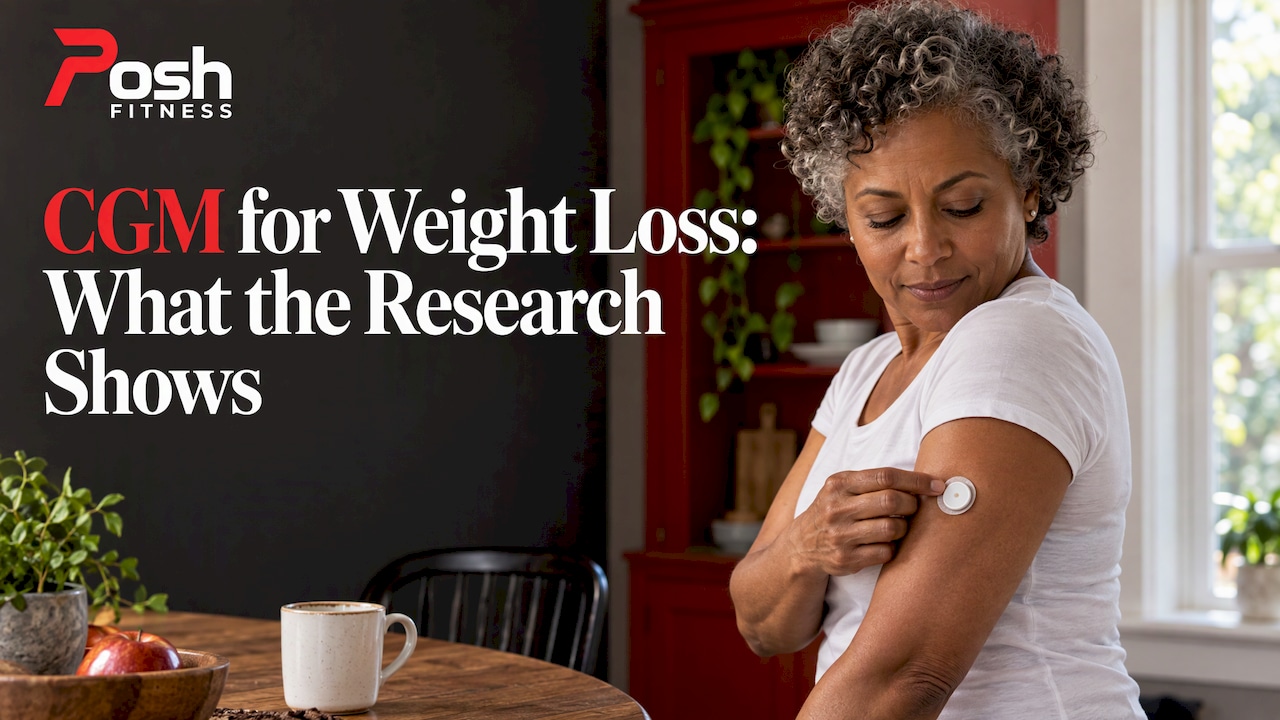

A continuous glucose monitor (CGM) does not cause weight loss. It shows you how your blood sugar moves after meals, workouts and poor sleep, and that feedback helps only when it changes what you do next. The trials point the same way: the biggest gains come when a CGM is paired with personalized nutrition guidance or behavioral coaching, and the smallest come when it is worn alone. At Posh Fitness we build programs from your DNA, bloodwork, gut microbiome and physical assessments, so the data you collect leads to a plan you can follow.
Key Takeaways
- A CGM is a feedback tool, not a weight-loss treatment. Across 25 trials, the effect on weight and BMI alone was not statistically significant.
- Results improve when glucose data is paired with coaching: in one 30-day trial, the CGM plus personalized nutrition group lost 4.27 lbs versus 2.22 lbs.
- Healthy people spend most of the day in a normal range, so a post-meal rise is usually ordinary physiology, not a sign your diet is failing.
- Use a CGM for two to four weeks to learn your patterns, then turn the findings into habits: meal order, protein, walking after meals, sleep.
- If you have diabetes or take glucose-lowering medication, set up CGM use and diet changes with your physician.
Table of Contents
- How a CGM works
- Do CGMs help you lose weight?
- What a normal glucose curve looks like
- How to run a CGM diet experiment
- What about blood sugar and weight loss thresholds?
- What a CGM costs
- Where blood sugar fits in the bigger picture
- Safety: who should involve a physician first
- Turning data into a plan with Posh Fitness
- FAQ
- Sources
How a CGM works
A CGM is a small sensor worn on the skin that measures glucose in the fluid beneath it. According to the CDC, sensors are replaced every 7 to 14 days, readings update automatically every few minutes, and many devices alert you when glucose is rising or falling quickly. The CDC also notes that moving the sensor to a different spot on the body helps prevent skin irritation, and an extra adhesive patch can protect it in the shower or pool.
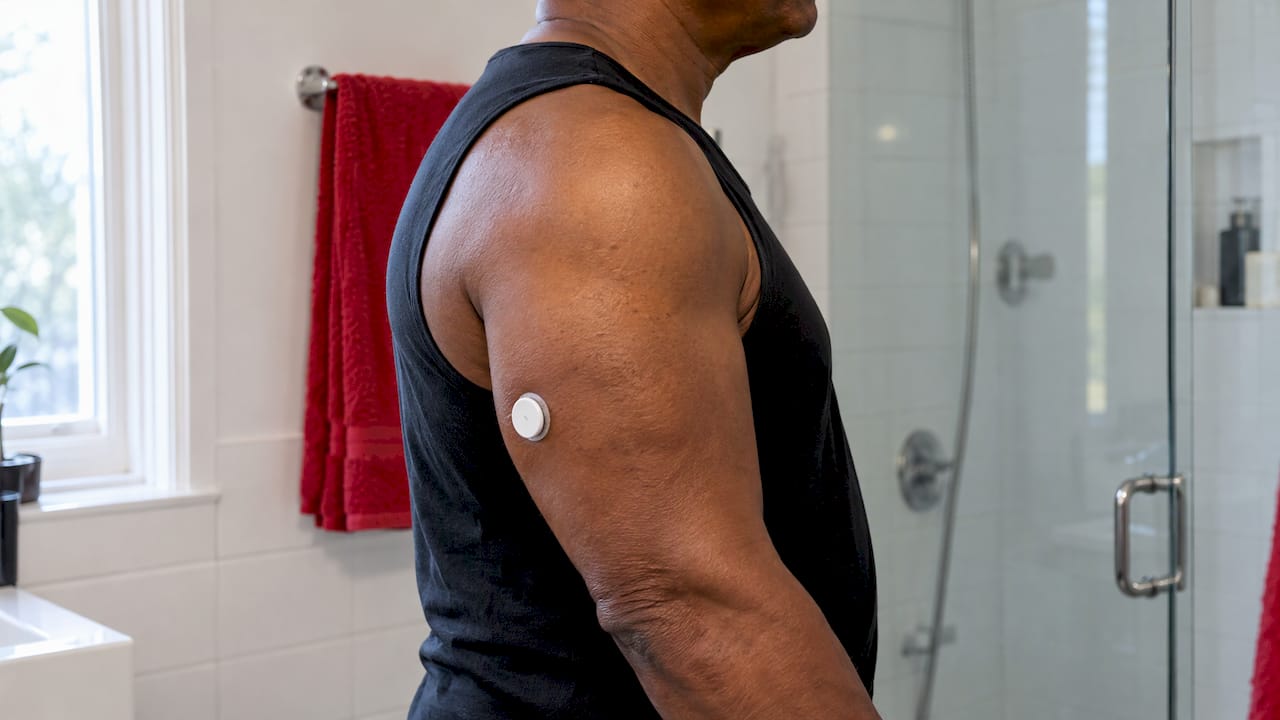
A fingerstick gives you one number. A CGM gives you a curve across the day and night. That curve is what makes it interesting for weight management: you can see which breakfast sends your glucose up fast, which dinner keeps it steady, and what a 15-minute walk does afterward.
Do CGMs help you lose weight?
The honest answer is: sometimes, and mostly through the behavior changes they prompt. Here is how the main studies line up.
| Study | Who | What it found |
|---|---|---|
| Meta-analysis of 25 trials (2024), 2,996 participants | Mixed groups | Better HbA1c (down 0.28%) and time in range, but non-significant effects on BMI and weight |
| Basiri and Cheskin RCT (2024) | Adults with prediabetes | CGM plus personalized nutrition therapy lost 4.27 lbs in 30 days versus 2.22 lbs for the control group |
| Katzmarzyk et al. (2026) | Adults with type 2 diabetes | CGM plus behavioral weight management gave a 3.2% greater body weight reduction at 6 months than usual care |
| JAMA Network Open study (2022), reported in 2025 | Adults on a CGM-based personalized diet | No significant weight-loss difference from a standard low-fat diet |
The pattern is consistent. The device alone is a modest lever. The device plus a person or program that helps you act on it is where results show up. In the George Mason University study, the researchers suggested that seeing the effect of foods on glucose may make people follow nutrition recommendations more seriously. A dietitian quoted by TODAY.com made a similar point: CGM use does not directly cause weight loss, and its value lies in feedback that supports self-regulation.
So the useful question is not “does a CGM work?” but “what will I do with the data?”
What a normal glucose curve looks like
This is where many people without diabetes get tripped up. A glucose rise after a meal is normal. A study of healthy non-diabetic participants of all ages found they spent about 96% of the day between 70 and 140 mg/dL, and readings above 180 mg/dL were exceptionally rare. If you see a bump to the 130s or 140s after lunch, that is not a verdict on your diet.
What the data is good for is comparison within your own life:
- Same meal, different order or different time of day
- Same dinner, with and without a short walk afterward
- A night of poor sleep versus a night of seven hours
- A hard workout versus a rest day
Those comparisons are far more informative than chasing a flat line. A flat line is not the goal, and a food that produces a small rise is not automatically a food to avoid.
How to run a CGM diet experiment
A structured two-to-four-week test teaches more than a month of casual glancing. Here is a routine that works with the evidence.
- Set a baseline week. Eat as you normally do and log meals, sleep and workouts in the app. Do not change anything yet.
- Pick two or three repeat meals. Choose your usual breakfast, a common lunch and a typical dinner. The American Diabetes Association’s example for people with diabetes is to check glucose before a meal and again two hours later to see what that food did.
- Change one variable at a time. A clinical case series in Clinical Diabetes found that eating vegetables and protein before carbohydrates, reducing rice portions and dropping sugar-sweetened drinks improved glucose responses and satiety in people with type 2 diabetes who were not on insulin.
- Build the plate. The ADA’s Diabetes Plate puts half the plate on non-starchy vegetables, a quarter on lean protein and a quarter on quality carbohydrates, with water as the main drink. It is a practical frame for any adult building meals.
- Add movement. In a study of 153 healthy participants, exercise lowered glucose by an average of 15 mg/dL from baseline to its lowest point, and a sensor-defined low occurred in only 0.4% of sessions. A walk after a meal is one of the simplest tests to run.
- Keep the whole diet in view. The same case series cautions that glucose numbers should be read alongside food quality, food access, preferences, weight goals and other conditions. A meal that keeps glucose low but is highly processed is not automatically a good meal.
- Stop and translate. After two to four weeks, write down three rules you learned and drop the sensor if you have what you need.
CGM data can also show up as a puzzle: a number that looks “bad” after a meal you thrive on. That is the moment where context from a qualified coach saves you from overcorrecting.
What about blood sugar and weight loss thresholds?
Readers often ask at what blood sugar level you lose weight. There is no single number that triggers fat loss. Weight change depends on energy balance, muscle, sleep, stress, hormones and consistency over weeks. One preliminary Tufts University study presented at an ADA meeting found that people with higher fasting glucose lost more weight on a high-fiber, low-glycemic-load diet over six months (9.4% of body weight versus 4.1%). That suggests your starting metabolic profile matters for which approach fits you, not that any given reading predicts loss.
What a CGM costs
Prices move, so check each maker’s page before you buy. According to a 2026 pricing guide, over-the-counter CGMs that require no prescription cost about $49 to $99 per month out of pocket, while subscription services that bundle sensors with an app and coaching range from $588 to $4,788 per year depending on the tier. Insurance generally covers sensors for diabetes, not for general weight loss.
When you compare options, look at five things:
- Prescription or not. Over-the-counter sensors are the usual route for adults without diabetes.
- Wear time. Sensors that last up to 15 days mean fewer changes.
- What the app shows. Meal logging, activity and sleep in one view makes patterns easier to read.
- Who interprets the data. Some plans include app-based AI tips, others a registered dietitian. Ask who will help you act on the numbers.
- Total monthly cost. Include sensors, membership and any lab add-ons.
Where blood sugar fits in the bigger picture
Glucose is one marker. Fatigue, stubborn fat, low motivation and a plateau can also trace back to sleep, cortisol, muscle mass, thyroid, lipids, inflammation and genetics. That is why we pair glucose awareness with broader measurements. If you want to see how lab data gets organized into something usable, this explainer on weight loss clinic labs shows the idea. For our own take on which markers matter, read our guide to lab markers for weight loss.
A few related reads if you are working through a stall: our piece on breaking a weight loss plateau, the guide to metabolic flexibility and steady energy, and how sleep affects fat loss. If your goal is to keep muscle while the scale moves, see body recomposition versus weight loss.
Safety: who should involve a physician first
If you have diabetes, prediabetes you are treating, or take insulin or other glucose-lowering medication, talk with your physician before changing your diet or exercise based on CGM readings. The same applies if you are pregnant, have a history of disordered eating, or have a medical condition that affects how you eat. For skin irritation from the adhesive, the CDC’s advice is to rotate sensor sites. CGM numbers are not a diagnosis, and a reading you find worrying belongs with your doctor, not with a diet tweak.
What we think about CGMs and weight loss
When people come to us tired, frustrated with workouts that stopped working, or stuck at the same weight, the missing piece is rarely more information. It is a plan built for their biology and someone to help them follow it.
That is how we work. Our programs start from DNA analysis, bloodwork, gut microbiome testing and physical assessments, then translate the results into training and nutrition that fit your body. A glucose curve can be a useful chapter in that story. It is not the whole book, and the research agrees: feedback tools help most when they sit inside coaching.
Our aim is to reset your biology and extend your healthspan, so you regain the energy and performance you had earlier in life. We deliver that at home in Fairfield County, at affiliated gyms or virtually, so the plan fits your schedule rather than the other way around.
Peter
Turning data into a plan with Posh Fitness
If you are in Fairfield County, CT or Westchester County, NY, and you want your numbers to turn into a plan, start with a conversation. Our 4 Week DNA Coaching uses your genetic profile to shape training and nutrition, and our 16 Week Premium Coaching Plan takes the work further with longevity coaching. Our trainers are scientifically credentialed, and sessions can happen at your home, at a gym or online.
Prefer to start virtually? The Online Personal Fitness Plan Starter is $40 per month, the Truly Personal Plan is $99 per month, and a Live Virtual Training Session is $80. For in-home training near you, see personal training in Greenwich, Stamford, Westport, Norwalk and Darien, or get started here.
FAQ
Is a CGM worth it for weight loss?
It can be, as a short learning tool paired with nutrition guidance. Trials show modest weight changes when a CGM is worn alone and better results when it is combined with personalized nutrition or behavioral coaching. Decide what you will change based on the data before you start.
Which CGM is best for weight loss?
No sensor causes weight loss on its own, so the best choice is the one you will wear consistently and that comes with support you will use. Compare wear time, app features, who interprets your data and total monthly cost, and check each maker’s page for current prices.
At what blood sugar level do you lose weight?
There is no single glucose number that switches fat loss on. Weight change reflects energy balance, muscle, sleep, stress and consistency over weeks. Your own patterns across several days tell you more than any one reading.
Can I use a CGM for fitness?
Yes. It can show how different workouts and meals before or after them affect your glucose. In a study of healthy adults, exercise lowered glucose by an average of 15 mg/dL, and low readings were rare. If you take glucose-lowering medication, check with your physician first.
Sources
- Continuous Glucose Monitors, CDC
- The efficacy of using continuous glucose monitoring as a weight loss tool, systematic review and meta-analysis
- Personalized nutrition therapy with CGM, Basiri and Cheskin (PMC)
- George Mason University study news release
- Virtual weight management and CGM, Katzmarzyk et al. (PMC)
- Can a Continuous Glucose Monitor Help You Lose Weight?, TODAY.com
- Using a CGM to Manage Diabetes, American Diabetes Association
- CGM as a behavior change tool, Clinical Diabetes
- Effect of exercise and meals on CGM, PMC
- Fasting glucose as a marker for greater weight loss, Tufts University
- How Much Does a CGM Cost in 2026?, GlucoseIntel
- Weight loss clinic labs, KoHealth Labs